Developed in the context of university teaching in Korean studies for beginners in Classical Chinese hanmun, the puzzle method is used to approach unknown texts with a focus on efficiency, as in an exam where time is limited and the use of electronic devices is prohibited. It synthesizes common practices among readers of Classical Chinese, centered around the concept of a “puzzle.” The metaphor works on multiple levels: the text is the puzzle to be reconstructed, its main lines are the ‘big picture’ that the puzzle represents; the pieces are the words, presenting semantic (image) and syntactic (contours) aspects; the pieces are variously loaded with information to suggest the big picture of the puzzle, so that the search primarily targets the most suggestive Sino-Korean characters hancha in order to be effective. The playful aspect of the puzzle, using information provided by characters already known to learners as a starting point to build a search plan that prioritizes the hancha to be searched for, helps develop beginners’ self-confidence. It develops patience, concentration, and reflection in learners, and dispels the belief that the dictionary is a magic tool that immediately provides the correct solution. The method, developed without the use of AI, is environmentally friendly and does not create dependence on specific technological tools, other than knowledge of how to use indexes to search for hancha in paper dictionaries. It was described in detail in a hanmu teaching textbook published in France in 2025.
This paper takes as its point of departure the persistent difficulty in reading Hanmun (Korean Literary Sinitic) texts despite prior knowledge of grammatical rules, and reexamines this problem from cognitive and pedagogical perspectives. It argues that reading failure in Hanmun texts lacking punctuation should not be attributed to an insufficient understanding of individual grammatical items, but rather to a lack of syntactic unit recognition and reading stability. From this perspective, the article focuses on toksong 讀誦, a core practice in premodern Hanmun education, and interprets it not merely as recitation or memorization but as a mode of reading through which syntactic structures are embodied via rhythm and repetition.
Drawing on theories of embodied cognition and skill acquisition, the article demonstrates that toksong functioned as a cognitive mechanism that fostered syntactic familiarity and stabilized grammatical segmentation prior to semantic interpretation. It further examines the place of toksong in modern Hanmun pedagogy and repositions it not as a substitute for grammatical analysis, but as a preparatory reading practice that enables such analysis. By reconceptualizing the reading of Hanmun as a structural experience that precedes meaning-centered interpretation, this study offers pedagogical and theoretical implications for contemporary Hanmun education and research on classical literacy.
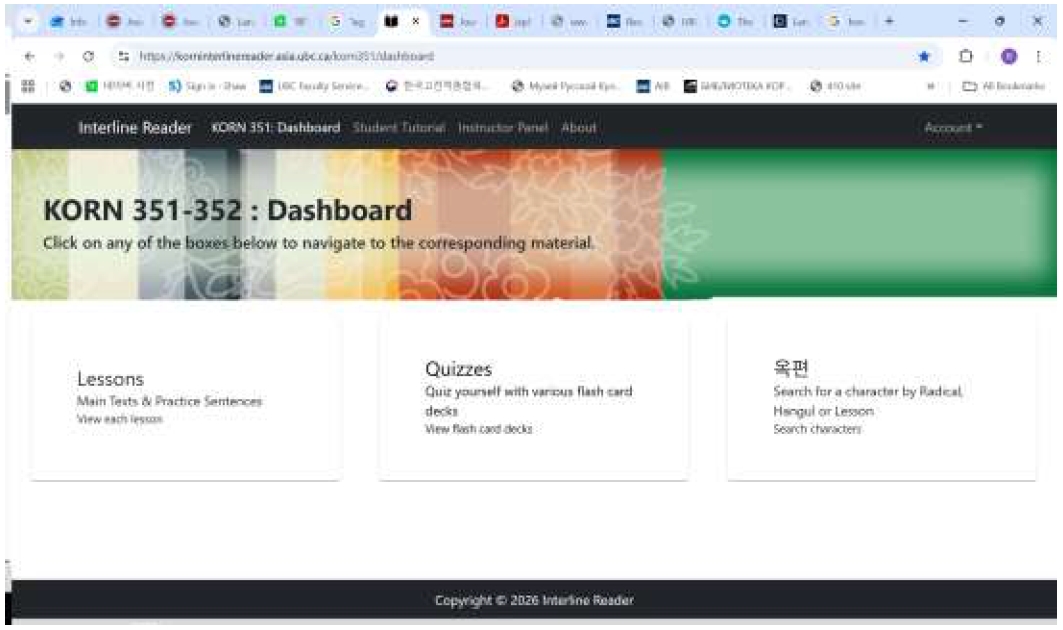
In the context of a special issue on education outside Korea, this paper surveys the current status of sinograph education in Korean Language Education (KLE) for foreigners, and finds that there is a dearth of both research on and teaching materials for hancha kyoyuk. Hence the “First Things First” in the title: we can hardly expect to make progress in hanmun education when so little exists in the way of resources for and courses in sinograph education—the single most basic prerequisite for teaching hanmun. After suggesting a number of reasons for the current lamentable neglect of hancha education, the paper draws some illustrative comparisons with sinograph education in Japanese Language Education and Chinese Language Education before rehearsing a number of compelling justifications for including a robust hancha education component in KLE (whether for Koreans or foreign learners of Korean). The remainder of the paper introduces the pedagogical ideology and methodology behind the Advanced Korean: Sino-Korean Companion textbook and its companion online resource, the UBC Interline Reader.


 News
News First
First Prev
Prev