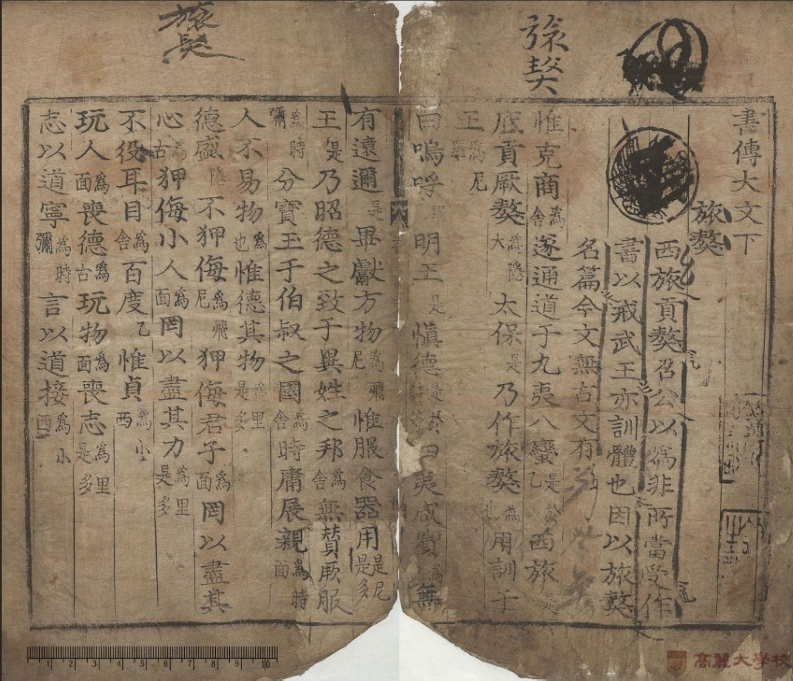
This study examines the development of royal-led publishing culture and the formation of reading practices in early Chosŏn. The Chosŏn court institutionally defined the content and method of canonical reading through the importation and reprinting of the Yongle emperor's imperially commissioned Sishu wujing daquan and Xingli daquan, the compilation of comprehensive annotated editions such as the Sajŏngjŏn hunŭi on the Zizhi tongjian, and the kugyŏl projects of the Sejo reign and the vernacular translation projects of the Sŏnjo reign. Through analysis of the Ŭrhaetype editions of the Nonŏ taemun kugyŏl and the Sŏjŏn taemun preserved in the Hwasan Collection at Korea University Library, this study identifies at least two distinct kugyŏl traditions existing between the Sejo-period kugyŏl project and the Sŏnjo-period vernacular translation project. It further demonstrates that Yi Hwang’s Kyŏngsŏ sŏgŭi reveals the persistence of a flexible scholarly environment in which multiple interpretations coexisted despite the state’s efforts to establish a single authoritative standard. Through analysis of Yi Sik's “Si ason tŭng,” this study additionally shows that the reading practices of Chosŏn literati unfolded within a dual structure shaped by the tension between state-sanctioned canonical reading and the pragmatic goal of examination success. This tension between what the state sought to teach and what literati actually sought to learn is understood as an enduring issue that resonates with contemporary Korean educational culture.
The controversy regarding the late-compiled Ancient-Scrip Shangshu extended over several centuries. It was initially instigated by Song宋 and Yuan元 scholars, including Wu Yu吳棫 , Zhu Xi 朱熹, and Wu Cheng 吳澄, who introduced a skeptical approach toward the classic. Subsequently, during the Ming period, scholars such as Mei Zhuo梅鷟 and Hao Jing郝敬 conducted textual investigations that revealed significant doubts regarding the work.
Amid this fervent debate, neighboring Korea and Japan—through diplomatic book acquisitions and cultural exchanges—gradually became attentive to the issues of authenticity associated with the late-compiled Ancient-Script Shangshu古文尙書, influenced by the scholarly debates of the Ming 明 and Qing 淸periods. A survey of Chinese texts in both countries, however, indicates that the debate resonated more profoundly in Korea than in Japan. This discrepancy can be attributed to the fact that Zhu Xi’s Neo-Confucianism served as the foundational norm for all ritual practices during the formation of the Korean state. Zhu Xi regarded the sixteen-character method for cultivating the mind—“人心惟危,道心惟微。惟精惟一,允執厥中”—as the self-cultivation technique practiced by the ancient sage-kings of the Three Dynasties. Notably, the chapter Dayu Mo, which records this method, is included in the late-compiled Ancient-Script Shangshu.
Accordingly, this paper focuses on seventeenth-century Korea, investigating how Korean Confucian scholars of that era perceived the authenticity issues related to the late-compiled Ancient-Script Shangshu.


 News
News First
First Prev
Prev