Abstract
This study examines the development of royal-led publishing culture and the formation of reading practices in early Chosŏn. The Chosŏn court institutionally defined the content and method of canonical reading through the importation and reprinting of the Yongle emperor's imperially commissioned Sishu wujing daquan and Xingli daquan, the compilation of comprehensive annotated editions such as the Sajŏngjŏn hunŭi on the Zizhi tongjian, and the kugyŏl projects of the Sejo reign and the vernacular translation projects of the Sŏnjo reign. Through analysis of the Ŭrhae-type editions of the Nonŏ taemun kugyŏl and the Sŏjŏn taemun preserved in the Hwasan Collection at Korea University Library, this study identifies at least two distinct kugyŏl traditions existing between the Sejo-period kugyŏl project and the Sŏnjo-period vernacular translation project. It further demonstrates that Yi Hwang’s Kyŏngsŏ sŏgŭi reveals the persistence of a flexible scholarly environment in which multiple interpretations coexisted despite the state’s efforts to establish a single authoritative standard. Through analysis of Yi Sik's “Si ason tŭng,” this study additionally shows that the reading practices of Chosŏn literati unfolded within a dual structure shaped by the tension between state-sanctioned canonical reading and the pragmatic goal of examination success. This tension between what the state sought to teach and what literati actually sought to learn is understood as an enduring issue that resonates with contemporary Korean educational culture.
-
Keywords: early Chosŏn, royal-led publishing, civil service examinations, reading culture, kugyŏl, vernacular translation (ŏnhae), Sishu wujing daquan, dual reading structure, interpretation of the Classics, Yi Hwang
Introduction
In South Korea, interviews with students who achieve top scores on the College Scholastic Ability Test (CSAT) attract public attention every year. When asked about the secret to their success, these students most frequently mention studying primarily from textbooks, maintaining steady and disciplined study habits, and allowing themselves sufficient rest. Indeed, according to the Korea Institute for Curriculum and Evaluation, the CSAT is designed to measure the scholastic abilities required for university education and aims to contribute to the normalization of high school education by aligning its content and level with the official high school curriculum. In other words, the CSAT is structured so that anyone who has faithfully studied the material presented in school textbooks should be able to solve the exam questions. Yet, apart from these seemingly straightforward study strategies, the majority of students and parents rely heavily on private education: academy courses tailored specifically to the ‘real exam,’ and countless ‘munjejip’ 問題集 “test-preparation workbooks” ‘based on textbook content.’ Reflecting this educational reality, South Korea is often described as a “republic of examinations.” This phrase also captures a structural characteristic of Korean society, which has inherited a long tradition of state examinations originating in the civil service examination system in the Chosŏn period.
Founded upon Confucianism as its state ideology, the Chosŏn dynasty sought to realize the ideal of a Confucian cultural state through the study of Literary Sinitic classics. To this end, the Chosŏn court acquired authoritative editions of Literary Sinitic classics with authoritative commentaries through various channels, printed them in movable type or reproduced them through woodblock printing, and sought to establish the cultural legitimacy of the new. King Sejong, in particular, expressed strong endorsement of the comprehensive commentary of the Yongle Emperor’s imperially commissioned compendia such as the Sishu wujing daquan 四書五經大全 “The Complete Compendium of the Four Books and Five Classics” and the Xingli daquan 性理大全 “Complete Compendium on the Nature and Principle.” On the basis of collaborative seminar sessions with scholars of the Chiphyŏnjŏn 集賢殿, “Hall of Worthies,” he oversaw the compilation of comprehensive Chosŏn commentaries on major classical texts including the Sajŏngjŏn hunŭi 資政殿訓義for the Zizhi tongjian 資治通鑑 and the Zizhi tongjian gangmu 資治通鑑綱目 as well as the Ch’anju pullyu tushi 纂註分類杜詩 “Compiled Annotations and Classified Collection of Du Fu's Poetry.” During the reign of King Sejo, systematic kugyŏl (vernacular glossing) projects on the Confucian classics were undertaken while in the reign of King Sŏnjo ŏnhae (vernacular translation) projects were carried out under the supervision of the Ŏnhaech’ŏng 諺解廳 “Office of Vernacular Interpretation.” King Sŏngjong oversaw the publication of the Pullyu tugongbushi ŏnhae, that is, the Tushi ŏnhae. These commentarial and vernacular editions compiled under royal patronage were read by literati as state-authorized texts for the corresponding classics. They also functioned as established orthodox interpretations in the composition of civil service examination answers serving either as authoritative interpretations or as reference standards in composing answers for the civil service examinations.
At the same time, beyond these official texts, various examination preparation manuals were produced to help candidates prepare for the diverse literary genres tested in the civil service examinations. Some were published by the state, but many were compiled and circulated in the form of ‘problem-bank style workbooks,’ much like modern-day ‘test-preparation workbooks,’ copied and read among candidates for examination purposes. These workbooks generally fell into two categories: those containing past examination questions with model answers, and those presenting anticipated questions with model answers. The latter were often written by literati who, much like today’s private academy instructors, earned their livelihood by composing predicted examination questions and exemplary responses.
What kinds of books did the Chosŏn court, in its effort to sustain and develop state learning, officially prescribe for literati to read? What scholarly standards did it establish and apply in the selection of government officials? How did Chosŏn literati receive and respond to these state educational and examination policies, and what forms of reading culture did they cultivate in turn? This study examines how the early Chosŏn government established Confucian ideology through the compilation of statesponsored publications and explores how scholars developed reading practices and intellectual cultures within that framework.
What to Teach: The Development of State-Led Publishing Policies
1) The Implementation of the Civil Service Examination and the Importation of the Yongle Imperially Commissioned Daquan Compendia
Ten days after ascending the throne on July 28, 1392, King T’aejo issued an enthronement edict which included the following provisions regarding the implementation of the civil service examination.
1. The civil and military examinations were to be administered in balanced form (the Koryŏ dynasty had not maintained a regular military examination).
2. The practice of the chwaju-munsaeng system (Examiner-Protégé System which was a vestige of the Koryŏ examination system whereby successful candidates formed personal ties with their chief examiner) was to be abolished.
3. The school system was to be reformed and systematically linked to the examination system.
4. The examination subjects were to be structured as follows: the first stage (ch’ojang) would test kanggyŏng (oral examination on the Classics) on the Four Books, the Five Classics, and the Zizhi tongjian; the second stage (chungjang) would test literary compositions such as p’yomun (memorials), changju (policy submissions), and kobu (ancient-style rhapsodies); and the final stage (chongjang) would consist of ch’aegmun (policy questions).
Through these institutional reforms, the Chosŏn court sought to cultivate literati-officials who 1) were well-versed in classical learning, 2) possessed literary competence, and 3) were well versed in current affairs under state leadership. Among them, those deemed most outstanding would be selected for government service. The structure of the civil examination, testing classical learning in the first stage, literary composition in the second stage, and policy questions in the final stage reflects this policy intention.
While it reorganized the state examination system, the Chosŏn court undertook a comprehensive reform of the educational system. On the very day King T’aejo issued his enthronement edict, he also restructured the official bureaucracy of civil and military officials and implemented sweeping reforms to the academic system of the Sŏnggyun’gwan (National Confucian Academy) and the Sahak (Four Capital Schools). Following the decision to relocate the capital to Seoul, construction of the Sŏnggyun’gwan in Seoul began in the 4th year of T’aejo’s reign (1395), and the complex was completed three years later, in the 7th year (1398). Adhering in part to Koryŏ precedents, the court also established schools in each of the five administrative districts of the capital providing Confucian education centered on the Xiaoxue and the Four Books and Five Classics (In practice, the northern district school was not established, and the system came to be known as the Sabu hakdang (the Four District Schools)). In the provinces, Hyanggyo (Local Confucian Schools) were founded as local state educational institutions, operating under a ‘one prefecture, one school’ system. From the founding of the dynasty onward, the court steadily refined this institutional framework: instructors were dispatched from the central government while local magistracies selected school supervisors.
As is well known, the Sŏnggyun’gwan, the Sahak, and the provincial Hyanggyo were closely interconnected in function. Just as the Sŏnggyun’gwan was designed to fulfill two principal roles, veneration of sages at the Confucian shrine and and the cultivation of Confucian learning through education, the Hyanggyo were similarly structured albeit on a smaller scale. They possessed a Taesŏngjŏn (Hall of Great Completion), east and west side halls, a Myŏngnyundang (Hall of Illuminating Human Relations), and east and west dormitories. The Sahak, by contrast, were essentially scaled-down versions of the Sŏnggyun’gwan. They included a Myŏngnyundang and east and west dormitories but did not have a Confucian shrine.
In the Hakryŏng (Educational Ordinances) promulgated in the early Chosŏn period, the curriculum of these state educational institutions was organized as follows.
1
• […] Students must at all times read the Four Books, the Five Classics, and the various dynastic histories. They are not to carry with them or study heterodox works such as the Zhuangzi, the Laozi, Buddhist scriptures, or the miscellaneous writings and collected works of the Hundred Schools. Those who violate this regulation shall be punished.
• Monthly composition exercises (Chesul) are to be conducted as follows: in the first ten-day period, students shall compose sasŏŭi (Questions on the Four Books), Oogyŏngŭi (Expositions on the Five Classics), or non (discursive essays); in the middle ten-day period, they shall compose pu (rhapsodies), p’yo (memorials), or song (eulogies); in the final ten-day period, they shall compose taech’aek (responses to policy questions) or ki (records). The style must be concise and rigorous, precise and to the point, such that the writing serves solely to convey meaning. One must not indulge in obscure or eccentric expressions. Anyone who alters the established style of the times and promotes florid or ostentatious prose shall be dismissed, and those whose calligraphy is improper shall likewise be punished.
Meanwhile, from the very founding of the dynasty, the Chosŏn court deepened its understanding of Confucianism (i.e., Zhu Xi learning) as state learning by lecturing on Zhen Dexiu’s
Daxue yanyi 大學衍義 in the royal seminars (kyŏngyŏn) as a guide to kingly governance. King Sejong in particular had studied the
Daxue yanyi since his time as Crown Prince. After his accession, he selected it as the very first text for the royal seminars,
2 and lectured on it again the following year.
3 Thereafter, Sejong further consolidated the system of Zhu Xi learning as state orthodoxy by lecturing in the royal seminars on the
Sishu wujing daquan, the
Zizhi tongjian and the
Zizhi tongjian gangmu, and the
Xingli daquan. The
Sishu wujing daquan and the
Xingli daquan were imported in complete sets in 1419 (Sejong 1), approximately four years after their publication in the Ming.
4
In the 6th year of his reign (1424), Sejong ordered fifty sets of the
Daxue zhangju daquan 大學章句大全 to be printed with the Kyŏngja type and distributed to civil officials.
5 In the 8th year (1426), the tribute envoy Kim Si-u returned from the Ming with an imperial edict and was granted one set of the
Sishu wujing daquan and the
Xingli daquan, as well as one set of the
Zizhi tongjian gangmu.
6 The
Xingli daquan and Sishu Wujing daquan thus acquired were subsequently used as base texts for woodblock reproduction within Chosŏn to facilitate their domestic dissemination.
The reprinting projects of the
Sishu wujing daquan and the
Xingli daquan proceeded concurrently. In the 7th month of the 9th year of Sejong’s reign (1427), the governor of Kyŏngsang Province Ch’oe Pu 崔府 submitted the newly carved blocks of the
Xingli daquan.
7 In the 9th month of the same year, Sejong sent the
Zhouyi daquan,
Shujing daquan, and
Chunqiu daquan to the same governor, instructing him to carve and print them according to the precedent established for the
Xingli daquan.
8 In the 10th month, he similarly ordered the governor of Chŏlla Province Sim To-wŏn 沈道源 to print the
Shijing daquan and
Chunqiu daquan following the same model.
9
In the following year, on the 2nd day of the 3rd month of the 10th year of his reign (1428), King Sejong addressed Kim Ton 金墩, then
Ŭnggyo 應教 of the Chiphyŏnjŏn, during a royal seminars, saying: “The
Xingli daquan shu 性理大全書 has now been printed, and having tried reading it myself, I find that its philosophical principles are so subtle and refined that they are not easy to fully comprehend. However, as you are a person of meticulous discernment, I ask that you apply yourself and read through it.”
10 From this, we can ascertain that the printing of the
Xingli daquan was completed by this time. Also in December of the same year, rice grants were bestowed upon those who had been involved in the printing of the
Xingli daquan and the Kyŏngsŏ taejŏn 經書大全. From this, we can ascertain that the reprinting project for the
Xingli daquan and the
Sishu wujing daquan was completed around this time.
11
In the 12th month of the 9th year (1427), Pyŏn Kyeryang卞季良, then serving as Taejehak (Grand Scholar) of the Chiphyŏnjŏn composed a colophon entitled “Postface to the Sishu wujing xingli daquan.” Although the Siku Tiyao 四庫提要 later criticized the Yongle imperially commissioned daquan compendia such as the Sishu wujing daquan and the Xingli daquan for compiling earlier interpretations in a piecemeal fashion and including much redundant material, Pyŏn emphasized in his postface that these compendia systematically gathered and organized the accumulated scholarship of numerous Confucian scholars since the Song dynasty. This explains why Sejong adopted these texts as the principal textbooks of the royal seminars and invested substantial state resources in their reprinting, viewing them as essential for establishing and disseminating Zhu Xi learning as state orthodoxy. The establishment of a centrally administered school system, together with the publication and circulation of the daquan compendia, provided the institutional foundation for standardizing education in both the capital and the provinces. The implementation of the civil service examinations on this basis further consolidated the framework of state learning and functioned as the adhesive that cultivated the type of literati required by the state.
2) Royal-Led Compilation of Comprehensive Commentaries on Literary Sinitic Classics
King Sejong was deeply impressed by the editorial processing and commentarial methods employed in the daquan editions such as the Sishu wujing daquan and the Xingli daquan. In response, he planned the compilation of annotated editions of major Literary Sinitic classics.
The first undertaking in this project was the compilation of commentaries on the Zizhi tongjian and the Zizhi tongjian gangmu. This initiative reflected not only Sejong’s particular scholarly interest in historiography but also the growing recognition of the need to articulate a coherent national history in order to consolidate dynastic legitimacy. From the early years of his reign, Sejong repeatedly lectured on the Zizhi tongjian and the Zizhi tongjian gangmu in the royal seminars, and he devoted considerable effort to the establishment of historical studies including the printing of related works in movable type. These efforts culminated during his reign in the compilation of the Sajŏngjŏn hunŭi 思政殿訓義 on both the Zizhi tongjian and the Zizhi tongjian gangmu, as well as in works based upon them such as the Ch’ipyŏng yoram 治平要覽 and the Yongbi ŏch’ŏn’ga 龍飛御天歌. In the subsequent generation, this trajectory bore further fruit in the compilation and systematization of the national histories including the Koryŏsa 高麗史 and the Tongguk t’onggam 東國通鑑.
In the 8th year of his reign (1436), on the 27th day of the 2nd month, King Sejong distributed to civil officials copies of the
Sajŏngjŏn hunŭi on the Zizhi tongjian 資治通鑑思政殿訓義, newly printed with the Kabin type which had recently been cast.
12 In the preface he composed, An Chi 安止(1377-1464) quoting Sejong, explained that this
Sajŏngjŏn hunŭi had gathered together the exegetical glosses of various scholars, selected only the essential points from diverse interpretations, eliminated redundancies, corrected errors, and appended interlinear annotations to each historical event to facilitate convenient reading.
13 In the 7th month of the same year (1436), Sejong ordered Yi Kye-jŏn李季甸and Kim Mun 金汶, both Pugyori 副敎理 “Associate Collator” of the Chiphyŏnjŏn to compile
Sajŏngjŏn hunŭi on the Zizhi tongjian gangmu.
14 In the 20th year of his reign (1438), in the 11th month, the
Sajŏngjŏn hunŭi on the Zizhi tongjian gangmu was published. In his preface, Yu Ŭison 柳義孫 (1398-1450), Chikchehak 直提學 “Deputy Director” of the Chiphyŏnjŏn, described it as a “
daquan of historical writings,” that is, a comprehensive compendium of historiography.
The method of compiling annotated and edited editions established during the reign of Sejong continued into the reign of Sŏngjong. In the preface to the
Pullyu tugongbu shi ŏnhae 分類杜工部詩諺解,
Cho Wi 曹偉, quoting King Sŏngjong, explained the motivation behind the vernacular translation project. He noted the
Dugongbu caotang shijian 杜工部草堂詩箋 was verbose and contained numerous errors while the
Ji qianjia zhu pidian fenlei Du gongbu shiji 集千家註批點分類杜工部詩集 was concise but overly abridged. Moreover, because interpretations of Du Fu’s poems varied widely and the commentaries often contradicted one another, it became necessary to organize these materials systematically and to establish authoritative interpretations.
15 Similarly, the
Taehak yŏnŭi chipryak 大學衍義集略 was compiled by Hong Kyŏngson 洪敬孫, Cho Chi 趙祉, and Min Chŏng 閔貞 who substantially abridged Zhen Dexiu’s
Daxue yanyi 大學衍義 and supplemented it with exemplary and admonitory cases drawn from the
Koryŏsa 高麗史. In his “Preface to the
Taehak yŏnŭi chipryak,” Yi Sŏk-hyŏng 李石亨 stated that the editors condensed the prolix portions and added instructive materials from the
Koryŏsa, thereby making the work more convenient for consultation and reading.
Since the reign of Sejong, the series of annotated editions compiled under court leadership were modeled on the textual processing and commentarial methods of the daquan compendia. Drawing upon these precedents, they synthesized major commentaries on the Confucian classics and historical works and reorganized the text in a format convenient for reading and consultation. “Facilitating ease of reading” referred not only to formal features such as presenting the text in a clear and systematic layout and employing interlinear annotations, but also to substantive editorial principles. Chief among these was the selective adoption of only the most essential annotations from multiple commentarial traditions and their integration into a single work. At the same time, this “selective synthesis of essential annotations” carried an additional objective: to reconcile divergent and even contradictory interpretations and to present a single, authoritative interpretations. The commentaries compiled under royal auspices thus functioned as state-sanctioned interpretations of the respective Literary Sinitic classics much like the Sishu wujing daquan and the Xingli daquan. They were read by literati as official guides and, like the daquan editions, served as normative standards in the composition of answers for the civil service examinations.
3) The Development of the Classics Kugyŏl Project and the Standardization of Scriptural Interpretation
During the reign of king Sŏnjo, the Kyojŏngch’ŏng 校正廳 “the Office of Collation” was newly established in 1585. Thereafter, vernacular annotated editions of the Confucian classics were successively published: the
Sohak ŏnhae 小學諺解(1587), the
Hyogyŏng ŏnhae 孝經諺解(1589), the
Sasŏ ŏnhae 四書諺解(1590),
the Chuyŏk ŏnhae 周易諺解(1606), the
Sŏgyŏng ŏnhae 書經諺解(1613), and the
Sigyŏng ŏnhae 詩經諺解(1613). These officially collated vernacular editions were subsequently reprinted by private individuals and local government offices and circulated widely. They came to function as standard translations of the Confucian classics and were broadly read among literati. The vernacular translation project had originally been promoted by Yu Hŭi-ch’un 柳希春, but it was only after the formal establishment of the Kyojŏngch’ŏng in the 18th year of Sŏnjo’s reign (1585) that the compilation of the ŏnhae editions resumed in earnest. Yu Hŭi-ch’un, drawing in part on the interpretations of Yi Hwang 李滉, undertook the careful standardization of kugyŏl glosses and vernacular translations. On the 4th day of the 4th month of the 9th year of Sŏnjo (1576), he received royal permission to entrust the task of translating the classics to Yi I 李珥. Yu died of illness the following year (1577). Yi I continued Yu’s work and completed the vernacular translation of the Four Books by the following year. A Kyŏngjin-type edition of the
Sasŏ ŏnhae was bestowed upon Tosan sŏwŏn 陶山書院“Tosan Confucian Academy” in the 23rd year of Sŏnjo’s reign, and this copy is still extant. It may thus be inferred that by around 1590 the text had been printed using the Kyŏngjin type.
16
However, prior to the compilation of these vernacular editions, a foundational task had to be completed: the establishment of the authoritative kugyŏl glosses to the classical text that would serve as the basis for vernacular translation. Alongside its project of compiling comprehensive royal commentaries on major Literary Sinitic classics, the Chosŏn court convened leading scholars of the time to standardize the kugyŏl for the Four Books and Five Classics. Through this undertaking, the court sought to review earlier glossing traditions such as those associated with Kwŏn Kŭn, and to establish an orthodox reading of the canonical texts on the basis of the commentaries in the Sishu wujing daquan. These standardized glosses were, of course, also intended to function as authoritative criteria in the civil service examination.
Sŏ Yu-gu 徐有榘 (1764-1845) in his
Nup’an’go 鏤板考 recorded vernacular editions of the Four Books and Five Classics including
the Chuyŏk ŏnhae 周易諺解,
Sŏjŏn ŏnhae 書傳諺解,
Sijŏn ŏnhae 詩傳諺解,
Taehak ŏnhae 大學諺解,
Nonŏ ŏnhae 論語諺解,
Maengja ŏnhae 孟子諺解, and
Chungyong ŏnhae 中庸諺解, and stated that systematic kugyŏl work based on the kugyŏl traditions of Chŏng Mong-ju 鄭夢周 (1337-1392) and Kwŏn Kŭn 權近 (1352-1409) was undertaken during the reign of Sejo while the vernacular translation projects were carried out in the reign of Sŏnjo.
17 Yet evidence suggests that efforts to standardize kugyŏl predated the reign of Sejo. During his reign, Sejong had already sought to establish authoritative glosses for the
Xiaoxue and the Four Books and Five Classics.
18 Moreover, according to the
Sejong sillok (the
Veritable Records of Sejong), there also was kugyŏl annotations by Kwŏn Kŭn for the
Shijing, the
Shujing, and the
Zhouyi.
19 It appears, however, that the kugyŏl project initiated during Sejong’s reign was not fully completed at that time. The undertaking was later carried forward in the final years of Sejo’s reign as a systematic project to establish kugyŏl for the
Xiaixue and the Four Books and Five Classics, and it was on this foundation that Sŏnjo’s court was able to implement the vernacular translation project of the Confucian canons.
The figure who oversaw the Confucian Classics kugyŏl project during the reign of Sejo was Ch’oe Hang 崔恒(1409-1474). When the kugyŏl project was underway, Sejo would discuss with various officials the differences and variants among existing glossing traditions and then render his own final judgment. In this process, Ch’oe Hang served as a principal adviser. Having instructed Sejo since his time as a grand prince, Ch’oe continued to exert scholarly influence after Sejo’s accession, participating in major state-sponsored publishing projects. It is highly likely that Sejo’s understanding of the Confucian classics and his approach to kugyŏl glosses were substantially shaped by Ch’oe Hang.
20
According to Sŏ Kŏ-jŏng’s “Inscription for Ch’oe Munjŏng (with Preface),” Sŏ himself, together with Chŏng In-ji 鄭麟趾, Shin Suk-chu 申叔舟, Ku Chong-jik 丘從直, Kim Ye-mong 金禮蒙, Han Kye-hŭi 韓繼禧, and Ch’oe Hang, participated in the kugyŏl project on the Confucian classics. Ch’oe Hang, in his “Postface to the
Kugyŏl of the Classics and the
Xiaoxue,” recorded in detail both the significance of the project and the individuals responsible for glossing each text. He noted in particular that Sejo personally supplied kugyŏl for the
Zhouyi and the
Xiaoxue, and that when revising the glosses prepared by the scholars, he made independent determinations in crucial passages.
21 The project continued until shortly before Sejo’s death. The individuals responsible for preparing and collating the kugyŏl for each classic were as follows:
• Zhouyi 周易 and Xiaoxue 小學: King Sejo
• Shijing 詩經: Chŏng In-ji 鄭麟趾
• Shujing 書經: Chŏng Ch’ang-son 鄭昌孫
• Liji 禮記: Shin Suk-chu 申叔舟
• Lunyu 論語: Yi Sŏk-hyŏng 李石亨
• Mengzi 孟子: Sŏng Im 成任
• Daxue 大學: Hong Ŭng 洪應
• Zhongyong 中庸: Kang Hŭi-maeng 姜希孟
• Collators: Ku Chong-jik, Kim Ye-mong, Chŏng Cha-yŏng 鄭自英, Yi Yŏng-gŭn 李永垠, Kim Su-nyŏng 金壽寧, and Pak Kŏn 朴楗
The first entry in the
Veritable Records concerning the kugyŏl project appears under the 11th year of Sejo’s reign (September 26, 1465). On that day, Sejo summoned Sŏnggyun Saye (Director of Learning) Chŏng Cha-yŏng, Chikkang (Direct Lecturer) Yu Hŭi-ik 兪希益, Minister of Personnel Han Kye-hŭi, Minister of Taxation No Sashin 盧思愼, and Vice Minister of Personnel Kang Hŭi-maeng, and discussed the kugyŏl of the
Zhouyi late into the night.
22 From this record, it may be inferred that a draft of the kugyŏl for the
Zhouyi had already been completed around that time. In the 12th year of his reign (March 5, 1466), Sejo visited the Sŏnggyun’gwan with members of the royal family and high officials, performed rites at the Confucian shrine, and promulgated the
Zhouyi kugyŏl that he had personally determined.
23 The text promulgated on that occasion, known as the
Chuyŏk chŏnŭi Kangnyŏngjŏn kugyŏl 周易傳義康寧殿口訣 was printed in movable type using the Ŭrhae type.
In the 13th year of his reign (December 1, 1467), Sejo ordered an extensive review of the kugyŏl for the
Shijing. He commanded Chŏng In-ji, Kang Hŭi-maeng, Kim Ye-mong, Chŏng Cha-yŏng, Yang Sŏng-ji, and Yi Kŭk-ki, Ch’oe Chi, Yu Yun’gyŏm, Yi Maeng-hyŏn, Ch’oe Cha-bin, Yi Chong-san, Kim Ku, Sŏng Hyŏn, and Yi Sukch’am to collate and correct the kugyŏl of the
Shijing. At the same time, he ordered Chŏng Ch’ang-son, Song Ch’ŏ-kwan, Ku Chong-jik, Yi P’a, Yi Kŭk-chŭng, Yu Chin, Yu Hŭiik, Yi Hyŏng-wŏn, Min Chŏng, Son Ch’a-myŏn, Kwŏn Ho, Yi Kyŏng-dong, Ko T’aejŏng, and Kim Kye-ch’ang to collate the kugyŏl of the
Shujing.
24 On the following day, December 2, Sejo again summoned Chŏng Cha-yŏng, Ku Chong-jik, and Kim Yemong to continue revising the kugyŏl of the
Shijing and
Shujing.
25 On December 13, he once more called Ku Chong-jik, Kim Ye-mong, and Chŏng Cha-yŏng to further correct the kugyŏl for the
Shijing.
26 Even in the following year (1468), while gravely ill, Sejo continued to devote attention to this work. On August 19 and again on August 21, he summoned Ku Chong-jik and others to revise the
Shijing and even hosted them at a banquet.
27 Since Sejo passed away shortly thereafter, on September 8, 1468, it is clear that after the promulgation and printing of the
Chuyŏk kugyŏl, he continued the collation and correction of the kugyŏl for
Shijing and
Shujing until only days before his death.
A fragmentary woodblock-printed copy (one volume) of the
Shizhuan 詩傳 with Cai Shen’s蔡沈
Jizhuan 集傳 and Zou Jiyou’s 鄒季友
Yinshi 音釋, is preserved at the Kyujanggak Institute for Korean Studies, Seoul National University (call no. 想白古 181.113-J868s -v.19/20). The volume contains a colophon written by Kim Chong-jik in 1478. At the end of the fascicle appears the publication record: “Printed in the 4th month of the 15th year of Chenghua (1479) at Miryang Prefecture” (成化十五年己亥四月日密陽府開刊) confirming that the work was issued in 1479 at Miryang.
28
In the postface he composed when the work was printed at Miryang, Kim Chongjik noted that copies of the kugyŏl editions of the Shijing and Shujing printed during the reign of Sejo had been reproduced. This indicates that, in addition to the Shijing, a kugyŏl edition of the Shujing was also printed at that time. This evidence shows that the 1479 Miryang edition was based on the kugyŏl editions of the Shijing and Shujing prepared under Sejo. Furthermore, judging from its layout and typeface, the Kyujanggak copy appears to be a re-carved woodblock reproduction of an edition originally printed with the first-cast Kabin type. Although in the extant Kyujanggak copy the spaces where the kugyŏl should appear are left blank, Kim Chong-jik’s postface explicitly states, “This edition contains the Jizhuan and the kugyŏl, so that upon a single reading beginner students may grasp its essential meaning.” From this we may infer that the original Miryang edition did in fact include the kugyŏl. The present Kyujanggak volume thus appears to be a later re-carving of the first woodblock edition during which the kugyŏl glosses were omitted in the course of reproduction.
In summary, although Ch’oe Hang’s “Postface to the Kugyŏl of the Classics and the Xiaoxue” states that during the reign of Sejo the kugyŏl for the Four Books and Five Classics, together with the Xiaoxue were determined, the works that can presently be confirmed as having reached completion and proceeded to publication are three: the Zhouyi, the Shijing, and the Shujing. After completing the kugyŏl of the Zhouyi, Sejo continued to revise and refine the kugyŏl of the Shijing and the Shujing until shortly before his death. It is therefore plausible that the actual printing of these two works took place after Sejo’s passing. According to Sŏ Kŏ-jŏng’s “Inscription for Ch’oe Munjŏng,” Sejo in 1464 distributed the Four Books and Five Classics among Chŏng In-ji, Shin Suk-chu, Ku Chong-jik, Kim Ye-mong, Han Kye-hŭi, Ch’oe Hang, Sŏ Kŏjŏng, and others, ordering them to determine and submit their respective kugyŏl. Since the kugyŏl of the Zhouyi, Shijing, and Shujing appear to have been completed around 1468, it may be inferred that the work on these three classics extended over roughly a decade. However, while the kugyŏl editions of the Zhouyi and Shijing can be substantiated through extant evidence, no copy of a Sejo-period Shujing kugyŏl has yet been discovered.
How Were Standards of Scriptural Interpretation Established? The Differentiation and Synthesis of Kugyŏl Traditions
As examined in Chapter 2, the Chosŏn court gradually institutionalized the question of ‘what books should be read’ through the importation and reprinting of the daquan editions and through the compilation of comprehensive commentaries on Literary Sinitic classics. Yet the content of ‘what the state should teach’ was defined most concretely through the kugyŏl projects on the Confucian classics. Whereas the daquan editions and commentaries determined the scope of texts to be studied, kugyŏl annotations prescribed how those texts were to be read regulating interpretation at the level of individual phrases within the canonical text itself. As discussed above, candidates in the sasŏŭi and ogyŏngŭi examinations were required to demonstrate a coherent understanding of the classics based on the daquan tradition; accordingly, the standardization of kugyŏl became a direct criterion by which the correctness of examination answers was judged.
Let us now return to the vernacular editions of the classics produced by the Kyŏjŏngch’ŏng in the reign of Sŏnjo. What kugyŏl texts served as the source editions when annotations and vernacular translations were added in the editorial process? And when were these kugyŏl versions originally compiled and printed?
Although there is no explicit record that the state-sponsored kugyŏl project left incomplete during the reign of Sejo was formally resumed as a nationwide undertaking under a later monarch, two extant works which appear to have been printed after the reign of Sejo but before that of Sŏnjo, are preserved today in the Hwasan Collection of Korea University Library. These are:
• A single-volume Ŭrhae-type edition of the Nonŏ taemun kugyŏl 論語大文口訣 (call no. Hwasan 貴 183 1)
• A fragmentary Ŭrhae-type edition of the Sŏjŏn taemun 書傳大文 (call no. Hwasan 貴 132 2)
Both books print the canonical text (taemun) of the Analects and the Shujing in large characters with the kugyŏl glosses supplied in smaller characters alongside the main text. As their titles indicate, each volume contains only the main canonical text. The principal difference between the two lies in the form of the glosses: in the Nonŏ taemun kugyŏl the kugyŏl glosses are written in Hangŭl whereas in the Sŏjŏn taemun they are written in Chinese characters. In this respect, the Nonŏ taemun kugyŏl stands in continuity with the vernacular annotation tradition during the reigns of Sejong and Sejo. Judging from the condition and style of the printing, the Nonŏ taemun kugyŏl appears to have been issued earlier than the Sŏjŏn taemun.
The fact that these two works were printed in Ŭrhae type and contain the canonical text of the Analects and the Shujing furnished with kugyŏl suggests several points. First, they were likely compiled as part of the state-sponsored kugyŏl project that had been pursued since the early Chosŏn period. Second, their glosses must have maintained a certain continuity with the earlier kugyŏl determinations established in the previous generation. Finally, these editions may be understood as preparatory stages for the vernacular translation projects of the Confucian classics undertaken during the reign of Sŏnjo.
1) The Kugyŏl Glosses of the Ŭrhae-Type Edition of the Nonŏ Taemun Kugyŏl
The Ŭrhae-type edition of the
Nonŏ taemun kugyŏl is a printed volume in which the canonical text of the
Analects is set in large characters, with the corresponding kugyŏl glosses inserted in smaller characters between the lines of the text. Judging from the condition and typographic features of the printing, it appears to have been issued earlier than the Ŭrhae-type edition of the
Sŏjŏn taemun. At present, the only known copy in Korea is preserved in the Hwasan Collection of Korea University Library. The extant volume contains neither a preface nor a postface, and it is therefore unclear whether such paratextual materials originally accompanied the publication.
29
Unlike the case of the
Sŏjŏn taemun whose kugyŏl correspond almost exactly to those of the
Sŏjŏn ŏnhae, the kugyŏl of the
Nonŏ taemun kugyŏl diverge in a number of places from those found in the
Nonŏ ŏnhae. If we take the “Xue’er學而”chapter as an example and compare the kugyŏl of the
Nonŏ taemun kugyŏl with those of the
Nonŏ ŏnhae, the differences may be observed as follows.
In the “Xue’er” chapter, there are no major differences in the overall interpretation of the canonical text. Nevertheless, several noteworthy points may be identified.
(1) The two editions differ in their use of the nominative particleㅣ(-i). In the
Nonŏ taemun kugyŏl, the phrase appears simply as “子曰,” whereas in the
Nonŏ ŏnhae it is rendered “子ㅣ曰,” with the nominative particle added after “子” (Confucius). This pattern holds consistently throughout the
Analects in the ŏnhae edition. For example, in “Xue’er 15,” the
Nonŏ taemun kugyŏl reads: “子貢曰貧而無諂"

” whereas the
Nonŏ ŏnhae reads: “子貢이 曰貧而無諂"
,” adding the nominative marker after “Zigong.” In general, the
Nonŏ taemun kugyŏl tends to omit the subject particle in formulaic expressions such as “子曰,” but adds it in other cases, as in “曾子ㅣ曰吾'(

)” (Xue’er 4). Even with “子,” when it does not appear in the formula “子曰,” the subject marker is supplied. By contrast, the
Nonŏ ŏnhae typically inserts the nominative particle before “曰” and does so more frequently overall than the
Nonŏ taemun kugyŏl.
(2) In the
Nonŏ taemun kugyŏl the object markers appear as ‘

’ and ‘

’ whereas in the
Nonŏ ŏnhae they are written as ‘을’ and ‘를.’ Likewise, the subject marker appears as ‘

’ in the
Nonŏ taemun kugyŏl but as ‘은’ in the
Nonŏ ŏnhae. In the case of the topic marker ‘
’, however, both texts consistently use the same form. As for the locative marker ‘에’, while the
Nonŏ taemun kugyŏl generally employs ‘애’ as in “Xue’er” 11 (“父沒애”), the
Nonŏ ŏnhae tends to use ‘에.’ This distinction, however, is not entirely consistent.
(3) As seen in “Xue’er” 15, where the form written as “何如

” appears in the
Nonŏ ŏnhae as “何如

,” forms employing the archaic iŭng (

) in the
Nonŏ taemun kugyŏl are frequently replaced by the ordinary iŭng in the
Nonŏ ŏnhae. The archaic iŭng was commonly used as an initial consonant in texts of the midfifteenth century, but its occurrence gradually declined; by the early sixteenth century only a few examples remained, and it eventually came to be used exclusively as a final consonant.
30
(4) There are instances in which differences in kugyŏl lead to subtle differences in interpretation.
For example, in Xue’er 4, the
Nonŏ taemun kugyŏl reads: “曾子ㅣ曰吾(
) 日로 三省吾身

爲人謀而不忠乎

與朋友交而不信乎
傳不習乎애니라.” Whereas the
Nonŏ ŏnhae reads: “曾子ㅣ曰吾ㅣ日三省吾身
爲人謀而不忠乎아 與朋友交而不信乎아 傳不習乎애니라.” The modern translation following the
Nonŏ taemun kugyŏl may be rendered as: “Master Zeng said: Each day I examine myself in three ways: Have I been disloyal in planning matters for others? Have I been untrustworthy in my dealings with friends? Have I failed to review what has been transmitted?”
The Nonŏ ŏnhae interpretation is essentially the same in substance. Thus, in this passage the revisions in the Nonŏ ŏnhae represent only minor adjustments rather than substantial interpretive changes.
These differences are not merely matters of orthographic variation. Although in the “Xue’er” chapter such differences generally do not produce major divergences in the interpretation of the text, the cases from “Weizheng” and “Liren” discussed below demonstrate that variations in kugyŏl can at times reflect fundamentally different understandings of the syntactic structure of the passage itself. From the perspective of examination candidates composing answers, for example, for the sasoŭi section of the civil service examinations, the choice of which kugyŏl tradition to follow could therefore shape the overall direction of their responses.
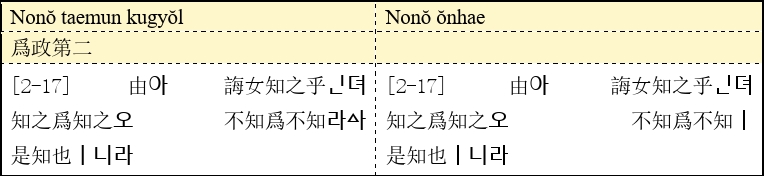
In “Weizheng 17” (爲政 17), a clearer interpretive divergence appears. The
Nonŏ taemun kugyŏl reads: “不知爲不知

是知也ㅣ니라.” Whereas the
Nonŏ ŏnhae reads: “不知爲不知ㅣ 是知也ㅣ니라.” According to the
Nonŏ taemun kugyŏl, the phrase “不知爲不知” is followed by “
,” which functions as a conditional connective. The sentence is thus construed as a conditional clause: “If one says of what one does not know that one does not know it, this is knowledge.”
By contrast, in the
Nonŏ ŏnhae, the same phrase is treated as the grammatical subject of the sentence, marked by the nominative particle ㅣ(-i). The vernacular rendering reads: “

.” (“To say of what one does not know that one does not know it; this is knowing.”) In other words, the
Nonŏ taemun kugyŏl interprets the phrase as a conditional clause, whereas the
Nonŏ ŏnhae construes it as a nominalized subject. Although the philosophical meaning does not fundamentally differ, the syntactic analysis, and thus the structural understanding of the sentence diverges in a noticeable way.

The Nonŏ taemun kugyŏl glosses this as: “夕死ㅣ 可矣니라.” Whereas the Nonŏ ŏnhae reads: “夕死ㅣ라도 可矣니라.” According to the Nonŏ taemun kugyŏl, the construction yields a literal modern rendering such as: “To die in the evening is acceptable.” By contrast, the Nonŏ ŏnhae adds the concessive particle 라도 (-rado) producing the sense: “Even if one were to die in the evening, it would be acceptable.” Although the overall translation does not differ dramatically in meaning, the Nonŏ ŏnhae reflects a more explicit concessive interpretation. In fact, the Nonŏ ŏnhae appears to have consulted the Lunyu jizhu 論語集註, which cites Cheng Yi’s explanation: “One cannot fail to know the Way. If one could attain the Way, then even if one were to die, it would be acceptable.” 言人不可以不知道, 苟得聞道, 雖死可也. Thus, by inserting 라도 (-rado), the Nonŏ ŏnhae aligns its syntactic gloss more closely with Zhu Xi’s and Cheng Yi’s interpretation making explicit the concessive nuance.
The two examples discussed above demonstrate that differences in kugyŏl could alter the very understanding of the canonical text itself. In “Weizheng” 17, whether 不知爲不知is read as a conditional clause (“only if one acknowledges what one does not know”) or as a subject clause (“to say that one does not know what one does not know”) leads to different interpretive orientations regarding the notion of 知 (chi. knowledge) in the Analects. Likewise, in “Liren” 4, the contrast between “夕死ㅣ可矣” and “夕死ㅣ라도 可矣” constitutes an issue of significance even within the history of commentary.
Tracing how such kugyŏl in the Nonŏ taemun kugyŏl were subsequently revised, and through what processes they converged into the kugyŏl of the Nonŏ ŏnhae is therefore not merely a philological exercise. It also reveals the historical process through which the Chosŏn court came to establish standards of interpretation for the classics that it sought to teach. The kugyŏl observed in the Nonŏ taemun kugyŏl can be understood more fully when examined in relation to the “older interpretations” discussed in Yi Hwang’s Nonŏ sŏgŭi 論語釋義 which will be considered below.
2) The Kugyŏl of the Ŭrhae-Type Edition of the Sŏjŏn Taemun
The Ŭrhae-type edition of the
Sŏjŏn taemun survives domestically only in a single volume (the lower volume) preserved at Korea University Library and at the Chon’gyŏnggak of Sungkyunkwan University (call no. 稀A03-0015 v.2). Since only the latter half of the work is extant, it is not possible to determine whether a preface was originally composed and included at the time of publication. Neither the Korea University copy nor the Sungkyunkwan University copy contains a postface.
31
Regarding the date of publication, the bibliographic note of the Chŏn’gyŏnggak copy at Sungkyunkwan University tentatively assigns the
Sŏjŏn taemun to the period spanning the reign of Myŏngjong to the early years of Sŏnjo. Although some scholars have suggested that Ŭrhae-type editions bearing Hŭkku (black line) at the center of the page generally belong to the reign of Chungjong,
32 the typographic condition of the characters in this case makes it plausible that the edition was printed during the reign of Myŏngjong. Even if one were to date it to the early Sŏnjo period, its publication would still fall chronologically between the Confucian Classics kugyŏl project of the Sejo reign and the vernacular translation project undertaken under Sŏnjo.
According to the Diary of Miam, during the reign of Chungjong, Yu Sung-jo 柳崇祖(1452-1512) had established kugyŏl for the Confucian classics shortly before the appearance of this edition. That work is no longer extant. However,, an entry in the Veritable Records of Sŏnjo (7th year, 10th month, 25th day [1574]) records that Yu Hŭi-ch’un, having received a royal command to revise the kugyŏl of the Confucian classics, remarked that although the glosses established by Yu Sung-jo and others were generally well done, there were occasional errors even in the Shangshu currently being lectured upon, and he was uncertain whether they ought to be corrected. This passage indicates that during the Sŏnjo period, the kugyŏl editions attributed to Yu Sung-jo and his circle were being read both within and outside the court. It is plausible that the “Shangshu currently being lectured upon” mentioned by Yu Hŭi-ch’un refers precisely to the Ŭrhae-type Sŏjŏn taemun discussed above.
Yu Sung-jo was widely recognized as a scholar deeply versed in classical learning. On the 12th day of the 11th month of the 1st year of the reign of Chungjong (1506), upon the recommendation of the Ŭijŏngbu 議政府 “the State Council”, he was transferred on November 22 from the P’angyŏlsa 判決事 “Chief Adjudicator of the Changyewŏn” to the relatively inactive position of Kongjo ch’amŭi 工曹參議 “Third Minister of the Ministry of Works” while concurrently serving as a royal lecturer.
In the 9th month of 1508, he was appointed the Taesasŏng 大司成 “Chief of the National Confucian Academy”, a post he held for four years. On the 19th day of the 11th month of the 6th year of Chungjong (1511), the day after the king’s ceremonial visit to the National Confucian Academy, Yu submitted “Taehak cham” 大學箴 “Admonitions on the Great Learning” which was accepted with approval. He was thereupon promoted to the rank of Kasŏn Taebu 嘉善大夫 “Grand Master of Excellent Virtue” and appointed Governor of Hwanghae Province. However, in preparation for lecturing on the
Yixue qimeng 易學啓蒙 “
Introduction to the Study of the Changes” in the royal seminars, the Office of Royal Seminars petitioned that he remain in the capital. Before the lectures could proceed, he suddenly fell ill and died in the 2nd month of the 7th year of Chungjong (1512).
33
Let us now compare the kugyŏl of the Ŭrhae-type Sŏjŏn taemun with those of the extant Sŏjŏn ŏnhae. As an example, we may examine the opening portion of the “Luao 旅獒” chapter in the surviving lower volume of the Sŏjŏn taemun. A partial transcription is as follows:
In example 1, according to the Sŏjŏn ŏnhae, the phrase is rendered “商을 이기시니” (“having defeated Shang”) whereas in the Sŏjŏn taemun it appears as “商을 이기셔서” (“having defeated Shang, and then”). The difference lies in the connective ending: the former uses “시니(-si-ni),” while the latter employs “셔서(-syŏ-sŏ),” producing a slightly different nuance in syntactic linkage. In example 2, the Sŏjŏn daejŏn omits the nominative particle “ㅣ(-i).” The Sŏjŏn taemun generally supplies the particle in similar contexts, yet in a few instances it likewise omits -i and writes only “羅” (ra). Example 3 shows complete agreement between the two texts.
Although in examples 1 and 2 minor differences in kugyŏl occur consecutively, in the overwhelming majority of cases the kugyŏl of the Sŏjŏn taemun correspond closely to those of the Sŏjŏn ŏnhae, and instances in which differences in glossing produce substantive divergences in interpretation are exceedingly rare. One notable feature of the Sŏjŏn taemun is the mixed usage of variant notational forms in the kugyŏl:
• sentence endings such as “是羅” (ira) and “羅” (ra)
• locative markers following temporal adverbs, written variously as “於是” (e) and “厓” (ae)
• interrogative markers “可” (ga) and “阿” (a)
• alternate spellings such as “是” and “伊” (both representing ‘i’), and “豆” and “斗” (both representing ‘tu’)
This orthographic inconsistency suggests that the kugyŏl work was not executed by a single hand but rather as a collaborative enterprise. Indeed, in the compilation of state-sponsored publications it was customary to divide the work into sections and assign them to different individuals.
Below, a few representative cases will be presented in which the Sŏjŏn ŏnhae and the Sŏjŏn taemun differ in their interpretation of the canonical text.
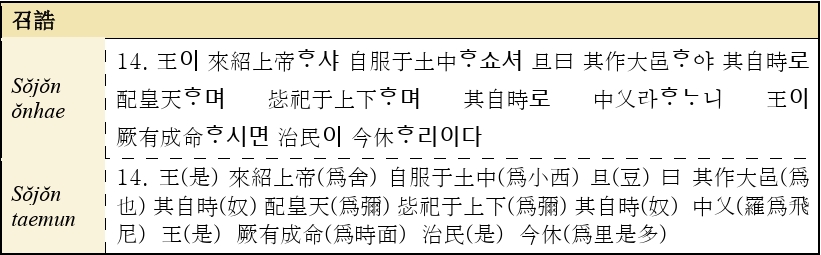
In “Shaogao” (召誥) 14, the
Sŏjŏn ŏnhae reads: “旦曰 其作大邑

” whereas the
Sŏjŏn taemun reads: “旦(豆)曰 其作大邑(爲也).” The insertion of “豆” (tu) after “旦” (tan) in the
Sŏjŏn taemun appears to reflect consultation of Cai Chen’s
Jizhuan 集傳. In the commentary, it is stated: “Therefore the Duke of Shao spoke of himself as acting in the central lands, and
also cited the Duke of Zhou who had once said ‘By constructing this great city, from here we may respond to and revere Heaven above, offer sacrifices in return to the earthly spirits, and from here dwell in the center to plan governance.’” (故召公以自服土中爲言, 又擧周公嘗言作此大邑, 自是可以對越 上天, 可以饗答神祗, 自是可以宅中圖治.) That is, the Duke of Shao’s statement is presented together with a reference to the Duke of Zhou’s earlier words. The
Sŏjŏn taemun seems to emphasize this connection by inserting the
kugyŏl “豆” after “旦,” thereby clarifying syntactically that the statement invokes the Duke of Zhou in addition to the Duke of Shao.
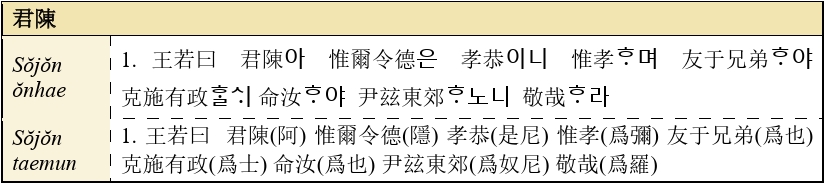
In “Junchen” (君陳) 1, the
Sŏjŏn ŏnhae provides the following kugyŏl: “君陳아 惟爾令德은 孝恭이니 惟孝
友于兄弟
克施有政

命汝
尹玆東郊
敬哉

.” By contrast, the
Sŏjŏn taemun reads: “君陳(阿, a) 惟爾令德(隱, ŭn) 孝恭(是尼, ini) 惟孝(爲彌, hamyŏ) 友于兄弟(爲也, haya) 克施有政(爲士, hasa) 命汝(爲也, haya) 尹玆東郊(爲奴尼, hanoni) 敬哉(爲羅, hara).” The phrase “克施有政
” in the
Sŏjŏn ŏnhae carries the approximate meaning of “
Because you were able to implement governance,” whereas the
Sŏjŏn taemun gloss “克施有政(爲士, hasa)” carries the approximate meaning of “having been able to implement good governance,
and thereby.” According to Cai Chen’s
Jizhuan, the passage is interpreted as follows: “Junchen possessed excellent virtue: in serving his parents he was filial, and in serving his superiors he was respectful.
Because he was filial and fraternal at home, he was thereby able to implement governance in the state.” (君陳有令德, 事親孝, 事上恭, 惟其孝友於家, 是以能施政 於邦.) In light of this interpretation, the intended meaning is: “Because you were filial and fraternal and thus able to carry out governance, I appoint you to administer the Eastern Suburb.” Reflecting this causal logic more explicitly, the
Sŏjŏn ŏnhae appears to have adjusted the kugyŏl of the
Sŏjŏn taemun to clarify the inferential relationship.
From the examples above, it becomes clear that the Sŏjŏn ŏnhae largely adopts the kugyŏl of the Sŏjŏn taemun as its foundation with only minor exceptions. Put differently, the Sŏjŏn ŏnhae may be understood as a revision and partial refinement of the kugyŏl tradition embodied in the Sŏjŏn taemun rather than as an entirely new and independent glossing enterprise. This suggests that the kugyŏl of the Sŏjŏn taemun had already come very close to the interpretive standards that the state sought to establish for teaching the canonical text. The Kyŏjŏngch’ŏng was therefore able to complete the Sŏjŏn ŏnhae by adopting it as a base text and making only minor adjustments with reference to the Shujizhuan書集傳 and Yi Hwang’s Sŏsŏgŭi 書釋義.
3) The Differentiation of Kugyŏl Traditions and Yi Hwang’s Kyŏngsŏ sŏgŭi
As discussed above, the kugyŏl in the Nonŏ taemun kugyŏl shows substantial differences from those found in the Kyŏjŏngch’ŏng vernacular editions, whereas the kugyŏl in the Sŏjŏn taemun aligns very closely with them. This indicates that the standardization of kugyŏl was not established in a single moment but was instead gradually accumulated and revised across multiple generations from the classics kugyŏl projects under Sejo to the vernacular translation initiatives of the Sŏnjo period. For convenience, let us refer to the kugyŏl tradition represented by the Nonŏ taemun kugyŏl as Group A, and that represented by the Sŏjŏn taemun as Group B. At the same time, it is important to note that alongside this lineage of state-sanctioned kugyŏl, independent efforts by scholars outside the court were also engaged in reexamining interpretations of the classics. Such individual scholarly work which allowed for multiple interpretive possibilities within or against a single state-sanctioned kugyŏl reading suggests that a gap already existed between what the state sought to teach and what scholars actually read and understood at the level of textual interpretation.
Chronologically situated between the
Nonŏ taemun kugyŏl and the
Sŏjŏn taemun on the one hand and the Kyŏjŏngch’ŏng vernacular editions on the other, Yi Hwang’s
Kyŏngsŏ sŏgŭi 經書釋義 sought to organize various earlier interpretations of the Confucian classics and to present authoritative views on pronunciation glosses and exegetical explanation. Unlike the state-compiled
kugyŏl texts, the
Kyŏngsŏ sŏgŭi was a personal scholarly work that critically reviewed the multiple interpretive traditions accumulated since early Chosŏn and offered Yi Hwang’s own judgments, thereby differing in character from the state-led kugyŏl projects that aimed to establish a single standardized interpretation.
34
As noted above, the Nonŏ taemun kugyŏl predates the Sŏjŏn taemun, and thus the sequence of compilation among the four texts discussed here may be established as follows: the Nonŏ taemun kugyŏl, the Sŏjŏn taemun, Yi Hwang’s Kyŏngsŏ sŏgŭi, and finally the Kyŏjŏngch’ŏng vernacular editions of the Four Books and Three Classics. Furthermore, as observed earlier, the kugyŏl of the Nonŏ taemun kugyŏl stands closer to the earlier traditions associated with the Sejong–Sejo period whereas the kugyŏl of the Sŏjŏn taemun aligns more closely with the readings adopted in the Kyŏjŏngch’ŏng editions. In short, the A-group (represented by the Nonŏ taemun kugyŏl) may be seen as closer to the early phase of the classics kugyŏl projects while the B-group (represented by the Sŏjŏn taemun) approximates their later, more finalized form. Positioned between these two lineages, Yi Hwang’s Kyŏngsŏ sŏgŭi, through its examination of multiple earlier interpretations, serves as a crucial intermediary source for tracing the process by which kugyŏl traditions diverged and evolved.
While the Sŏjŏn ŏnhae appears to have been compiled on the basis of the Sŏjŏn taemun, with additional reference to interpretations such as those found in Yi Hwang’s Kyŏngsŏ sŏgŭi, the Nonŏ taemun kugyŏl stands at a much greater distance from the Nonŏ ŏnhae, differing from its kugyŏl readings in numerous passages. Then, what relationship does the kugyŏl readings found in the Nonŏ taemun kugyŏl bear to the various interpretations concerning kugyŏl and vernacular translation discussed in the Nonŏ sŏgŭi? Among the kugyŏl-related materials recorded in the Nonŏ sŏgŭi, a few representative examples that bear on the kugyŏl readings of both the Nonŏ taemun kugyŏl and the Nonŏ ŏnhae may be presented as follows.
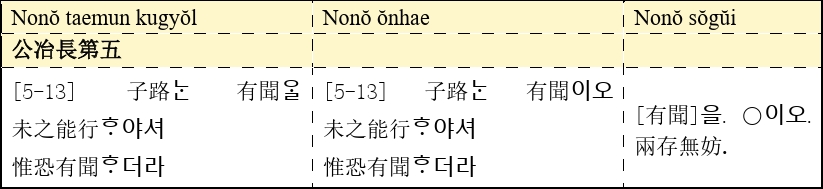
In “Gongye” 13, the phrase “子路有聞” reveals a significant difference in syntactic interpretation between the two traditions. The
Nonŏ taemun kugyŏl glosses it as: “子路
有聞
” whereas the
Nonŏ ŏnhae glosses it as: “子路
有聞이오.” According to the
Nonŏ taemun kugyŏl, the addition of the object marker “
” (-ŭl) () after “有聞” indicates that the phrase functions as the object clause of the subsequent verb “能行” (“to be able to practice”). The resulting interpretation may be rendered in modern Korean as:
“Zilu, having heard good words, has not yet been able to put them into practice.” By contrast, the Nonŏ ŏnhae attaches “이오” (-io), treating “有聞” as a preceding clause that sets the condition or circumstance for what follows. Its interpretation runs: “Zilu has heard (the teaching), yet has not been able to practice it.” Thus, the Nonŏ taemun kugyŏl construes “有聞” as the object of “能行,” whereas the Nonŏ ŏnhae understands it as forming a conditional or circumstantial clause preceding the main predicate. In his Yi Hwang Nonŏ sŏgŭi, Yi Hwang states that both glossing options, adding “-ŭl” or “-io,” are acceptable. This indicates that, at the time he composed the Nonŏ sŏgŭi, the two interpretive traditions coexisted and the Nonŏ ŏnhae ultimately adopted the “-io” interpretation.
It is noteworthy that Yi Hwang describes the two readings here as “兩存無妨” (both acceptable).” This stance differs in orientation from the state-sponsored projects that sought to standardize the interpretation of the classics. Although the state attempted to fix a single kugyŏl reading as the basis for what it intended to teach, Yi Hwang’s position suggests that a more flexible intellectual environment persisted in which multiple interpretive possibilities remained open and could coexist among scholars. Yi Hwang’s adoption of this approach is not limited to this particular passage. Throughout the Kyŏngsŏ sŏgŭi, he frequently records multiple older interpretations in parallel. This method stands in contrast to the orientation of the daquan editions and the kugyŏl projects of the Sejo period which sought to establish a single orthodox interpretation. In this respect, the Kyŏngsŏ sŏgŭi may be understood not simply as an acceptance of state-compiled kugyŏl traditions but also as a work that subjects them to critical examination.
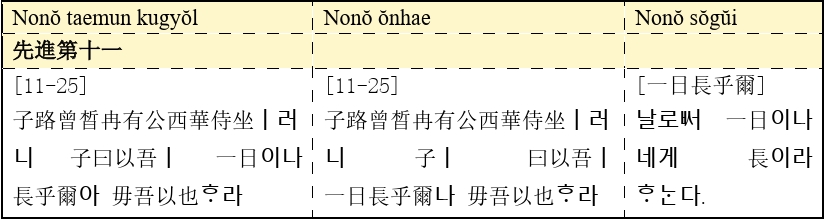
In “Xianjin” 25, the phrase “子曰以吾一日長乎爾” presents another instructive divergence. The
Nonŏ taemun kugyŏl glosses it as: “子曰以吾ㅣ 一日이나 長乎爾아” whereas the
Nonŏ ŏnhae glosses it as: “子ㅣ曰以吾ㅣ 一日長乎爾나.” In the
Nonŏ taemun kugyŏl, the particle “이나” (-ina) is attached to “一日,” and the sentence is understood as interrogative in force. On this reading, the modern translation would be: “Do you regard me as being even one day older than you?” By contrast, the
Nonŏ ŏnhae treats the clause as declarative, rendering it along the lines of: “Though I am but one day older than you.” The
Nonŏ sŏgŭi reads, “

一日이나 네게 長이라

.” Here, the addition of “이나” (ina) after “一日,” and interpreting the sentence as interrogative accords with the reading found in the
Nonŏ taemun kugyŏl.
The Nonŏ ŏnhae appears to have consulted the Lunyu jizhu 論語集註 where the phrase is explained as: “Although I am slightly older than you.” (我雖年少長於女) On the basis of this interpretation, the Nonŏ ŏnhae omits “-ina” after “一日,” and construes the sentence as a statement rather than a question.
In this case, although the Nonŏ sŏgŭi adopts the kugyŏl reading of the Nonŏ taemun kugyŏl, the Nonŏ ŏnhae does not follow it and instead revises the passage into a declarative sentence in accordance with the interpretation found in the Lunyu jizhu. This demonstrates that, in the process of compiling the vernacular editions, the Kyŏjŏngch’ŏng did not indiscriminately accept all interpretations presented in the Kyŏngsŏ sŏgŭi. Rather, the Kyŏjŏngch’ŏng vernacular project may be understood as an effort that drew upon the accumulated kugyŏl traditions, the various older interpretations recorded in Yi Hwang’s Kyŏngsŏ sŏgŭi, and the commentaries of the daquan editions, yet ultimately sought to consolidate these into a single orthodox interpretation grounded in the daqian editions.
From the examples discussed above, it becomes clear that a considerable number of the “kusŏl” 舊說 “older interpretations” cited in the Nonŏ sŏgŭi correspond to kugyŏl readings found in the Nonŏ taemun kugyŏl. This stands in contrast to the case of the Sŏjŏn taemun whose kugyŏl readings are already very close to those of the Sŏjŏn ŏnhae. Accordingly, many of the “older interpretations” recorded in the Sŏ sŏgŭi do not align with the kugyŏl tradition represented by the Sŏjŏn taemun. Put differently, whereas in the case of the Shujing the interpretive standard that the state intended to teach had largely been fixed by the stage of the Sŏjŏn taemun, in the case of the Lunyu substantial revisions took place between the Nonŏ taemun kugyŏl and the Nonŏ ŏnhae. The multiple “older interpretations” recorded in Yi Hwang’s Kyŏngsŏ sŏgŭi may thus be understood as traces of interpretations that were either consulted or discarded in the course of this process of revision.
Yi Hwang’s Nonŏ sŏgŭi draws not only on the various interpretations found in the daquan tradition, including the Lunyu Jizhuan, but also on Chinese and Chosŏn scholarly opinions such as those of Kwŏn Kŭn and Yi Wŏn-gil 李原吉 from early Chosŏn. It is therefore difficult to determine whether the various “older interpretations” recorded in the Nonŏ sŏgŭi derive directly from the Nonŏ taemun kugyŏl or whether they were transmitted in parallel through a broader shared scholarly tradition. Moreover, the Nonŏ sŏgŭi occasionally presents third forms of kugyŏl that differ from both the Nonŏ taemun kugyŏl and the Nonŏ ŏnhae, suggesting that a variety of kugyŏl readings, unrecorded in the compiled texts, circulated among scholars at the time. At the same time, it is equally clear that kugyŏl readings found in the Nonŏ taemun kugyŏl, but absent from the Nonŏ ŏnhae, frequently appear in the Nonŏ sŏgŭi as one among several older interpretations. This indicates that, at least up to Yi Hwang’s period, the Nonŏ taemun kugyŏl was either still being read directly among literati or that the kugyŏl readings it contained continued to circulate within scholarly communities. This shows that even when the state endorsed a single kugyŏl standard, alternative interpretive traditions could persist alongside it within scholarly practice.
What relationship, then, do the kugyŏl readings found in the Sŏjŏn taemun bear to the various interpretations concerning kugyŏl and vernacular translation discussed in t Yi Hwang Sŏ sŏgŭi 書釋義? In Yi Hwang’s Sŏ sŏgŭi, which examines differences among earlier kugyŏl readings, a few representative examples may be noted where the kugyŏl of the Sŏjŏn taemun diverges from that of the Sŏjŏn ŏnhae, as follows:
In “Junchen” 君陳 1, the divergence between the
Sŏjŏn ŏnhae and the
Sŏjŏn taemun provides a useful point of comparison. The
Sŏjŏn ŏnhae glosses the phrase as: “克施有政
,” whereas the
Sŏjŏn taemun reads: “克施有政(爲士).” As noted earlier, the
Sŏjŏn ŏnhae gloss “
” conveys a causal nuance of “
because you were able to implement governance”, while the
Sŏjŏn taemun gloss “爲士” (-hasa) corresponds more closely to “having been able to implement good governance,
and thereby.” The
Sŏjŏn ŏnhae revised the kugyŏl readings of the
Sŏjŏn taemun in accordance with the interpretations presented in the Shujizhuan.
Yi Hwang’s
Sŏ sŏgŭi records two possible vernacular interpretations for “克施有政”: “能히 有政을 施
” (“being able to implement governance”), and “能히 政에 施
” (“being able to apply your ability to governance”). Yet in determining the kugyŏl following “克施有政,” the
Sŏ sŏgŭi adopts “
,” in line with the interpretation of the
Shujing jizhuan. Given this alignment, it is plausible that the
Sŏjŏn ŏnhae may have consulted the
Sŏ sŏgŭi when revising the gloss of the
Sŏjŏn taemun.
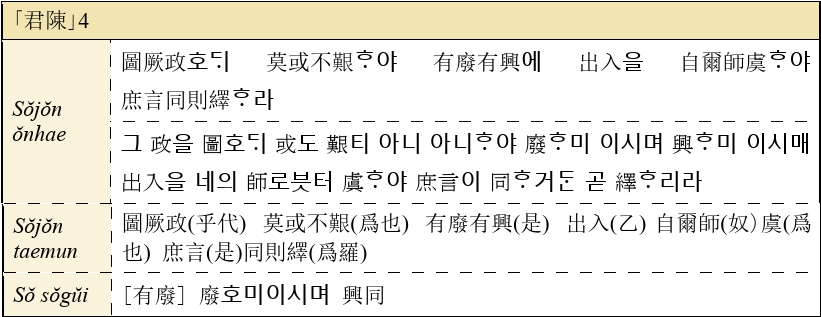
In “Junchen” 君陳 4, the divergence between the two traditions is again instructive. The
Sŏjŏn ŏnhae glosses the passage as: “有廢有興에 出入을 自爾師虞
,” while the
Sŏjŏn taemun reads: “有廢有興(是) 出入(乙) 自爾師(奴) 虞(爲也).” The
Sŏjŏn ŏnhae interprets the phrase as: “when there are things that ought to be abolished and things that ought to be established, repeatedly deliberate them together with the multitude.” By contrast, if one follows the gloss of the
Sŏjŏn taemun, the sense becomes closer to: “Regarding the things to be abolished and things to be established, deliberate on all comings and goings together with your people.” The
Shujing jizhuan explains the passage as follows: “In planning governance, whether in matters small or great, one should never fail to approach them with due seriousness; when there are things that ought to be abolished and things that ought to be established, one must repeatedly deliberate and reconsider, weighing them together with the multitude.” (圖 謀其政, 無小無大, 莫或不致其難, 有所當廢, 有所當興, 必出入反覆, 與衆共虞 度之.) The
Sŏjŏn ŏnhae clearly follows this interpretation. Yi Hwang’s
Sŏ sŏgŭi likewise glosses the phrase in line with the
Jizhuan, explaining it as “폐함이 있으며 흥함이 있으매” (“when there are things that ought to be abolished and things that ought to be established”).
As the examples above suggest, in most cases the Sŏjŏn ŏnhae partially revised the kugyŏl readings of the Sŏjŏn taemun in accordance with the interpretations found in the Shujizhuan, and it is likely that Yi Hwang’s Sŏ sŏgŭi was also consulted in this process. The discussion above has focused only on passages addressed in the Sŏ sŏgŭi where differences between the kugyŏl of the Sŏjŏn ŏnhae and the Sŏjŏn taemun are evident. However, not a few vernacular renderings in the Sŏjŏn ŏnhae appear to follow directly the interpretations proposed in the Sŏ sŏgŭi. In other words, the kugyŏl of the Sŏjŏn ŏnhae may be understood as having taken the Sŏjŏn taemun as its base text while introducing selective revisions through reference to works such as the Shujizhuan and the Sŏ sŏgŭi. This suggests that Yi Hwang’s Kyŏngsŏ sŏgŭi, although a private scholarly work, nonetheless made a substantive contribution to the state project of defining authoritative standards for interpreting the classics. In this respect, the kugyŏl project cannot be understood as a purely one-directional state initiative. Rather, it developed through the incorporation of scholarly research produced outside the court.
Based on the foregoing discussion, it may be concluded that at least two distinct kugyŏl traditions existed between the kugyŏl projects of the Sejo period and the vernacular translation projects of the Sŏnjo period. Among them, the B-group of kugyŏl, represented by the Sŏjŏn taemun, was transmitted almost directly into the kugyŏl readings adopted in the Sŏnjo-era vernacular editions. At the same time, alongside the state-sponsored kugyŏl compilations, private scholarly works devoted to the study of kugyŏl such as Yi Hwang’s Kyŏngsŏ sŏgŭi, also emerged. The Kyŏngsŏ sŏgŭi further reveals that multiple interpretations of kugyŏl circulated among literati at the time beyond the officially and unofficially compiled kugyŏl texts. Through its state-led projects on kugyŏl and vernacular translation, the Chosŏn court sought not only to synthesize the results of scholarly inquiry within the court itself but also to absorb diverse interpretive traditions circulating both inside and outside official institutions. In this sense, the compilation of the vernacular editions of the Four Books and Three Classics during the Sŏnjo period may be regarded as the culmination of these efforts by the Chosŏn court.
The Implementation of the Civil Service Examinations and the Formation of a Dual Reading Culture
1) Examination Genres and the Function of State-Authorized Texts
Chapter 2 examined how the Chosŏn court institutionally defined “what should be taught” through the importation and reprinting of the daquan editions, the compilation of comprehensive commentaries, and the implementation of kugyŏl and ŏnhae projects. Chapter 3 then explored how these state efforts were enforced, and at times transformed, at the micro level of scriptural interpretation through the differentiation of kugyŏl traditions. As the analysis in Chapter 3 has shown, however, even as the state sought to establish a single authoritative standard, a more flexible intellectual environment persisted among literati in which multiple interpretations coexisted. This gap did not remain confined to the sphere of classical interpretation alone, but became even more visible in the broader practices of literati reading. The following section examines how, through the institutional mediation of the civil service examinations, a dual reading culture emerged: one consisting of canonical reading centered on stateauthorized texts, and another oriented toward examination preparation through practical study aids.
Let us now return to the civil service examinations. In Chosŏn, the examination subjects formally included Si 詩 “poetry”, pu 賦 “rhapsody”, p’yo 表 “memorial”, chŏn 箋 “memorial to the throne”, ch’aek 策 “policy essays”, cham 箴 “admonition”, myŏng 銘 “inscription, song 頌 “eulogy”, non 論 “discursive essays”, ki 記 “record”, che 制 “edict”, cho 詔 “imperial proclamation”, ŭi 義 “expositions on the Classics”, and ŭi 疑 “questions on the Classics”. In practice, however, the genres most frequently tested were si, pu, p’yo, ch’aek, sasŏŭi 四書疑, and ogyŏng ŭi 五經義, the so-called Kwamun yukch’e 科文六體 “six literary genres of the examination.” In the composition of answers in these six examination genres, the state-authorized texts discussed above, i.e. the Sishu wujing daquan, the Xingli daquan, and the kugyŏl and vernacular editions of the classics, served as the fundamental standards of reference. Among them, the sections most directly relevant were sasŏŭi, and ogyŏngŭi genres.
The
sasŏŭi was a subject in which a doubtful or problematic point drawn from the main text of the Four Books was presented as a question where the examinee was required to compose a written response. The
ogyŏngŭi required examinees to expound the literary and philosophical meaning of a passage selected from the canonical text of one of the Five Classics. These subjects were tested in the preliminary (ch’osi) and second-stage (poksi) examinations of the lower examination (saengwŏnsi) as well as in the first stage of the higher civil examination (munkwa) during the regular triennial (Shingnyŏnshi) and special (chŭnggwangshi) examinations.
35
In the composition of answers for the sasŏŭi and ogyŏngŭi subjects, the authoritative interpretations sanctioned by the state were the Sishu wujing daquan, the Xingli daquan, and the scriptural exegeses suggested in the vernacular editions of the Four Books and Five Classics. The fundamental aim of these examination questions was to assess examinees’ understanding of the classics as interpreted through the daquan editions. Consequently, in examinations that tested matters such as pronunciation and glossing, textual meaning, and differences within and between classical texts, candidates were required to demonstrate a coherent understanding grounded in the daquan editions.
Consequently, the sasŏŭi and ogyŏngŭi examinations did not function as creative exercises inviting individual or innovative interpretations of canonical passages. Rather, they tested mastery of an officially prescribed body of learning. The requirement that literati study the daquan texts which synthesized the interpretations of Zhu Xi and other Song-Yuan Neo-Confucian scholars, and the use of these texts as the first threshold in the civil service examination system faithfully reflected the policy of the Chosŏn court which adopted Zhu Xi Learning as state orthodoxy. This fundamental orientation remained largely unchanged even into the late Chosŏn period. In this respect, the civil service examinations functioned as the most powerful institutional mechanism through which the state enforced what it sought to teach upon examination candidates.
Not only the Confucian classics but also literary works published under state sponsorship were closely connected to the civil service examinations. In the 17th year of the reign of Sejong (June 1435), then Taejehak (Grand Scholar) Yi Maeng-gyun 李孟畇 (1371-1440) submitted a memorial together with scholars of the Chiphyŏnjŏn, observing that although for more than forty years the literary examination had successfully promoted classical learning in accordance with the examination regulations set forth in the Wŏnjŏn 元典, the study of poetry had been virtually neglected with the result that literati no longer understood the poetic composition. They further warned that this decline in poetic training negatively affected the state’s ability to produce literary compositions for official purposes. For this reason, they contended that poetic learning must be revived.
Yi Maeng-gyun and his colleagues petitioned for the revival of the Chinsa examination in order to promote the study of poetry, proposing that candidates be tested on either a
pu composition or a ten-rhyme regulated verse (paeyul shibun shi). At the same time, they requested that students of the Sŏnggyun’gwan be allowed to study literary works such as the
Chuci,
Wenxuan, and the poetry of Li Bai 李白, Du Fu 杜甫, Han Yu 韓愈, and Liu Zongyuan 柳宗元 in addition to classical learning. This was officially approved.
36
This policy to promote the study of poetry soon led to the compilation and publication of a series of literary works including collections of Chinese poets regarded as exemplary models for poetic composition. Among the works printed with metal type were the
Pullyu poju yi t’aebaek shi 分類補註李太白詩, Classified and Supplementarily Annotated Poetry of Li Bai, 1435,
Chumungong kyo ch’angnyŏ sŏnsaeng chip 朱文公校昌黎先生集, Collected Works of Master Changli, Collated by Master Zhu, 1438,
Tang yu sŏnsaeng chip 唐柳先生集, Collected Works of Master Liu of the Tang, 1440,
P’ung’aik sŏnshi 風雅翼選詩, Selected Poetry of
Fengya Yi, 1442,
Ch’anju pullyu tushi 纂註分類杜詩, Compiled Annotations and Classified Collection of Du Fu's Poetry, publication ordered in 1443,
Chŭnggan kyojŏng wang changwŏn chipchu pullyu tongp’a sŏnsaeng chip 增刊校正王壯元集註分類東坡先生集, Enlarged, Revised, and Corrected Classified Collection of Master Dongpo, with Collected Annotations by Wang Zhuangyuan, 1444,
Hyangsan samch’e pŏp 香山三體法, Three Poetic Forms of Xiangshan, 1445,
Wallŭng maesŏnsaeng shisŏn 宛陵梅先生詩選, Selected Poetry of Master Mei of Wanling, 1446, and
Pihaedang chŏngsŏn pansan chŏnghwa 匪懈堂精選半山精華, Essential Selections from Banshan, Chosen by the Pihaedang, 1446. Other works such as
Chŭngju tanghyŏn chŏlgu samch’e shibŏp 增註唐賢絶句三體詩法, Poetic Methods of the Three Forms of Quatrains by Tang Worthies, with Augmented Annotations, 1436,
Siin oksŏl 詩人玉屑, Jade Dust of the Poets, 1439, and
Sangok shichu 山谷詩註, Annotated Poetry of Shangu, 1444 were produced as woodblock editions.
37
Among the various poetry collections published during this period, however, the one that came to define the standard of poetic learning throughout the Chosŏn dynasty was unquestionably the poetry of Du Fu. Du Fu’s poems were widely read among literati both as a foundational textbook for the study of poetics and as a practical examination manual for composing regulated verse required in the civil service examinations. The predominance of Du Fu in poetic education was grounded above all in contemporary evaluations that regarded his poetry as uniquely preserving the spirit of the Shijing while embodying the moral ideals of “loyalty to the ruler and love of the state 忠君愛國之心” and “loyalty to ruler and filial devotion 忠君愛親之情.” Such ideological framing consistently underpinned Chosŏn-era projects to compile and reprint editions of Du Fu’s works. Recognizing Du Fu as the great synthesizer of regulated verse who inherited the spirit of the Shijing, the Chosŏn court sponsored the compilation and publication of both the comprehensive annotated edition Ch’anju pullyu Tushi 纂註分類杜詩 and the vernacular translation Tushi ŏnhae 杜詩諺解. These state-sponsored editions demonstrate how literary publication policy was integrated with examination culture, further reinforcing the dual educational structure in which canonical Confucian learning and literary practice developed side by side.
2) The Emergence and Circulation of Examination Preparation Manuals
As discussed above, the corpus of state-authorized texts including the daquan editions, comprehensive annotated commentaries, the kugyŏl and ŏnhae of the classics, and literary compilations such as those centered on Du Fu, was not only read among literati within and outside the court, but was also distributed to local educational institutions where it formed the core curriculum for training literati in accordance with state ideology. In this sense, these works functioned as a kind of “national curriculum,” representing the totality of what the Chosŏn court sought to ‘teach.’ Yet candidates preparing for the civil service examinations did not rely solely on these “official textbooks.” In pursuit of the practical goal of passing the examinations, examinees used separate preparation manuals alongside state-authorized texts, through which they ‘learned’ the stylistic conventions required for examination writings. For instance, during the early Chosŏn period, both central and local authorities printed examination aids originating from Yuan and Ming China including model answer collections and anthologies of compositions by successful Chinsa laureates. These works circulated widely among examination candidates and were read as practical guides for examination success.
The
Veritable Records of Sejong contains an instructive royal admonition concerning the civil service examinations.
38 In this passage, Sejong reproaches students for neglecting the regular study of komun 古文 “ancient-style prose” and for secretly bringing books into the examination hall. He criticizes them not only for failing to study the classics and historical works in depth, but also for neglecting model prose texts such as
Yuanliu zhilun 源流至論,
Cexue tigang 策學提綱, Danchi dudui 丹墀獨對, and Song-Yuan pofang 宋元播芳 which he describes as standards for examination writing. Significantly, the books cited by Sejong were originally listed as examination manuals in
Chengshi jiashu dushu fennian richeng 程氏家塾讀書分年日程 “Master Cheng’s year-by-year reading schedule for family school instruction”, a study schedule compiled by Cheng Duanli 程端禮, an instructor at the county school of Jiande 建德 in Chizhou Circuit 池州路 during the Yuan period specifically for preparing candidates for the civil-service examinations. This indicates that such works had been imported into Chosŏn and were already widely recognized as practical guides for examination success.
39 Yuanliu zhilun (=
Xinjian jueke gujin yuanliu zhilun 新箋決科古今源流至論) edited by Lin Jiong 林絅 and Huang Liyong 黃履翁,
Cexue tigang edited by Zhu Yao 祝堯, and
Danchi duidui edited by Wu Fu 吳黼 were compiled as aids for
ch’aengmun 策問 “policy question” preparation. Likewise,
Song-Yuan bofang 宋元播芳, namely
Songchao mingxian wubai jia bofang daquan wencui 宋朝名賢五百家播芳大全文粹 and
Shengyuan mingxian bofang xuji 聖元名賢播芳續集 edited by Wei Qixian 魏齊賢 and Ye Fen 葉棻 was compiled for training in memorial writing
p’yo 表. What is particularly noteworthy is that, as Sejong’s remarks suggest, these books entered Chosŏn not only as examination preparation materials but also as major references for studying ancient-style prose.
Sejong’s reference to these works as models for examination composition suggests that the boundary between state-authorized texts and examination manuals was not necessarily clear-cut in the early years of the Chosŏn dynasty. In other words, materials intended specifically for examination preparation were already encompassed within the broader scope of what the state sought to teach. This reveals a structural feature of Chosŏn education: the ideological ideal of a Confucian cultural state and the practical goal of success in the civil service examinations could not be fully separated but instead coexisted within a single educational framework. In early Chosŏn, other prose anthologies such as
Wenxuan 文選,
Dieshan xiansheng pidian wenzhang guifan 疊山先生批點文章軌範,
Yuzhai xiansheng biaozhu chong guwen jue 迂齋先生標註崇古文訣,
Wenzhang bianti 文章辨體, and
Wenzhang zhengzong 文章正宗 were likewise published and read both as textbooks for the study of classical prose and as preparation manuals for the civil-service examinations.
40
Meanwhile, moving forward in time to the 17th century, the frequency of civil service examinations increased, and special examinations such as the Chŭnggwangsi (augmented examination), Chŏngsi (courtyard examination), and Ch’undangdaesi (examination at the Ch’undangtae) which were relatively accessible to students were held with greater regularity. The Chŏngsi, Alsŏngsi (post-sacrifice examination), and Ch’undangdaesi were all personally supervised examinations conducted in the presence of the king, and typically only a single question was set. In these cases, the examination topic was most often a memorial-style composition (
p’yo). Parallel prose (
pianli wen) was not only required for diplomatic documentation but was also favored because these royal examinations were administered and graded on the same day: compared with other genres, parallel prose was difficult to compose yet relatively straightforward to evaluate.
41
However, as memorial-style p’yo compositions came to dominate the examination system, candidates increasingly focused their studies almost exclusively on kwap’yo 科表 “examination-style memorials.” This produced a noticeable concentration of successful candidates from Seoul where access to specialized training and models was greater. By the late reign of Sukjong, the examination system itself had effectively developed a dual structure: hyangyu 鄕儒 “provincial students” tended to prepare for the Singnyŏnsi 式年試 “triennial examination” through kanggyŏng講經 “classical study” while kyŏngyu京儒 “capital-based candidates” concentrated on p’yo “memorial composition” for the Chŏngsi and Alsŏngsi.
Nam Ku-mam 南九萬(1629-1711), in the 20th year of the reign of Sukjong (1694), petitioned for a reduction in the frequency of civil service examinations. He argued that although examinations had never been held so frequently, talented literary scholars were not being successfully selected and attributed this problem to the overemphasis on parallel prose in the examination system.
42 His criticism pointed to a growing discrepancy between the curriculum of official schools and the actual criteria used in examinations. Because success depended heavily on mastery of parallel prose rather than on classical learning, many successful candidates reportedly lacked solid grounding in Confucian scholarship. Yet as P’yo compositions continued to dominate the examinations, candidates increasingly turned to specialized “customized” preparation materials.
43 In addition, collections of parallel prose such as Yi Sik’s 李植
Yŏmun chŏngsŏn 儷文程選 (printed with the Hullyŏn togam type in 1631), Kang Paek-nyŏn’s 姜栢年
Sŏlbong sosŏn 雪峰所選 (provisional title, no longer extant), Kim Sŏk-chu’s 金錫胄
Yŏmun ch’o 儷文抄 (printed with Hangu type during the Sukjong reign), Nam Yong-ik’s 南龍翼
Pyŏngmun yangch’e 騈文兩體(no longer extant), Yu Kŭn’s 柳近
Yŏmun chusŏk 儷文註釋 (printed with woodblock in 1711), and Kim Chin-gyu’s 金鎭圭
Yŏmun chipsŏng 儷文集成 (printed with Chŏngni type in 1711) were published and came to serve as compositional models for examination candidates.
44 In addition to these printed guides, the candidates also prepared for the various sections of the civil service examinations by using handwritten study materials that circulated among literati networks and were transmitted within families. Because questions set in one year could reappear the following year, or questions used in the capital examinations might later be reused in provincial examinations, candidates compiled collections of anticipated questions and model answers, or copies of actual answers submitted in examination halls as practical preparation manuals. One example is
Ŭidong 疑東 (Mansong D5 A105), a preparatory text for the
sasŏŭi currently preserved in the Mansong Collection of Korea University Library. This manuscript contains sixty-four question-and-answer sets, and beneath some responses appear the names of actual answer writers, such as Chu Mujun 周武俊, Ch’oe Ch’ung-un 崔冲雲(1578-?), Yi Sa-sŏng 李師聖(1605-1683), Hong Taek-wŏn 洪澤遠, Kim Sukhoe 金叔晦, Hong Kyŏng-shin 洪慶臣(1557-1623), Kim I-rip 金以立, Kim Myŏngwŏn 金鳴遠(1591–?), Chang Ŭng-il張應一(1599–1676), Son I-gwŏn 孫而卷, and Yi Ŏn-sul 李彦述. In cases where examination rounds and rankings are recorded, these details correspond to verifiable historical data indicating that the manuscript indeed preserved answers actually submitted in examination settings. Such “question-bank” style manuals can be broadly divided into two types: compilations of model answers drawn from real examination submissions, and collections of anticipated questions paired with exemplary responses that had not necessarily appeared in actual examinations but were considered likely to be asked. Produced in incalculable numbers across different genres and circulated widely among literati, these materials became an essential component of examination-oriented reading and study culture.
45 The existence of these question-bank style examination manuals clearly demonstrates that the reading practices of Chosŏn literati operated within a dual structure: on the one hand, classical learning based on state-authorized texts, and on the other, practical preparation through specialized examination aids. The state sought to establish orthodox interpretations of the Classics and present authoritative models of literary composition. Yet examinees supplemented their study with separate materials such as collections of past examination questions and model answers, compilations of anticipated questions and responses, and manuals for examination genres. Structurally, this phenomenon closely resembles the modern educational pattern in which students prepare for exams not only with official textbooks but also with workbooks, practice tests, and mock examinations.
Meanwhile, the mid-Chosŏn prose master T’aektang 澤堂 Yi Sik 李植(1584-1647), in his later years, composed a piece titled “Si ason-tŭng” (Instructions to my sons and grandsons) on New Year’s Day of 1642 (the 20th year of King Injo’s reign) where he outlined the order and method of reading for his descendants. This text offers a particularly clear example of how a literatus recognized and responded to the dual structure of reading culture: on the one hand, canonical learning grounded in stateauthorized texts, and on the other examination-oriented study based on practical manuals designed for success in the civil service examinations.
In this text, Yi Sik designated as ‘sŏndok’ 先讀 “books to be read first” such works as the
Shijing,
Shujing,
Lunyu,
Mengzi,
Zhongyong,
Daxue,
Tongjian kangmu, and
Songjian (History of the Song). As ‘ch’adok’次讀 “books to be read next”, he listed the major text of the
Zhouyi, the
Chunqiu zuozhuan (Zuo Commentary on the Spring and Autumn Annals), the
Chunqiu hushizhuan (Hu’s Commentary on the Spring and Autumn Annals), the
Liji (Classic of Rites), the
Yili (Rites and Ceremonies), the
Zhouli (Rites of Zhou), the
Xiaoxue (Elementary Learning), the
Zhuzi jiali (Master Zhu's Family Rituals),
Jinsilu (Reflections on Things at Hand), the
Xingli daquan,
Xingli junshu (Collected Works on the Nature and Principle), the
Xinjing (Classic of the Mind), the
Ercheng quanshu (Complete Works of the Two Chengs) and the
Zhuzi quanshu (Complete Works of Master Zhu) together with detailed guidance on how they should be studied. What is particularly interesting is that after discussing these categories of “first” and “next” reading, Yi Sik proceeds to outline a separate category of ‘kwamun kongbu’ 科文工夫“books for practicing examination prose”, along with specific methods of study. The list of texts and study methods he recommends is as follows.
46
• From among the prose writings of Han Yu, Liu Zongyuan, and Su Shi, the Wenxuan, the writings of the Tang-Song Eight Masters, Guwen zhenbao 古文眞寶, and Wenzhang guifan 文章軌範 select according to one’s preference and make an excerpted volume, then read it up to one hundred times. [These belong to the category of texts to be read first.]
• Excerpt the Shiji and the Hanshu together into one excerpted volume, limiting the selection to no more than thirty sections, and read it up to one hundred times.
• Choose one among the Xunzi, Hanfeizi, and Yangzi Fayan, make an excerpted version, and read it dozens of times.
• Excerpt the Wenxuan and the Chuci into one volume, and also excerpt seven-character poems by Li Bai, Du Fu, Han Yu, Su Shi, and Huang Tingjian, limiting the total to no more than two volumes. [Do not fix the number of repetitions; recite them constantly. Those studying Fu composition and poetry should select from these.]
• Excerpts of parallel prose should not exceed one volume.
• Texts such as the Laozi, Zhuangzi, and Liezi should be consulted only as references when reading works such as the Jinsilu. They are not to be read directly as primary study texts.
• Complete dynastic histories, the histories of Korea, collected literary works, the Kyŏngguk taejŏn (Grand Code for Governing the Nation), the Kukcho chŏn’go (Collected Statutes and Precedents of the Dynasty), and fiction should likewise be consulted only as reference works after first reading the Zizhi tongjian gangmu.
• Excerpt several volumes of examination compositions written by Korean authors and use them as references when composing examination prose.
Yi Sik goes on to argue that literary writing must be grounded in classical learning, and that examination prose too should be cultivated through the study of refined and pure works rooted in this intellectual foundation. Although such a path might appear indirect or impractical at first glance, he insists that it is precisely this method that ultimately guarantees success in attaining first place in the civil-service examinations. By contrast, if one prepares for the examinations by reading shallow or bizarre writings, namely, the formulaic manuals designed solely for examination success, such a strategy may seem like a shortcut, yet it does not necessarily lead to passing the examinations and in the end leaves one without genuine scholarly substance, incapable of becoming a true literatus.
In this sense, the reading curriculum and methods presented by Yi Sik may be understood as expressing the ideals of a literary master who also served as the Taejehak of the Sŏnggyun’gwan seeking to emphasize that the seemingly roundabout study of ancient-style prose was in fact the most direct route to examination success while at the same time hoping that his descendants would grow into “proper” scholars even as they prepared for the examinations. At the same time, his remarks indirectly reveal that most young literati of the period, as examination candidates, were in reality preparing through quesion-bank style manuals specifically designed for examination training.
What Yi Sik proposes here therefore transcends the binary opposition between “textbooks” and “examination manuals.” He advocates a third mode of reading: one that aims to achieve simultaneously the cultivation of Confucian intellectual substance and success in the examination system through the disciplined study of ancient-style prose. For Yi Sik, the writings of Han Yu, Liu Zongyuan, and Su Shi were neither merely utilitarian examination guides nor purely scholarly texts unrelated to the examinations. Rather, he positioned these works as a bridge between classical learning and examination composition, thereby attempting to resolve the tension generated by the dual structure of reading culture in his own way.
One further point deserves attention. Yi Sik recommends that for the composition of prose in the examination genres students should read the writings of major prose masters such as Han Yu, Liu Zongyuan, and Su Shi; anthologies such as Wenxuan, Guwen zhenbao, and Wenzhang Guifan; historical works including Shiji and Hanshu; and philosophical writings such as Xunzi, Hanfeizi, and Yangzi Fayan. For verse composition, he likewise advises the reading of Wenxuan and Chuci as well as sevencharacter poems by Li Bai, Du Fu, Han Yu, Su Shi, and Huang Tingjian. This reading list reflects Yi Sik’s own literary theory as a writer associated with the Tang-Song ancient-style prose tradition.
At the same time, it also demonstrates that these works were understood and read not only as materials for general literary cultivation but also as “formal” texts for preparing examination writing, that is, texts functioning more like textbooks than specialized examination manuals.
47 Furthermore, if we recall that the Confucian classics themselves constituted the foundational texts for examination preparation, the entire reading list presented in “Instruction to my sons and grandsons” may be regarded as falling within the broader scope of reading intended for success in the civil service examinations.
If we look more closely at the
Shiji within this context, it becomes clear that it was read in particular as an essential text for preparing for the
kwap’yo 科表 section of the examinations. The version most widely read at the time was the
Shichuan (史纂). Compiled by Ling Zhilong 凌稚隆 of the Ming dynasty, the
Shichuan was produced by first collecting the commentarial and evaluative notes of various scholars on the
Shiji and publishing them as the
Shiji pinglin 史記評林, then selecting and abridging these materials into a 17-volume edition. In the 2nd year of Kwanghaegun (1610), through the efforts of
Cho Wi-han 趙緯韓, Yi Tŏk-hyŏng 李德馨, Yun Kŭn-su 尹根壽, and Yi Hang-bok 李恒福, a revised text based on the Ming edition of the
Shichuan was printed using the Hunryŏn togam type. This edition was published after the same bureau had printed the
Zhu Wengong jiao Han Changli ji 朱文公校韓昌黎集, and was followed shortly thereafter by the publication of the
Xiaoxue Jishuo小學集說.
48
The selection of these three works within the publishing program of the Hunryŏn Togam was not accidental. As Yi Hang-bok remarked in his postface to the Han Changli ji, “it is regrettable that most of the books being printed are small works intended for examination preparation, chosen because they sell easily.” His statement makes clear that these texts enjoyed overwhelming demand as indispensable manuals for examination candidates. The confession that books had to be printed primarily because they would sell well in order to support military finances suggests that a considerable portion of the books produced by the Hunryŏn Togam were directly connected to the examination system. Yi Hang-bok further lamented that even the ancient classics and major commentaries were treated by common readers “as if they were works of military strategy or Buddhist scriptures,” so that vulgar scholars merely waved them away and showed no interest, leaving little opportunity for their publication. Although Yi Hang-bok referred to such readers as ‘soksa’ 俗士 “vulgar scholars”, in reality those who did not belong to this group were likely very few indeed.
It is difficult to regard Yi Sik’s vision as one that was widely embraced across the literary community of his time. As Yi Sik himself acknowledged, most young literati as examination candidates prepared for the civil service examinations by relying on question-bank style manuals compiled specifically for that purpose, and the reading path centered on ancient-style writing that he advocated appeared, at first glance, to be “indirect and impractical.” This reveals that the gap between the ideal reading promoted by the state, one grounded in classical learning and the cultivation of literary ability through the study of ancient-style writing, and the reading actually chosen by examination candidates, centered on practical test-preparation manuals aimed at immediate success, remained unresolved even in Yi Sik’s own era.
Conclusion
This study has examined the development of royal-led publishing culture and the formation of reading practices in early Chosŏn through two central questions: first, what kinds of books the Chosŏn court sought to have literary officials read as a matter of state policy in order to sustain and develop official learning, and what scholarly standards it established and applied in recruiting officials; and second, how Chosŏn literati received these educational and examination policies and what kinds of reading culture they in turn produced.
From the founding of the dynasty, the Chosŏn court systematically reorganized the civil service examination and educational institutions in an integrated manner and pursued a series of state-sponsored publishing projects aimed at cultivating literary officials who were well versed in classical learning, skilled in writing, and knowledgeable in practical affairs of governance. The core of this policy may be summarized in three points. First, through the importation and reprinting of the Yongle emperor’s imperially commissioned Sishu wujing daquan and Xingli daquan editions, the court established the intellectual orthodoxy of Zhu Xi learning and laid the foundation for the standardization of education across both central and local institutions. Second, strong endorsement to the editorial principles and commentarial methods embodied in these daquan editions, the court compiled comprehensive annotated editions of Chinese classics such as the Sajŏngjŏn hunŭi on the Zizhi tongjian and the Ch’anju pully tushi, thereby presenting state-sanctioned “authoritative interpretations” of both canonical and literary texts. Third, through the kugyŏl projects of the reigns of Sejong and Sejo and the ŏnhae projects of the reign of Sŏnjo, the state went beyond determining what books should be read to regulating how the canonical text should be read, that is, establishing standards for interpretation that served as normative criteria for examination answers. Together, these publishing enterprises functioned as mutually reinforcing institutional mechanisms supporting what the state sought to teach.
In particular, this study has shown, through analysis of the Ŭrhae-type editions of the Nonŏ taemun kugyŏl and Sŏjŏn taemun preserved in the Hwasan Collection at Korea University Library, that at least two distinct kugyŏl traditions existed between Sejo’s kugyŏl project and the later ŏnhae project of the Sŏnjo period. The A-group tradition, represented by the Nonŏ taemun kugyŏl, remains close to the kugyŏl practices of the Sejong–Sejo period yet differs considerably from the Nonŏ ŏnhae. By contrast, the B-group tradition, represented by the Sŏjŏn taemun, was transmitted almost directly into the Sŏjŏn ŏnhae produced by the Office of Collation. This demonstrates that the standardization of kugyŏl was not established in a single moment but was instead gradually accumulated and revised across multiple generations. At the same time, Yi Hwang’s Kyŏngsŏ sŏkŭi reveals that, despite the state’s efforts to establish a single standard, a more flexible scholarly environment persisted in which multiple interpretations coexisted. This suggests that a gap already existed at the micro-level of textual interpretation between what the state intended to teach and what scholars actually read and understood.
Actual reading practices among Chosŏn literati unfolded in a dual structure shaped by the tension between state-sanctioned canonical reading and the practical goal of examination success. The civil service examination was the most powerful institutional mechanism through which the state imposed what it sought to teach upon examination candidates. Yet the examination system also generated its own internal logic, sensitivity to question trends, technical training in answer composition, and the realistic pursuit of success, which in turn stimulated the widespread circulation of examination manuals outside the official texts. Candidates therefore prepared for examinations not only through state-authorized texts equivalent to “official textbooks,” such as the Sishu wujing daquan, Xingli daquan, and vernacular annotated classics and so on, but also through question-bank style manuals and model-answer collections. Yi Sik, in his “Si ason tŭng,” attempted to resolve the tension produced by this dual reading structure by positioning the prose of Han Yu, Liu Zongyuan, and Su Shi as a bridge between classical scholarship and examination writing. Yet, as Yi himself acknowledged, most literati continued to rely heavily on examination manuals.
In sum, the royal-led publishing culture of early Chosŏn systematically compiled and disseminated state-sanctioned editions of classical and literary texts under the ideal of constructing a Confucian cultural state, thereby establishing scholarly standards and even standardizing interpretation through kugyŏl and ŏnhae projects which together contributed to the construction of a unified educational and examination system. Nevertheless, the reading culture formed through the institutional mediation of the civil service examination developed upon a dual structure: on the one hand, an idealized, canon-centered mode of reading promoted by the state, and on the other, a pragmatic, examination-oriented mode pursued by candidates. The tension between what the state sought to teach and what literati actually sought to learn was therefore not unique to the Chosŏn period, but may be understood as an enduring issue that resonates even with modern Korean educational culture, often described as an “examination republic.”
Efforts by the court to reform this dual reading structure were repeatedly attempted from early Chosŏn reforms through the examination regulations of the 8th year of King Myŏngjong (1553) and later the examination policies of King Chŏngjo. Yet Chŏng Yag-yong in the self-preface to Yŏlsu munhwang 洌水文簧 offered a critical reflection on his own past lamenting that immersion in examination writing had hindered the pursuit of pure learning. A fuller examination of how this dual reading structure continued and transformed in relation to publishing culture, reading practices, and the examination system in late Chosŏn remains a subject for future research.
Notes
Fig. 1.Opening page of the Ŭrhae-type edi on of the Nonŏ taemun kugyŏl preserved in the Hwasan Collec on, Korea University Library.
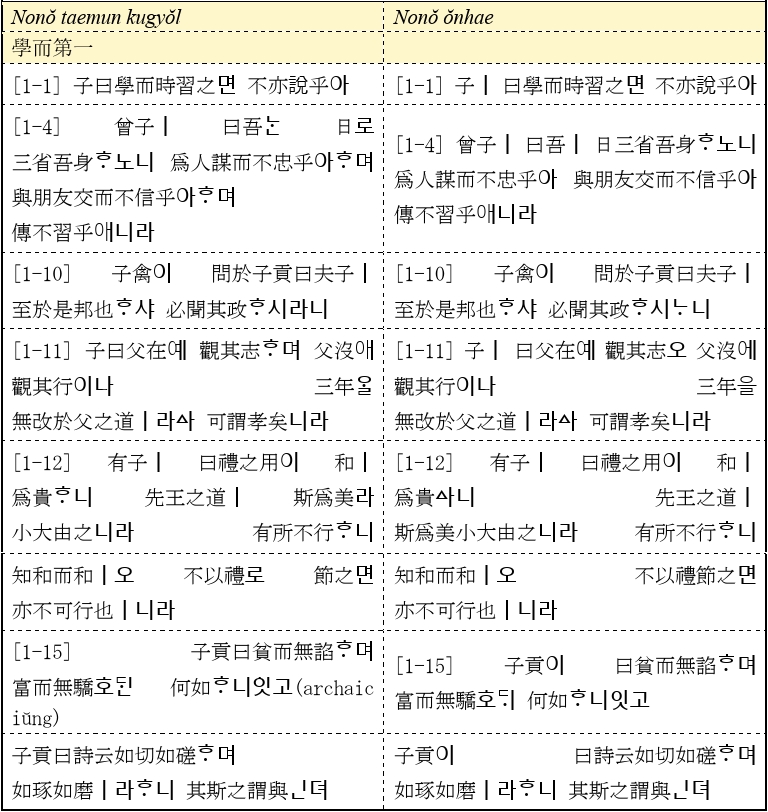
Fig. 2.Opening page of the lower volume of the Sŏjŏn taemun preserved in the Hwasan Collec on of the Korea University Library.
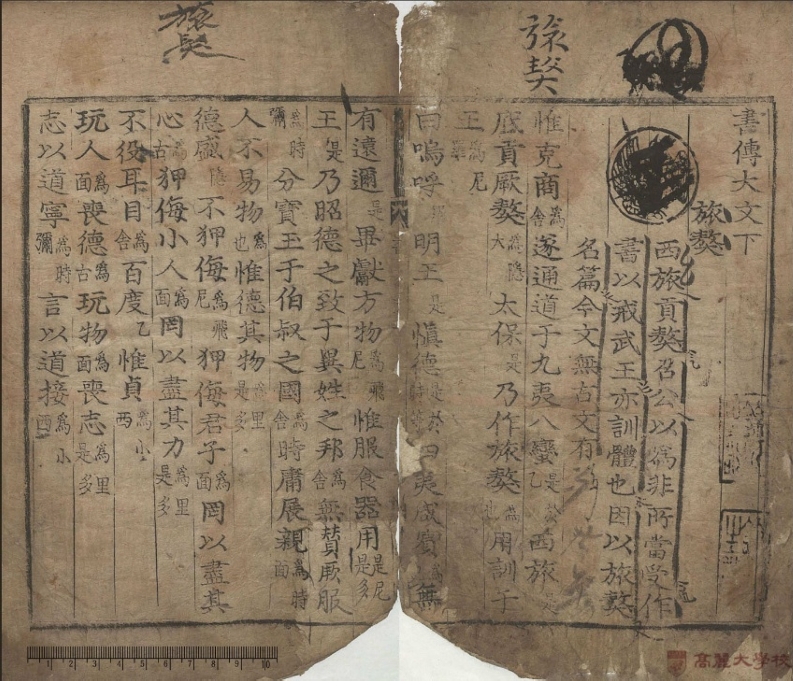
Reference List
- Ch'a Mi-hŭi 차미희. Chosŏn sidae kwagŏ chedo yŏn'gu조선시대 과거제도 연구 [A Study of the Civil Service Examination System in the Chosŏn Period]. Seoul: Kukhak Charyowŏn, 1999. Cho Chwa-ho 조좌호. Han'guk kwagŏ chedosa yŏn'gu 韓國科擧制度史硏究 [A.
- Study of the History of the Civil Service Examination System in Korea]. Seoul: Pŏmusa, 1996.
- Miya Noriko 宮紀子. Mongoru jidai no shuppan bunka モンゴル時代の出版文化 [Publishing Culture in the Mongol Period]. Nagoya: Nagoya Daigaku Shuppankai, 2006.
- Nam Kwŏn-hŭi 남권희. Han’guk kŭmsok hwalcha paltalsa: Chosŏn sidae 한국 금속활자 발달사: 조선시대 [A History of the Development of Korean Metal Movable Type: The Chosŏn Period]. Taegu: Kyŏngbuk Taehakkyo Ch’ulp’anbu, 2018.
- Noh Johann 노요한. “Chosŏn chŏn’gi kwanch’an chuhaesŏ ŭi munhŏnhakchŏk Yŏn’gu” 조선전기 관찬 주해서의 문헌학적 연구 [A Bibliographical Study of Officially Compiled Annotated Editions in the Early Chosŏn Period]. PhD diss., Korea University, 2019. ———. “Koryŏdae chungang tosŏgwan hwasan mun’go sojan Nonŏ taemun kugyŏl ŭi kugyŏle taehayŏ” 고려대 중앙도서관 화산문고 소장 『논어대문구결』의 구결에 대하여 [On the Kugyŏl of Nonŏ Taemun Kugyŏl in the Hwasan Collection of Korea University Library]. Ŏmun yŏn’gu 어문연구 209 (2026). ———. “Koryŏdae hwasan mun’go Sojang ũrhaeja bon Sŏjŏn taemun ŭi kugyŏle taehayŏ” 고려대 화산문고 소장 을해자본 『書傳大文』의 구결에 대하여 [On the Kugyŏl of the Ŭrhaeja Edition of Sŏjŏn Taemun in the Hwasan Collection of Korea University Library]. Taedong hanmunhak 대동한문학 74 (2023). ———. “Chosŏn chŏn’gi sŏngrisŏŭi suip kwa kanhaeng” 조선전기 성리서의 수입과 간행 [The Import and Publication of Neo-Confucian Texts in the Early Chosŏn Period]. Hanmunhak nonjip 한문학논집 66 (2023).
- Pak Hyŏn-sun 박현순. Chosŏn hugi ŭi wwagŏ 조선 후기의 과거 [The Civil Service Examinations in the Late Chosŏn Period]. Seoul: Somyŏng Ch’ulp’an, 2014.
- Pak U-hun 박우훈. “Han'guk-ŭi p'yŏnmunjip yŏn’gu” 한국의 騈文集 연구 [A Study of Parallel Prose Collections in Korea]. Kugŏ kungmunhak 국어국문학 114 (1995).
- Sim Kyŏng-ho 심경호. Chosŏn sidae hanmunhak kwa Sigyŏngnon 조선시대 한문학과 시경론 [Sino-Korean Literature and Poetics of the Classic of Poetry in the Chosŏn Period]. Seoul: Iljisa, 1999. ———. Han’guk hanmun kich’o haksa 한국한문기초학사 [History of Korean Philology]. Vol. 3. Seoul: T'aehaksa, 2012. ———. “Sŏnjo kwanghaegunjo ŭi Han Yu mun kwa Sagi yŏnch’an e kwanhayŏ: Han Yu mun kwa Sach’an ŭi hyŏnt’o wa chuhae rŭl chungsim ŭro” 宣祖ㆍ光海君朝의 韓愈文과 史記 硏鑽에 관하여: 韓愈文과 <史纂>의 懸吐와 註解를 중심으로 [On the Study of Han Yu's Prose and the Shiji during the Reigns of Sŏnjo and Kwanghaegun: With a Focus on the Reading Marks and Annotations in Han Yu's Prose and the Sach’an]. Sŏjihak po 서지학보 17 (1996).
- Son Po-gi 손보기. Sejong sidae ŭi inswae ch’ulp’an 세종시대의 인쇄출판 [Printing and Publishing in the Reign of King Sejong]. Seoul: Sejong Taewang Kinyŏm Saŏphoe, 1986.
- Yi Ki-mun 이기문. Kugŏsa kaesŏl 국어사개설 [A History of the Korean Language]. Rev. ed. Seoul: T'aehaksa, 1998.
- Yi Pyŏng-hyŏk 이병혁. Han’guk hanmunhak ŭi t’amgu 韓國漢文學의 探究 [Explorations in Korean Sino-Korean Literature]. Seoul: Kukhak Charyowŏn, 2003.
- Yi Sang-uk 이상욱. "Chosŏn kwamun Yyŏn'gu" 조선 과문 연구 [A Study of Examination Literature in the Chosŏn Period]. PhD diss., Yonsei University, 2015.
- Yun Sŏn-yŏng 윤선영. "Chosŏn sidae kwasi-ŭi sasŏŭi yŏn'gu" 조선 시대 科試의 四書疑 연구 [A Study of the Sasŏŭi (Questions on the Four Books) in the Civil Service Examinations of the Chosŏn Period]. PhD diss., Korea University, 2019.


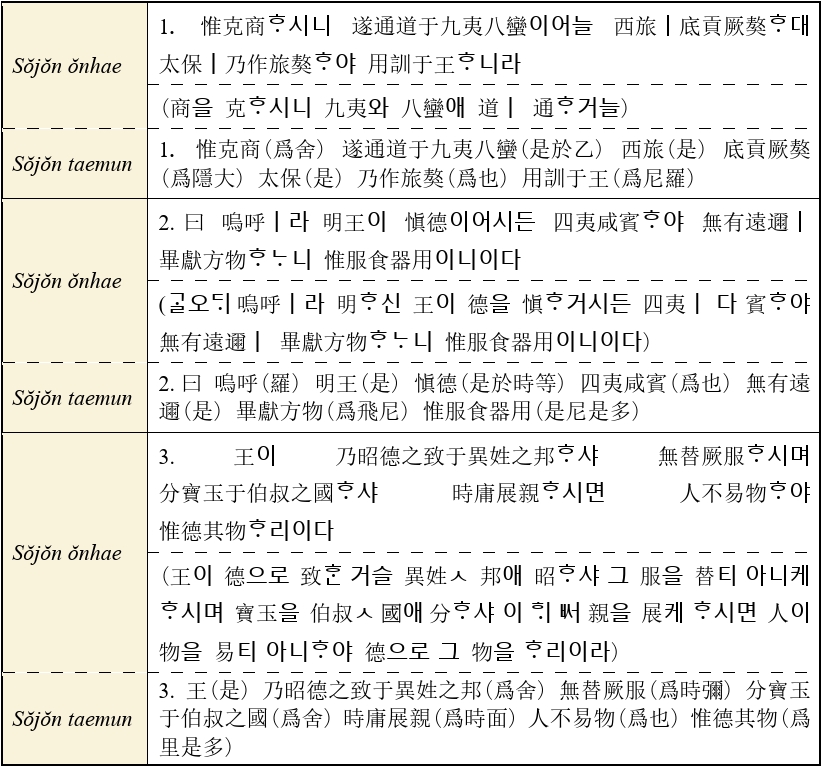
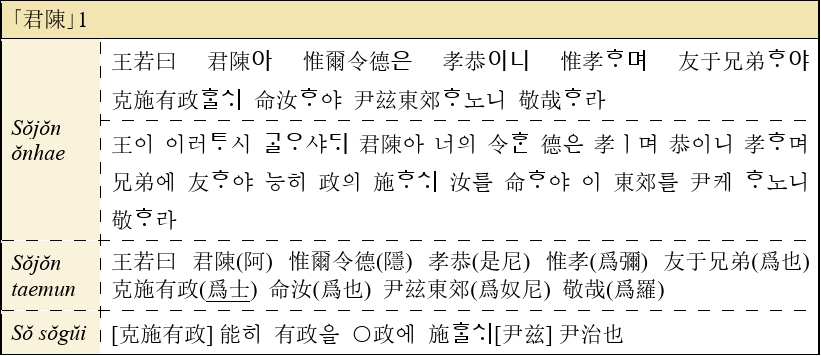

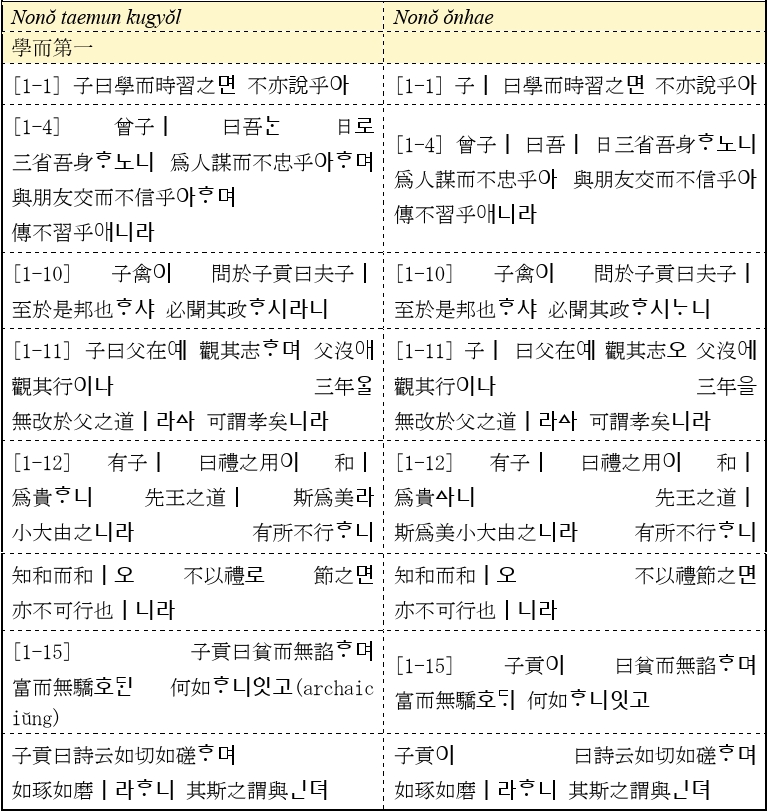
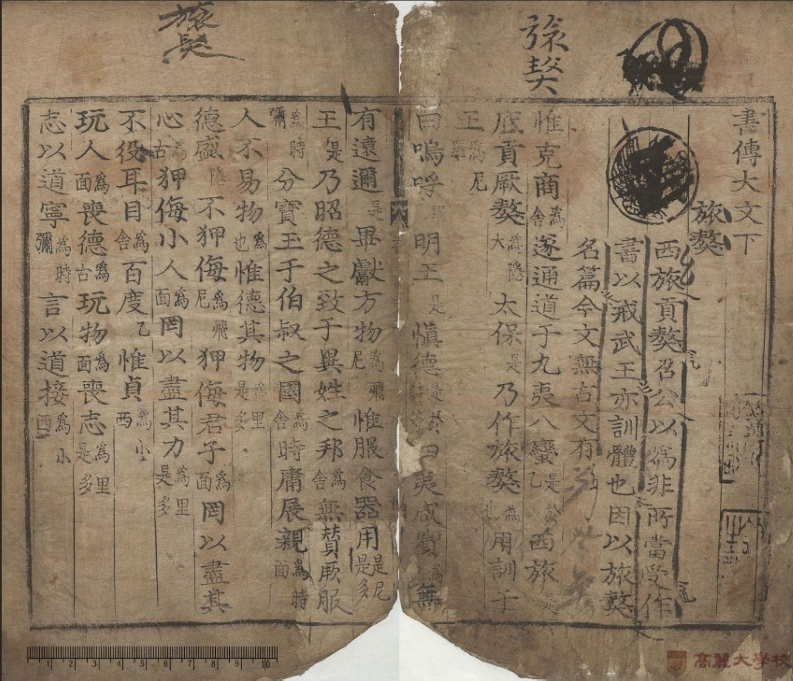
 News
News