• Contact us
  • E-Submission
ABOUT
BROWSE ARTICLES
EDITORIAL POLICY
FOR CONTRIBUTORS

Page Path

2
results for

"Kugyŏl"

Filter

Article category

Keywords

Publication year

Authors

"Kugyŏl"

Article

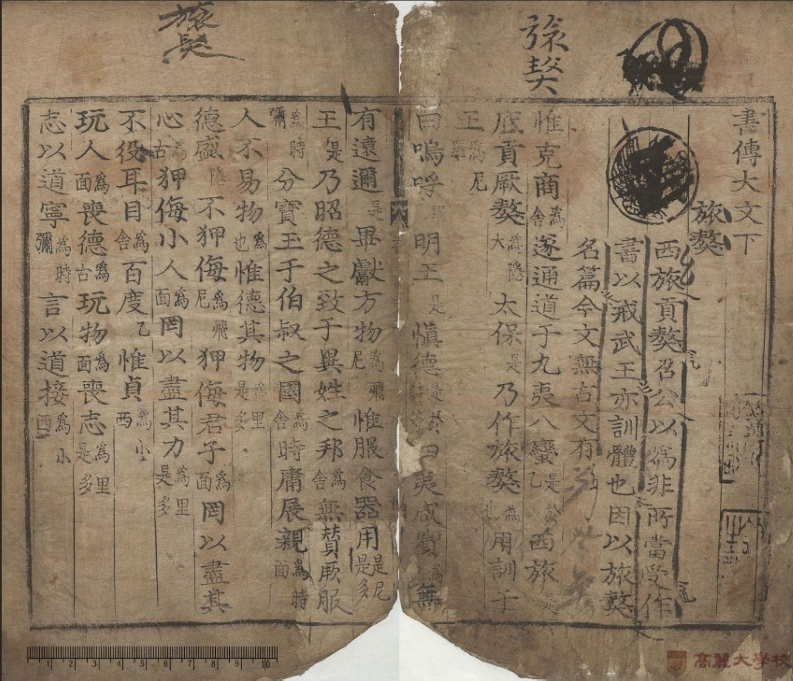
This study examines the development of royal-led publishing culture and the formation of reading practices in early Chosŏn. The Chosŏn court institutionally defined the content and method of canonical reading through the importation and reprinting of the Yongle emperor's imperially commissioned Sishu wujing daquan and Xingli daquan, the compilation of comprehensive annotated editions such as the Sajŏngjŏn hunŭi on the Zizhi tongjian, and the kugyŏl projects of the Sejo reign and the vernacular translation projects of the Sŏnjo reign. Through analysis of the Ŭrhaetype editions of the Nonŏ taemun kugyŏl and the Sŏjŏn taemun preserved in the Hwasan Collection at Korea University Library, this study identifies at least two distinct kugyŏl traditions existing between the Sejo-period kugyŏl project and the Sŏnjo-period vernacular translation project. It further demonstrates that Yi Hwang’s Kyŏngsŏ sŏgŭi reveals the persistence of a flexible scholarly environment in which multiple interpretations coexisted despite the state’s efforts to establish a single authoritative standard. Through analysis of Yi Sik's “Si ason tŭng,” this study additionally shows that the reading practices of Chosŏn literati unfolded within a dual structure shaped by the tension between state-sanctioned canonical reading and the pragmatic goal of examination success. This tension between what the state sought to teach and what literati actually sought to learn is understood as an enduring issue that resonates with contemporary Korean educational culture.

  • 20 View
  • 3 Download
Article
A Sino-Korean literature textbook for English-speaking college students, currently under development, should aim to highlight the unique characteristics of the history of Sino-Korean literature, offering distinct value compared to previous textbooks that primarily focus on Chinese classics. This paper outlines the design of a curriculum for teaching ‘Korean-style’ Sinographic literature in a single chapter of the new textbook, which was developed to address the mismatches between literary Chinese and vernacular Korean. The proposed curriculum is divided into two parts, each with three sections, and is designed to systematically convey the history, scope, and grammatical features of ‘Korean-style’ Sinographic literature. Part I addresses the historical context of Korean literature and examines how to define and delineate the boundaries of ‘Korean-style’ Sinographic literature. This part includes: Section 1, an explanation of the linguistic reasons behind the invention of ‘Korean-style’ Sinographic literature; Section 2, an overview of the historical development of ‘Korean-style’ Sinographic literature; Section 3, a justification for selecting Idu as a representative style among other Korean Sinographic writing systems. Part II focuses on approaches for teaching the grammatical elements of Idu and incorporating textual examples that demonstrate its practical usage. This part includes: Section 4, an introduction to the basic elements of Idu; Section 5, an analysis of the grammatical structure of Idu; Section 6, textual examples illustrating the use of Idu in historical contexts.
  • 24 View
  • 3 Download
TOP