Abstract
-
This study examines how Hanja education policy in Korea has changed in relation to shifts in language and script policy since the twentieth century. It takes as its starting point the 1894 Royal Edict of King Kojong 高宗(r. 1863–1907), which marked the transition of Korea’s official writing system from Hanja-centered writing to Han’gŭl-centered writing. To this end, the study divides Korean language and script policy into the periods before and after 1945 and analyzes how the policies of each period affected Hanja education policy in Korea.
The findings are as follows. First, the major policies that influenced Hanja education policy in Korea since the twentieth century include the 1894 Royal Edict of King Kojong, the Act on the Exclusive Use of Han’gŭl of 1948, and the Framework Act on the National Language of 2005. Second, in the process of implementing these policies, various issues related to Hanja education were discussed or put into practice, including arguments for the abolition of Hanja, Hanja education in elementary and secondary schools, Hanja education within the Korean language curriculum, the parallel notation of Hanja, the establishment of commonly used Hanja, and the designation of basic Hanja for Literary Sinitic education. Third, future Hanja education policy should be based on an investigation of Hanja vocabulary actually needed in daily life and official documents. It should also organize educational content around practical use and develop learner-customized methods that make effective use of science and technology.
This study confirms that changes in language and script policy in Korea since the twentieth century have shaped the character and direction of Hanja education policy. It is expected to provide basic material for establishing Hanja education policies suited to the linguistic life ofKorean society in the future.
-
Keywords: language and script policy in Korea since the twentieth century, Hanja education policy in Korea, Royal Edict of King Kojong, Act on the Exclusive Use of Han’gŭl, Framework Act on the National Language, mixed use of Han’gŭl and Hanja, exclusive use of Han’gŭl, parallel notation of Hanja
Introduction
This study examines how Hanja education policy in Korea has changed in accordance with shifts in language and script policy since the twentieth century, taking as its starting point the promulgation of the 1894 Royal Edict of King Kojong 高宗 (r. 1863–1907), by which Korea’s official writing system was transformed from Hanja to Han’gŭl. Through this examination, it seeks to identify directions needed for establishing and implementing Korea’s Hanja education policy in the future.
Existing studies of language and script policy related to Hanja and Literary Sinitic in Korea have focused mainly on examining language and script policy, Literary Sinitic education, and changes in the Literary Sinitic curriculum.
1 These prior studies are significant in that they discussed Literary Sinitic education and the problem of Hanja notation with reference to the ‘Act on the Exclusive Use of Han’gŭl’ and the ‘Framework Act on the National Language.’ However, studies that place Hanja education policy itself at the center and examine the mutual relationship between language and script policy and Hanja education policy since the twentieth century are still insufficient.
In examining Korea’s language and script policy, it is necessary to distinguish between Hanja and Literary Sinitic. Hanja, as a means of notation at the level of the character, is related to problems of script policy such as the exclusive use of Hanja, the combined use of Han’gŭl and Hanja, and the exclusive use of Han’gŭl. Literary Sinitic, by contrast, takes as its object classical literary texts (古典文言文) at the level of the sentence, and has been taught either as part of the Korean-language subject or as an independent Literary Sinitic subject. From the standpoint of script policy, therefore, it is necessary to distinguish Hanja from Literary Sinitic and to examine how Hanja has been treated within Korea’s language and script policy, which since 1894 has taken the exclusive use of Han’gŭl as its basic direction.
Accordingly, while drawing on the achievements of existing research, this study places the implementation and transformation of Korea’s Hanja education policy at its center and examines its relationship to Korean language and script policy since the twentieth century. Specifically, it considers how the 1894 ‘Royal Edict of King Kojong,’ the 1948 ‘Act on the Exclusive Use of Han’gŭl,’ and the 2005 ‘Framework Act on the National Language’ affected Korea’s Hanja education policy, and what characteristics the language and script policy of each period formed in Hanja education. Through this, it aims to grasp the influence of state-level language and script policy on Hanja education and to offer certain implications for seeking the future direction of Hanja education policy.
Language and Script Policy and Hanja Education Policy before 1945
Language and script policy is an institutional mechanism for planning and implementing the use of language and script at the level of the state. In this study, language and script policy refers to the series of policies related to the use of Hanja and to Hanja education in Korea among state-led script policies since 1894.
2 This chapter examines the period before 1945, when a new language and script policy emerged, focusing on the appearance of mixed Han’gŭl–Hanja writing and on the significance of the 1894 and 1895 ‘Royal Edicts of King Kojong.’
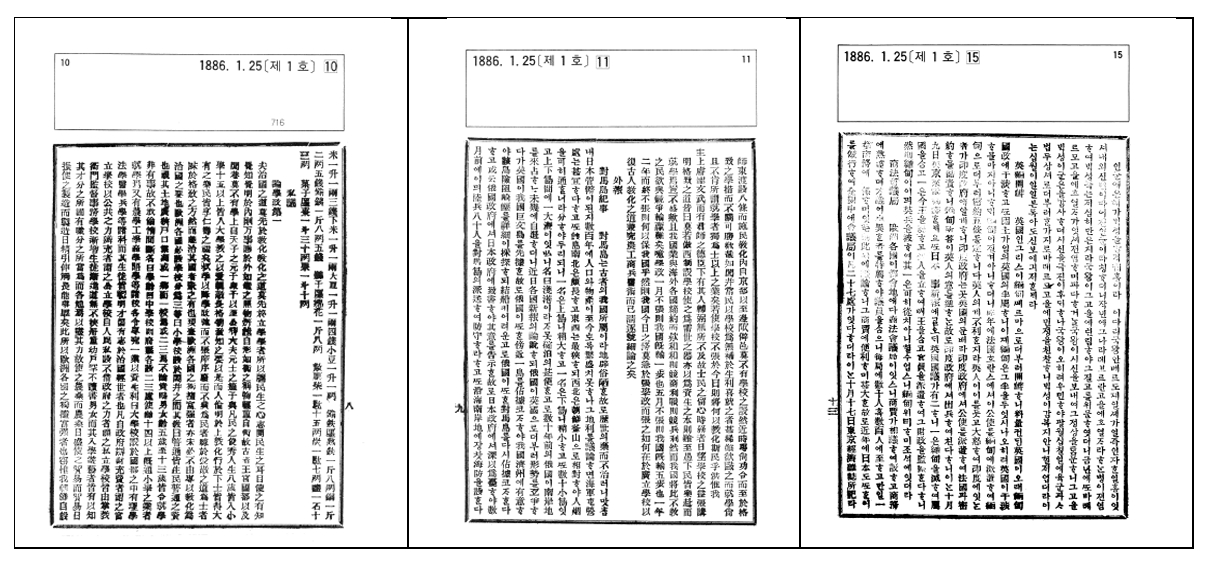
Before the 1880s, Chosŏn intellectuals mainly used Literary Sinitic, while the common people used the vernacular script, Han’gŭl. After the 1880s, however, when Chosŏn began to accept modern civilization, the need for Han’gŭl education was raised in order to convey new knowledge and information to ordinary people. As a result, debates arose advocating mixed Han’gŭl–Hanja writing and the exclusive use of Han’gŭl. The patterns of script use in this period can be confirmed in articles of the
Hansŏng chubo 漢城周報.
3
|
exclusive Hanja use |
mixed Han’gŭl–Hanja use |
exclusive Han’gŭl use |
The Hansŏng chubo, first issued on January 25, 1886, was a government newspaper. Unlike the Hansŏng Sunbo 漢城旬報, which had used Hanja only, it initially used together the three writing systems of mixed Han’gŭl–Hanja, exclusive Han’gŭl, and exclusive Hanja. From its 47th issue until its discontinuation in July 1888, however, the Hansŏng chubo wrote its articles in Literary Sinitic only. This shows that Literary Sinitic was the more familiar script for the newspaper’s readership at the time.
Meanwhile, even after 1888, the argument that Han’gŭl education was necessary for ordinary people continued. The following is the
Kŏnbaeksŏ 建白書 (Memorial) that Pak Yŏng-hyo 朴泳孝 wrote to convey his views on state affairs to King Kojong.
4
Pak Yŏnghyo, Kŏnbaeksŏ, February 24, 1888
六曰. 敎民才德文藝以治本
一.設壯年校, 以漢文, 或以諺文, 譯政治, 財政, 內外法律, 歷史, 地理及算術, 理化學大意等書, 敎官人之少壯者, [此似湖堂古事, 而其益必大也] 或徵壯年之士于八道, 以敎之. 待其成業, 以科擧之法試之, 而擇用於文官事.
一.先敎人民以國史及國語國文事, [不敎本國之歷史, 文章, 而但敎淸國之歷史文章, 故人民以淸爲本而重之, 至有不知自國之典故者, 此可謂捨本取末也]
In the ‘Memorial’ he submitted to King Kojong on February 24, 1888, Pak Yŏnghyo addressed eight reform topics, among which content related to language and script policy can be identified. That is, he proposed establishing schools for adults and educating young officials by translating books on politics, law, history, and other subjects into either Literary Sinitic or the vernacular script. He also emphasized the need to first teach ordinary people national history, the national language, and the national script. This proposal reflects the recognition that, in order to convey diverse knowledge to ordinary people, not only Literary Sinitic but also Han’gŭl had to be used. It shows that the principal script for conveying knowledge was beginning to change from Literary Sinitic to Han’gŭl and mixed Han’gŭl–Hanja writing.
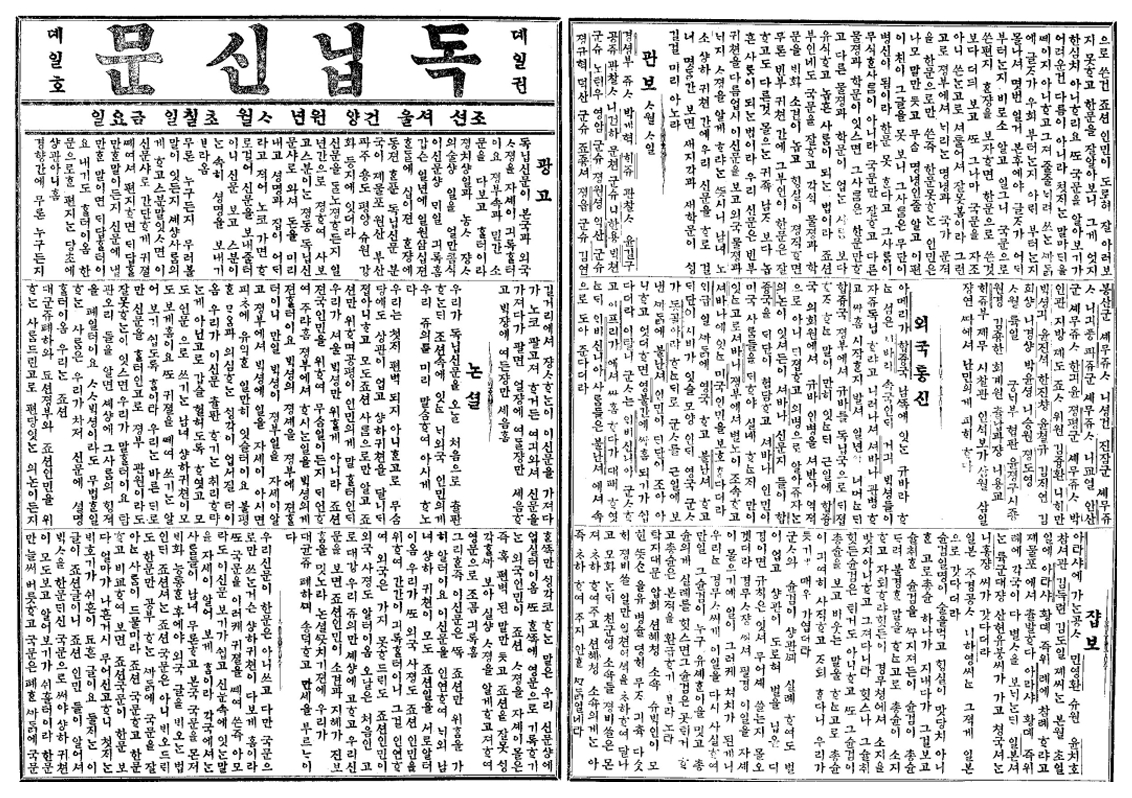
Thereafter, in accordance with Royal Edict No. 1 of King Kojong 高宗 on November 21, 1894, and Royal Edict No. 86 of May 8, 1895, Korea’s official mode of writing changed greatly. This change in language and script policy carried over into the exclusive-Han’gŭl editorials of the
Tongnip sinmun 獨立新聞, first issued on April 7, 1896.
In 1896, the Tongnip sinmun emphasized that the exclusive use of Han’gŭl was ‘easy to learn,’ ‘the script of Chosŏn,’ and ‘easy for ordinary people to read.’ This recognition carried on the transformation in the mode of script notation after 1894 and subsequently became an important foundation for the language and script policy of the exclusive use of Han’gŭl. In sum, the influx of new knowledge after the 1880s and the consequent need to educate ordinary people highlighted the need for Han’gŭl education, and the promulgation of the 1894 and 1895 ‘Royal Edicts of King Kojong’ institutionally supported this.
2) The 1894 and 1895 ‘Royal Edicts of King Kojong’
As examined above, the ‘Royal Edict of King Kojong’ became an important turning point in Korea’s official mode of script notation. This edict continued to influence the policy on Hanja use and Hanja education in Korea thereafter. The main content of the ‘Royal Edict of King Kojong’ is as follows.
5
Kojong sillok 고종실록, 31st year (1894), November 21
‘第十四條, 法律勅令, 總以國文爲本, 漢文附譯, 或混用國漢文.’
Kojong sillok 고종실록, 32nd year (1895), May 8
‘第九條, 法律命令은 國文으로!" 본을 삼!" 漢譯을 附#$며 或國漢文을 混用홈.’
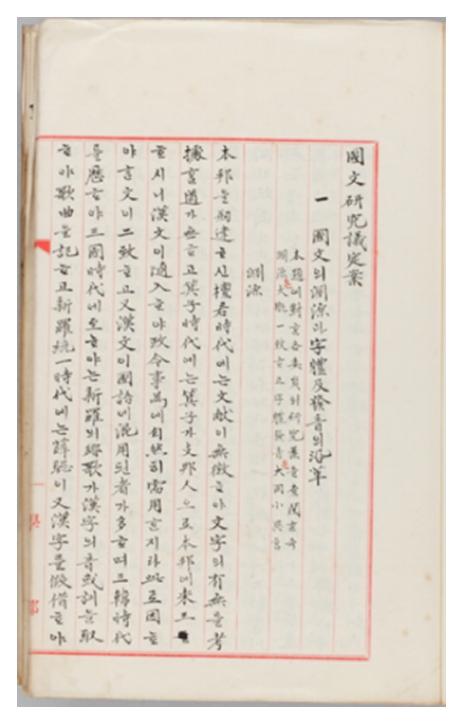
In accordance with this edict, Korea’s language and script policy after the twentieth century shifted toward taking Han’gŭl as its basis and using Literary Sinitic or mixed Han’gŭl–Hanja writing as auxiliary means. Even though a Han’gŭl-centered language and script policy was put forward, however, in actual script use Han’gŭl and Literary Sinitic continued to be mixed. The following is an example that allows this phenomenon to be inferred.
6
The Kungmun Yŏn'gu Ŭijŏng'an 國文硏究議定案, produced in 1909 by the Institute for the Study of the National Script under the Ministry of Education, was a report on Korean orthography at the level of the Korean government, yet it was written in mixed Han’gŭl–Hanja. This shows that, although all official government documents had been required to be written in Han’gŭl after 1894, mixed Han’gŭl–Hanja writing was still widely used in actual public documents up to 1909.
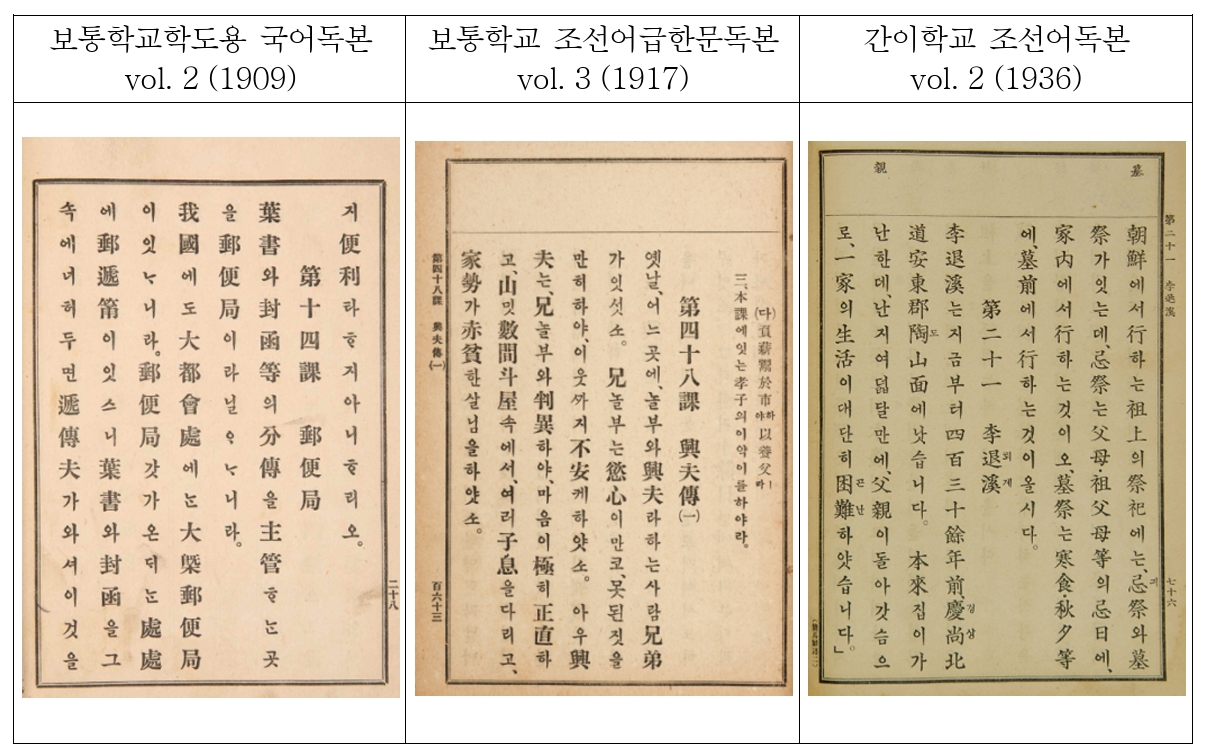
After Japanese colonial rule began in 1910, the Government-General of Chosŏn established language and script regulations such as the ‘Orthography of the Vernacular Script for Common Schools’ (1912), the ‘Outline of the Orthography of the Vernacular Script for Common Schools’ (1921), and the ‘Orthography of the Vernacular Script’ (1930). These regulations functioned as the language and script regulations related to Korean-language education during the colonial period and became the notational standards for Korean-language textbooks and dictionaries.
7
As can be seen in the materials above, although Korea’s official language and script policy shifted to the exclusive use of Han’gŭl after 1894, this was not immediately reflected in the actual educational field. Not only before 1909 but also in the Korean-language textbooks published by the Ministry of Education or the Government-General of Chosŏn during the colonial period, mixed Han’gŭl–Hanja notation continued to be used. This shows that there was a gap between language and script policy and the realities of the educational field.
Language and Script Policy and Hanja Education Policy after 1945
After Liberation in 1945, Korea’s language and script policy and Hanja education policy passed through the period of the U.S. Military Government and were fully institutionalized with the promulgation of the ‘Act on the Exclusive Use of Han’gŭl’ in 1948. The language and script policy of this period later became the basis of the 2005 ‘Framework Act on the National Language’ and continues to exert influence to the present.
1) The Textbook Subcommittee of the Chosŏn Education Deliberation Council
The period from Liberation in 1945 to 1948 was that of the U.S. Military Government. The language and script policy of this period can be specifically confirmed through the script policy discussed in the ‘Textbook Subcommittee’ of the ‘Chosŏn Education Deliberation Council,’ established within the Bureau of Education of the Military Government.
8
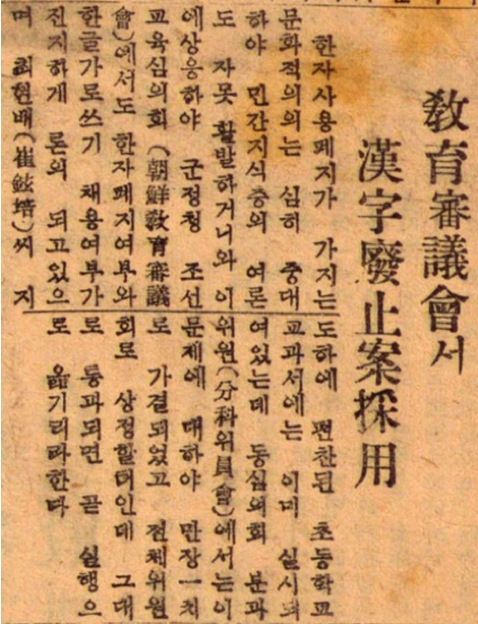
The core of the language and script policy resolved by the ‘Textbook Subcommittee of the Chosŏn Education Deliberation Council’ was, first, that ‘in elementary and secondary education Han’gŭl would in principle be used and Hanja would not be used.’ The ‘abolition of Hanja’ policy resolved in 1945 by the ‘Textbook Subcommittee of the Chosŏn Education Deliberation Council’ was a representative language and script policy related to Hanja education after Liberation, and the Ministry of Education, reflecting it, published and distributed
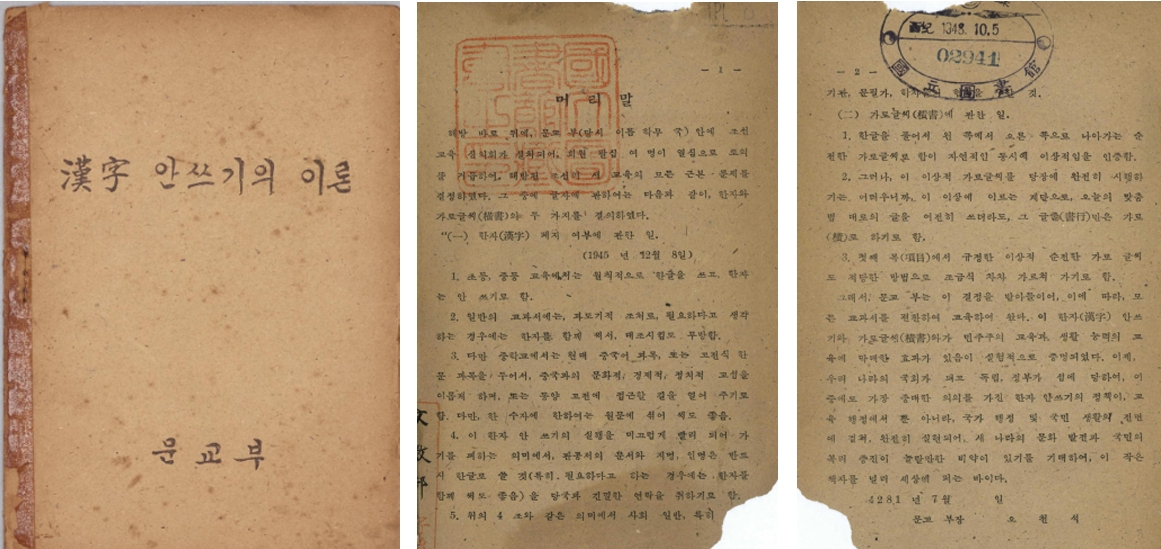
Hanja ansseugi ŭi iron 漢字 안쓰기의 이론 “The Theory of Not Using Hanja” in August 1948.
9
Hanja ansseugi ŭi iron was published in August 1948 by the Chosŏn Kyohak Tŏsŏ 朝鮮敎學圖書 Company; it is a book in which the Ministry of Education set out matters related to ‘not using Hanja.’ It mainly described ‘the grounds for abolishing the use of Hanja, a rebuttal to dissenters, and the methods of abolishing the use of Hanja.’ The main content concerning the abolition of Hanja is as follows:
Preface
Right after Liberation, the Chosŏn Education Deliberation Council was established within the Ministry of Education (then called the Bureau of Education), … Among its resolutions, concerning script it resolved the following two matters, on Hanja and on Hoengsŏ 橫書 “horizontal writing”.
(一) On whether to abolish Hanja 漢字.
(December 8, 1945)
1. In elementary and secondary education, Han’gŭl shall in principle be used, and Hanja shall not be used.
2. In general textbooks, as a transitional measure, where deemed necessary it is permissible to write Hanja alongside for comparison.
3. However, in middle schools a modern Chinese-language subject or a classical Literary Sinitic subject may be offered, so as to benefit cultural, economic, and political intercourse with China and to open a path of access to the East Asian classics. However, only numerals written in Hanja may be interspersed in the original text.
4. In order to make the practice of not using Hanja proceed smoothly and quickly, it shall be arranged, in close communication with the authorities, that official documents, place names, and personal names be written in Han’gŭl without fail (where deemed especially necessary, Hanja may be written alongside).
According to the preface, on December 8, 1945, the ‘Chosŏn Education Deliberation Council’ resolved the questions of whether to abolish Hanja and of horizontal writing. Its content was that in elementary and secondary education Han’gŭl would in principle be used and Hanja would not be used; that Hanja could be written alongside in textbooks where necessary as a transitional measure; and that middle schools could offer a classical Literary Sinitic subject.
In sum, the body that decided to abolish Hanja at the time was the ‘Ministry of Education–Chosŏn Education Deliberation Council,’ and the principle of language and script policy was the exclusive use of Han’gŭl. As a transitional measure, however, Hanja could be used for textbooks, place names, and personal names, and a Literary Sinitic subject could be established in middle schools. This resolution was subsequently reflected in the exclusive use of Han’gŭl and in horizontal writing in the textbooks used at schools of every level.
However, the matter of establishing an independent Literary Sinitic subject, discussed in 1945, was not organized as a single independent subject up through the First Curriculum of 1955 and the Second Curriculum of 1963. It was included as ‘Hanja and Literary Sinitic’ within the Korean-language subject, and Hanja education was carried out mainly with a focus on its relevance to daily life.
10
Meanwhile, the policy of not using Hanja shown in the 1948
Hanja ansseugi ŭi iron 漢字 안쓰기의 이론 was closely related to Chŏng T’aejin 丁泰鎭’s 1946
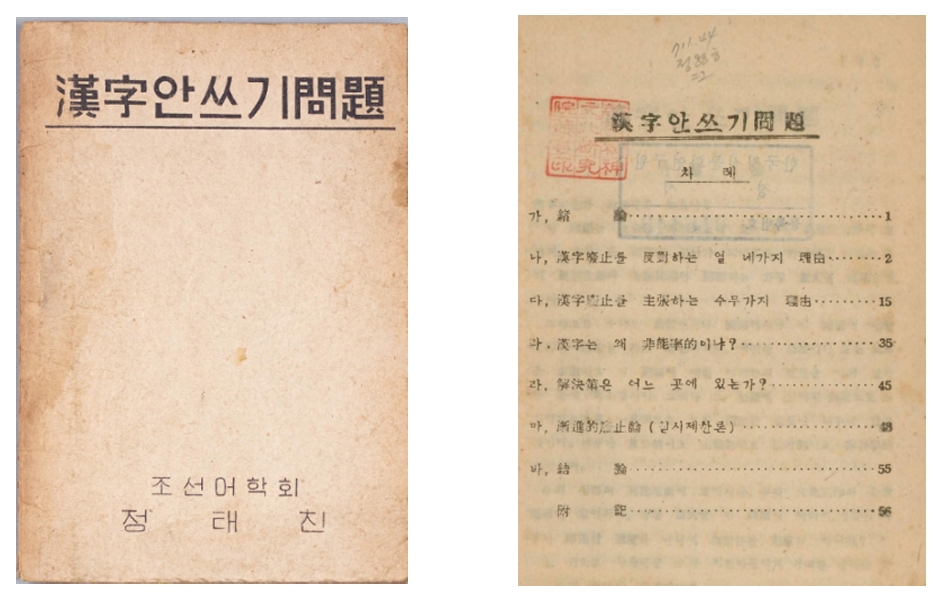
Hanja ansseugi munje 漢字안쓰기問題 “The Problem of Not Using Hanja” and Ch’oe Hyŏnbae 崔鉉培’s 1947
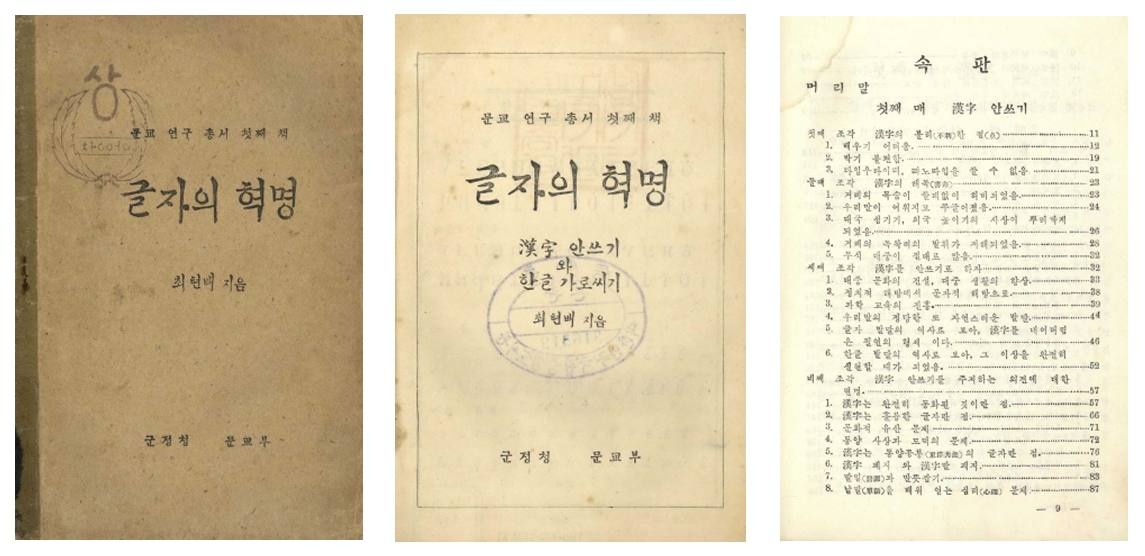
Kŭlcha ŭi hyŏngmyŏng 글자의 혁명 “The Revolution of Script.”
11
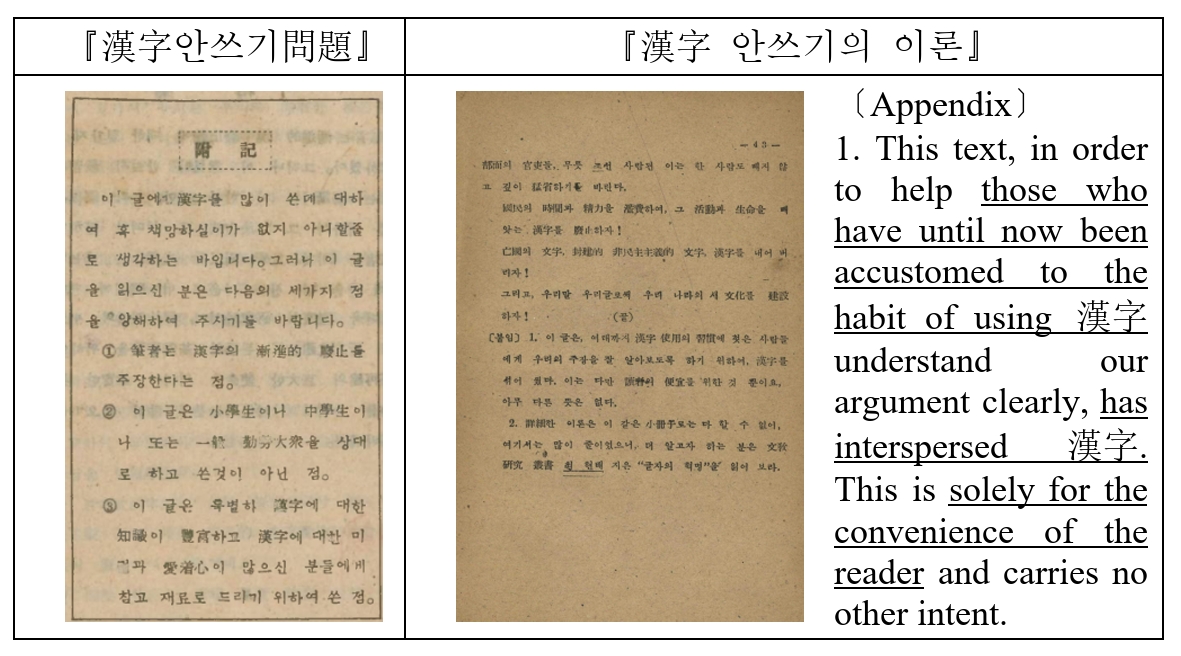
『漢字안쓰기問題』 is a research work on the gradual abolition of Hanja use, written by Chŏng T’aejin in 1946, set in horizontal writing using a mixture of Han’gŭl, Hanja, and English. Under the headings ‘fourteen reasons opposing the abolition of Hanja, some twenty reasons advocating the abolition of Hanja, why is Hanja inefficient, where does the solution lie, and the theory of gradual abolition (the theory of temporary restriction),’ it treated as its main content the arguments against and for the abolition of Hanja, the inefficiency of Hanja, solutions, and the theory of gradual abolition.
『글자의 혁명』 is Ch’oe Hyŏnbae’s research work on the policy of Korean script writing, with the subtitle ‘Not Using Hanja and Writing Han’gŭl Horizontally.’ It was published on May 6, 1947, by the Ministry of Education and the Chosŏn Kyohak Tŏsŏ Company, using parallel Hanja notation or a mixture of Hanja and English. Under the headings ‘the disadvantageous points of Hanja, the harm of Hanja, let us decide not to use Hanja, a rebuttal to opinions hesitant about not using Hanja, and methods of implementing the non-use of Hanja,’ it mainly described the inconvenience of using Hanja and the methods of implementing the non-use of Hanja.
As examined above, after 1945 Korea’s language and script policy during the U.S. Military Government period was pursued in the direction of taking the exclusive use of Han’gŭl as its principle in elementary and secondary education and of abolishing, or transitionally permitting or restricting, the use of Hanja. In actual script use, however, Hanja still occupied a large share. This actual state of Hanja use can be confirmed in the materials below.
Chŏng T’aejin’s 『漢字안쓰기問題』 and the Ministry of Education’s 『한자 안쓰기의 이론』 advocated a script policy based on the exclusive use of Han’gŭl and argued for not using Hanja, yet these works themselves were published in mixed Han’gŭl–Hanja. This was because the readership of the time was still accustomed to the use of Hanja. This fact clearly shows that there was a gap between the policy of abolishing Hanja and actual script life.
2) The 1948 ‘Act on the Exclusive Use of Han’gŭl’
The 1945 language and script policy of the principle of the exclusive use of Han’gŭl and the policy of abolishing Hanja in school education led to the promulgation of the ‘Act on the Exclusive Use of Han’gŭl’ in 1948. This act became the central basis of the exclusive-Han’gŭl policy until the ‘Framework Act on the National Language’ was enacted in 2005. The main content of this act is as follows:
‘Act on the Exclusive Use of Han’gŭl,’ promulgated October 9, 1948
‘The public documents of the Republic of Korea shall be written in Han’gŭl. However, for some time, when necessary, Hanja may be used alongside.’
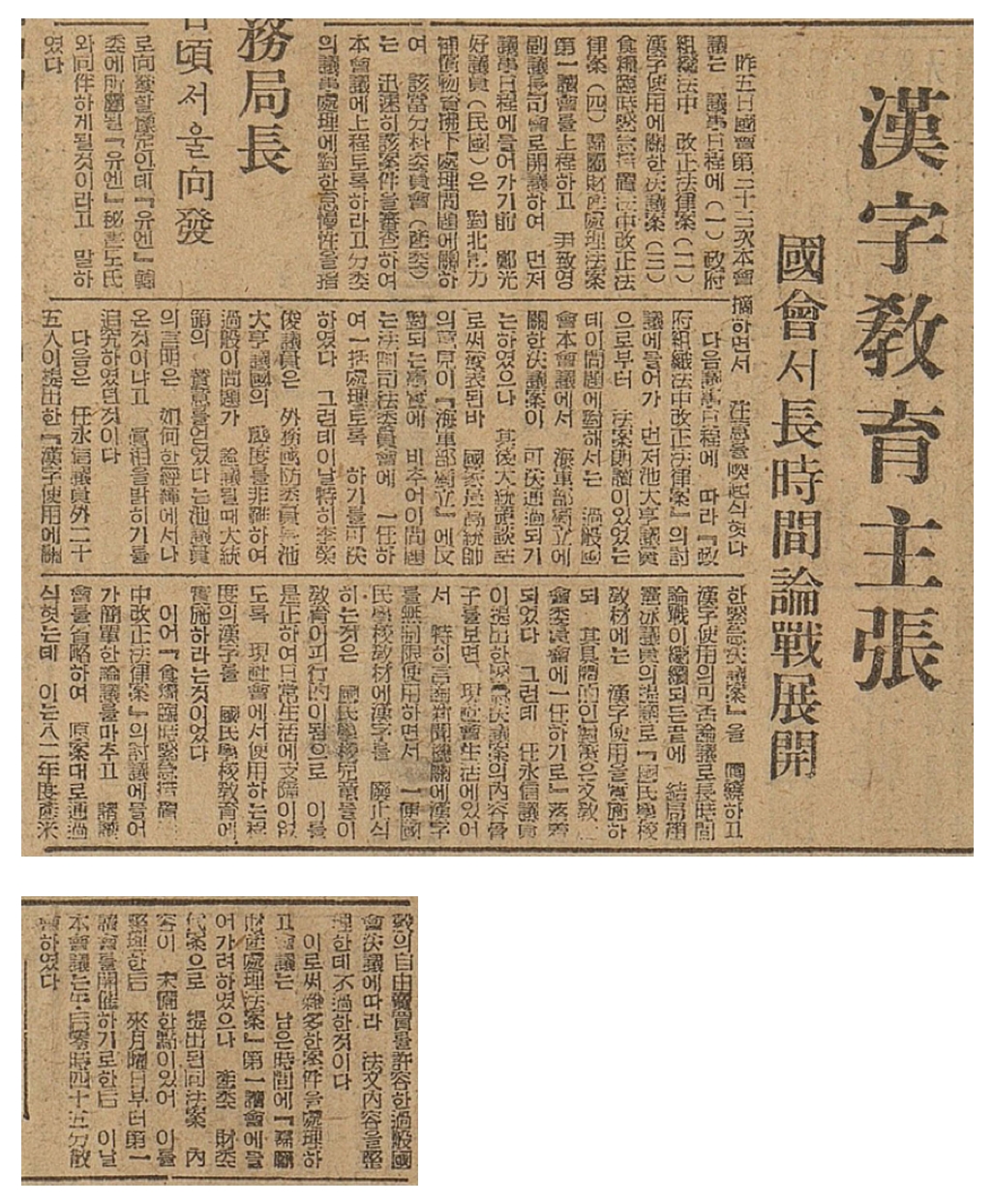
Whereas the 1945 principle of the exclusive use of Han’gŭl had been limited to school education, the 1948 ‘Act on the Exclusive Use of Han’gŭl’ required that not only school education but also all official documents be written in Han’gŭl, permitting the combined use of Hanja only when necessary. Even after this act was promulgated, however, Hanja continued to be used in newspapers and magazines, so the need for Hanja education in order to read them was raised. In this situation, on November 5, 1949, a ‘Proposal for the Use of Hanja in Textbooks’ was submitted to the National Assembly. Under the recognition that anyone who had graduated from elementary school should be able to read newspapers and magazines, this proposal led to the decision to ‘use simple Hanja in elementary-school textbooks and to use Hanja in a restricted manner in newspapers and magazines.’
After 1945, Korea took the exclusive use of Han’gŭl as the principle of its language and script policy and enacted the ‘Act on the Exclusive Use of Han’gŭl’ in 1948. As can be seen in the material above, however, debate over whether to use Hanja in elementary schools continued. Examples include the passage of the ‘Proposal for the Use of Hanja in Textbooks’ in 1949, the selection of ‘1,000 educational Hanja’ to be taught in elementary schools in 1950, the drive in 1951 to provide parallel notation of educational Hanja in fourth-grade elementary-school textbooks, and the 1963 decision that ‘from 1965, Hanja would be used alongside in textbooks for the fourth grade of elementary school and above.’
Thereafter, as the ‘Five-Year Plan for the Exclusive Use of Han’gŭl,’ begun in 1968, was pursued, the exclusive use of Han’gŭl in elementary-school textbooks was established from 1970. However, in the course of discussing the ‘2015 Revised Curriculum’ in 2015, the problem of parallel Hanja notation in elementary-school textbooks was again raised, with a statement that ‘concrete measures such as the method of Hanja notation in elementary-school textbooks and the appropriate number of Hanja would be discussed.’ In this way, debate over the exclusive use of Han’gŭl and parallel Hanja notation in school education has recurred repeatedly from 1945 until recent times.
12 The main changes in language and script policy related to Hanja education after 1945 are as follows:
At present, Korea’s language and script policy takes the exclusive use of Han’gŭl as its principle. Within this, ‘Literary Sinitic’ has become established as a subject studied from middle school onward. This means a system in which, up through the elementary-school stage, Han’gŭl education is central, while at the middle- and high-school stages students study the Hanja needed for reading Literary Sinitic. When one examines the process of change in language and script policy after 1945, however, even after the policy of abolishing Hanja was established in accordance with the exclusive-Han’gŭl policy, policies permitting the mixed or combined use of Hanja repeatedly appeared.
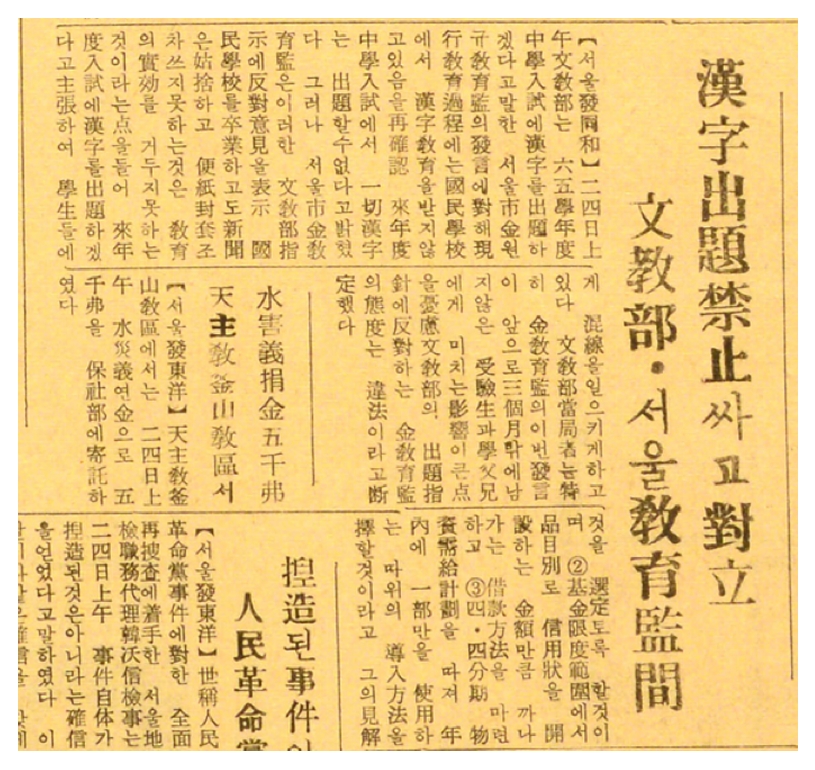
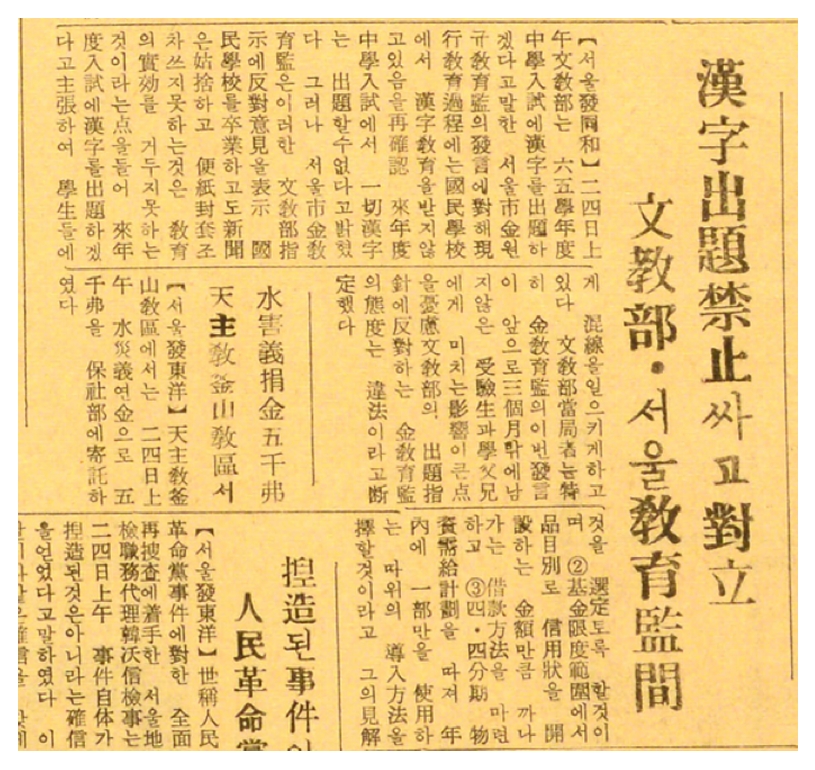
The material above shows that, even in 1964—after the exclusive-Han’gŭl policy had been implemented from the late 1950s through the early 1960s—debate over Hanja education continued. When the Ministry of Education announced at the time that it planned to set Hanja questions on the 1965 middle-school entrance examination, an opposing position was raised. The argument that setting Hanja questions was impermissible reflected the reality that students at the time were not receiving Hanja education. The argument that setting Hanja questions was necessary, on the other hand, was based on the awareness of the problem that, even after graduating from elementary school, students could not read newspapers or write letters in daily life.
This debate ultimately converged on the direction of implementing the teaching of commonly used Hanja in elementary, middle, and high schools in 1964. This shows the recognition that Hanja was necessary at the level of daily life as well, since it not only aids the understanding of classics written in Literary Sinitic but has also long performed a certain function within the linguistic life of Koreans.
13
The basic institution currently underpinning Korea’s language and script policy is the ‘Framework Act on the National Language.’ The ‘Framework Act on the National Language’ was promulgated as Act No. 7368 on January 27, 2005, and took effect on July 28, 2005. Within this act, the content noteworthy in relation to Hanja education is as follows:
14
‘Framework Act on the National Language,’ Act No. 7368, January 27, 2005. ○ Article 3 (Definitions)
“The national language” means Korean, the official language of the Republic of Korea.
“Han’gŭl” means our own intrinsic script that records the national language. ○ Article 14 (Preparation of Official Documents)
① The official documents of public institutions shall be prepared in Han’gŭl in accordance with the language and script norms. However, in cases prescribed by Presidential Decree, Hanja or other foreign scripts may be written within parentheses.
‘Enforcement Decree of the Framework Act on the National Language,’ Presidential Decree No. 18973, July 27, 2005.
○ Article 11 (Preparation of Official Documents and Use of Han’gŭl)
Pursuant to the proviso of Article 14, paragraph 1 of the Act, the cases in which Hanja or foreign scripts may be written within parentheses when public institutions prepare official documents are as follows :
1. Where necessary in order to convey the meaning accurately
2. Where difficult or unfamiliar technical terms or Sinjoŏ 新造語 “newly coined words” are used
○ Article 8 (Subcommittees)
2. Subcommittee on Language and Script Norms
e. Matters concerning Chahyŏng 字形 “the character form,” Tugŭm 讀音 “pronunciation”, and meaning of Hanja
Article 3 of the ‘Framework Act on the National Language’ defines ‘Han’gŭl’ as Korea’s own intrinsic script that records the national language. Article 14 ① stipulates that official documents must be prepared in Han’gŭl, while providing that, in cases prescribed by Presidential Decree, Hanja may be written alongside within parentheses. Article 11 of the ‘Enforcement Decree of the Framework Act on the National Language’ specifies that the cases in which parallel Hanja notation is permissible are ‘where necessary in order to convey the meaning accurately’ and ‘in the case of technical terms and newly coined words.’ Article 8, moreover, specifies ‘matters concerning the character form, pronunciation, and meaning of Hanja.’
The ‘Framework Act on the National Language’ declared that it takes the exclusive use of Han’gŭl as its principle. However, it allowed Hanja to be written alongside in parentheses where necessary to convey the meaning accurately. While inheriting the provision of the 1948 ‘Act on the Exclusive Use of Han’gŭl’ that ‘for some time, when necessary, Hanja may be used alongside’ in preparing official documents, it presented the necessity of the combined use of Hanja more concretely from the standpoint of ‘conveying meaning.’ It is also significant in that, for the first time at the institutional level, it explicitly mentioned the form, sound, and meaning of Hanja.
After the 2005 ‘Framework Act on the National Language’ took effect, in the ‘2007 Revised Curriculum’ and the ‘2009 Revised Curriculum,’ which reflected this language and script policy, mention of Hanja and Sino-Korean idioms within the Korean-language subject was weakened or disappeared, unlike in the ‘Seventh Curriculum.’ After the ‘2009 Revised Curriculum,’ moreover, ‘Literary Sinitic’ was changed into an elective subject. In addition, the problem of parallel Hanja notation in elementary-school textbooks, discussed in the ‘2015 Revised Curriculum,’ was abandoned when the 2016 decision that ‘making Hanja education mandatory is incompatible with the Constitution’ was issued. As a result, Hanja education in elementary, middle, and high schools was reduced in character from a part of language and script policy to Hanja education for the sake of understanding Literary Sinitic within the Literary Sinitic subject.
Recently, however, as the problem of students’ declining vocabulary has been raised as a social issue, in 2026 the National Education Commission formed a ‘Special Committee on Literacy’ and is now discussing measures to improve literacy. Given that the Korean language is characterized by a large proportion of Sino-Korean (Hanja-based) vocabulary, there is a need to actively discuss ways of drawing on Hanja education within the regular curriculum to improve students’ literacy.
Characteristics of Korea’s Hanja Education Policy
When Hanja education policy was implemented in Korea, its background and aims were in many cases not clearly distinguished. Arguments for the abolition of Hanja, Hanja education in elementary and secondary schools, Hanja education within the Korean language curriculum, parallel Hanja notation, the establishment of commonly used Hanja, and the designation of basic Hanja for Literary Sinitic education set out from different policy goals, but in actual discussion they were treated together. In order to understand this problem, this study examined the process of change in Hanja education policy with a focus on Korea’s language and script policy since the twentieth century. As a result, it confirmed that the language and script policy of each period, implemented from 1894 to the present, is closely related to the use of Hanja and to the formation of Hanja education and related institutions.
First, Korea’s Hanja education policy has been closely linked to changes in the state’s script policy. The 1894 and 1895 ‘Royal Edicts of King Kojong’ put forward a Han’gŭl-centered language and script policy by taking Han’gŭl as the basis and recognizing Literary Sinitic translation or mixed Han’gŭl–Hanja writing as auxiliary. The 1948 ‘Act on the Exclusive Use of Han’gŭl’ made the use of Han’gŭl in official documents the principle, and the 2005 ‘Framework Act on the National Language’ made the institutional basis of the current exclusive use of Han’gŭl clearer. In this way, the necessity and scope of Hanja education policy have been adjusted in the course of changes in the state’s language and script policy.
Second, Hanja education policy changed repeatedly among the abolition of Hanja, mixed Han’gŭl–Hanja writing, and the combined use of Hanja. Each time the exclusive-Han’gŭl policy was strengthened, policies were pursued to abolish or reduce the use of Hanja, but in actual linguistic life the necessity of Hanja was continually raised. The establishment of 1,000 ‘commonly used Hanja’ (常用漢字) following the 1948 ‘Act on the Exclusive Use of Han’gŭl,’ the drive in 1951 to provide parallel notation of Hanja in parentheses in textbooks for the fourth grade of elementary school and above, and the establishment of 1,300 commonly used Hanja in 1957 show this trend.
Third, the 1972 selection of ‘1,800 basic Hanja for Literary Sinitic education’ was a turning point at which the character of Hanja education shifted from language and script education to Literary Sinitic subject education. Whereas the commonly used Hanja before 1972 presupposed mixed Han’gŭl–Hanja writing, the basic Hanja for Literary Sinitic education after 1972 had the character of educational Hanja for reading and understanding Literary Sinitic within the Literary Sinitic subject. This may be said to have been a measure that maintained the grand principle of the exclusive use of Han’gŭl while separately selecting Hanja intended solely for Literary Sinitic education.
Fourth, after the 2005 ‘Framework Act on the National Language,’ the principle of the exclusive use of Han’gŭl was further consolidated, and Hanja-related content within the Korean-language subject was reduced. Nevertheless, the provision allowing Hanja to be written in parallel in official documents to ‘convey meaning,’ the explicit specification of the form, sound, and meaning of Hanja as objects of discussion in the language and script norms, and the fact that Hanja education is being discussed in 2026 from the standpoint of improving literacy all show that Hanja still performs a certain function in Korea’s linguistic life.
As examined above, Korea’s Hanja education policy has changed in close relation to language and script policy. Therefore, in the course of discussing future Hanja education policy, it is necessary to consider together not only Hanja education within the Literary Sinitic subject but also the Hanja education needed for actual linguistic life, official documents, and the comprehension of technical terms.
Proposals for Korea’s Hanja Education Policy
This study examined the process of change in Hanja education policy in accordance with changes in Korea’s language and script policy since the twentieth century. As a result, it confirmed that the aspects continually mentioned in Hanja education policy from the late nineteenth century to the present are the necessity of Hanja education, the selection of educational and commonly used Hanja, the scope of Hanja education by school level, and the relationship between daily life and the Literary Sinitic subject. On the basis of this examination, the matters to be considered in the course of developing future Hanja education policy are presented as follows:
First, a survey of target vocabulary is needed.
At present, Korea’s language and script policy takes the exclusive use of Han’gŭl as its principle. There is no disagreement, however, that Hanja can aid the conveyance of meaning in daily life and official documents. Therefore, in establishing Hanja education policy, it is necessary to survey the Sino-Korean words that are used in daily life and official documents or whose meaning is difficult to grasp. If, on the basis of such a survey, vocabulary by school level or by field and the necessary Hanja are selected, this can serve the educational function of helping the understanding of word meanings and sentences through Hanja.
Second, the content of Hanja education needs to be reconstituted.
At present, Literary Sinitic education mostly organizes its content around classical texts (古典). From the standpoint of language and script policy, however, educational content connected to practical use in daily life—such as newspapers, official documents, and technical terms—is needed in addition to the reading of Literary Sinitic. The treatment of ‘everyday terms’ and ‘learning terms’ in the ‘2015 Revised Literary Sinitic Curriculum’ and the provision in the ‘Language Life and Hanja’ subject of the ‘2022 Revised Literary Sinitic Curriculum’ for learning ‘basic vocabulary and technical vocabulary’ may be said to be meaningful changes in this direction.
Third, educational methods that make use of science and technology should be developed.
The vocabulary that learners use, the Sino-Korean words they find difficult, and the field-specific technical terms they need differ from individual to individual. Therefore, it is necessary to develop customized programs that support the Hanja and vocabulary to be studied according to learners’ levels and needs. In particular, it is necessary to build systems for learner diagnosis, vocabulary analysis, and feedback that actively make use of science and technology.
The matters presented above should be discussed and examined from more diverse perspectives in the future, with consideration for actual linguistic life and Hanja education policy. On the basis of researchers’ continued discussion and the achievements that follow from it, a Hanja education policy that meets the needs of Korean society should be developed. Through this, it will be possible to present more clearly the value and role of Hanja education within Korea’s language and script policy.
Notes
Figure 1
Hansŏng chubo, January 25, 1886.
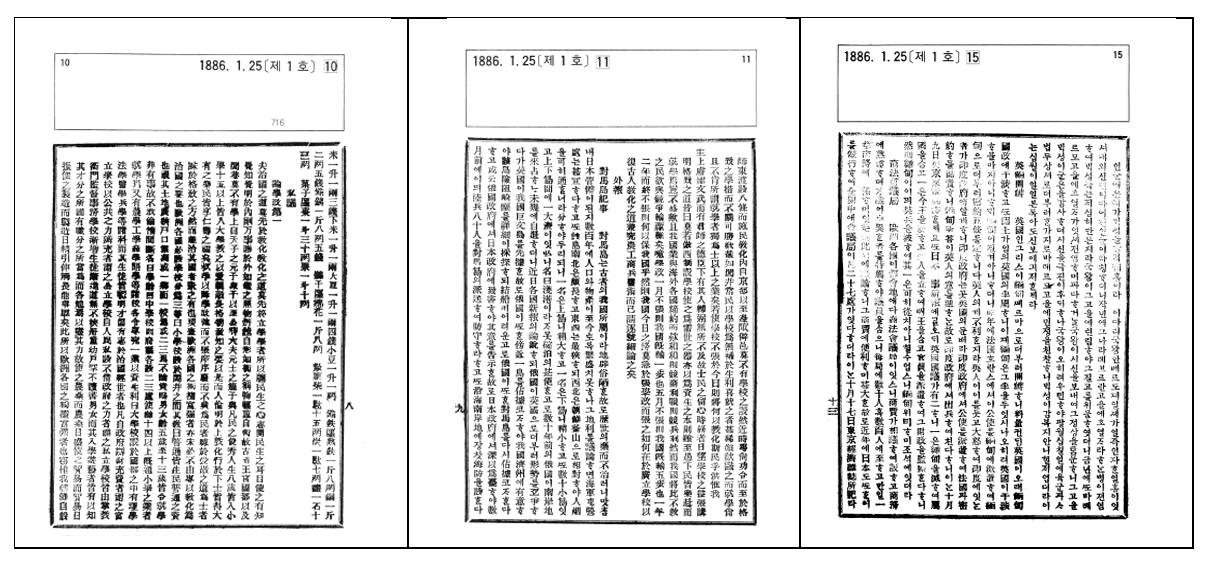
Figure 2
Tongnip sinmun, editorial, April 7, 1896.
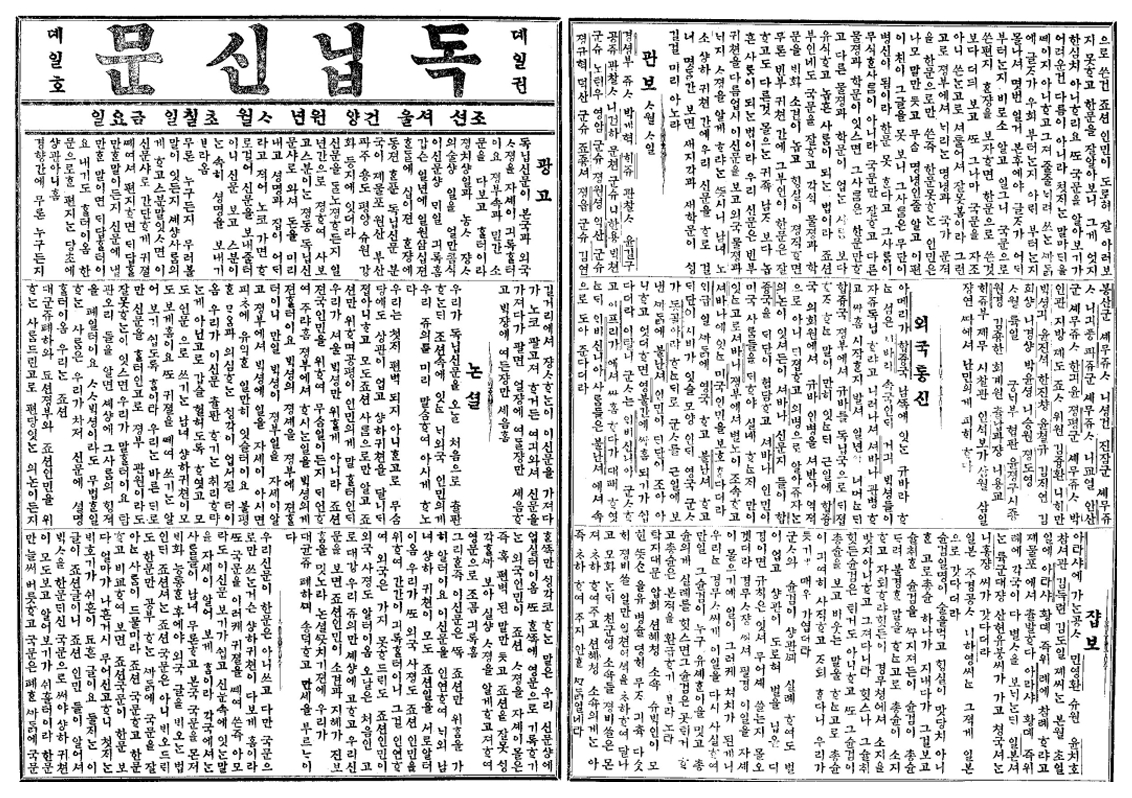
Figure 3
Kungmun Yŏn'gu Ŭijŏng'an 國文硏究議定案 “Draft Resolution on the Study of the National Script”, compiled by the 國文硏究所, 1909.
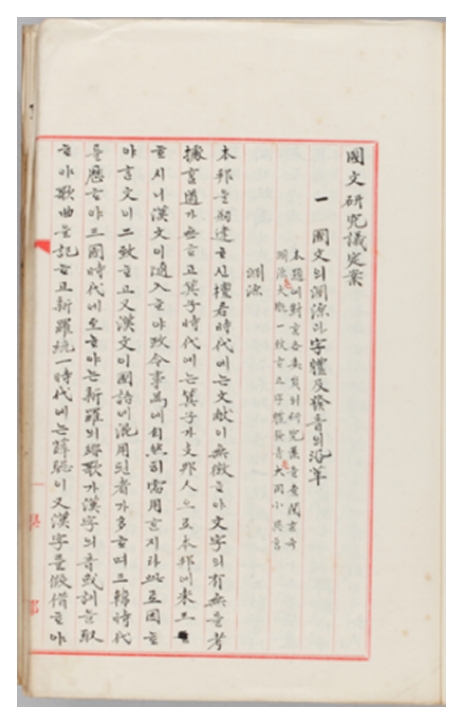
Figure 4Korean-language textbooks of the colonial period
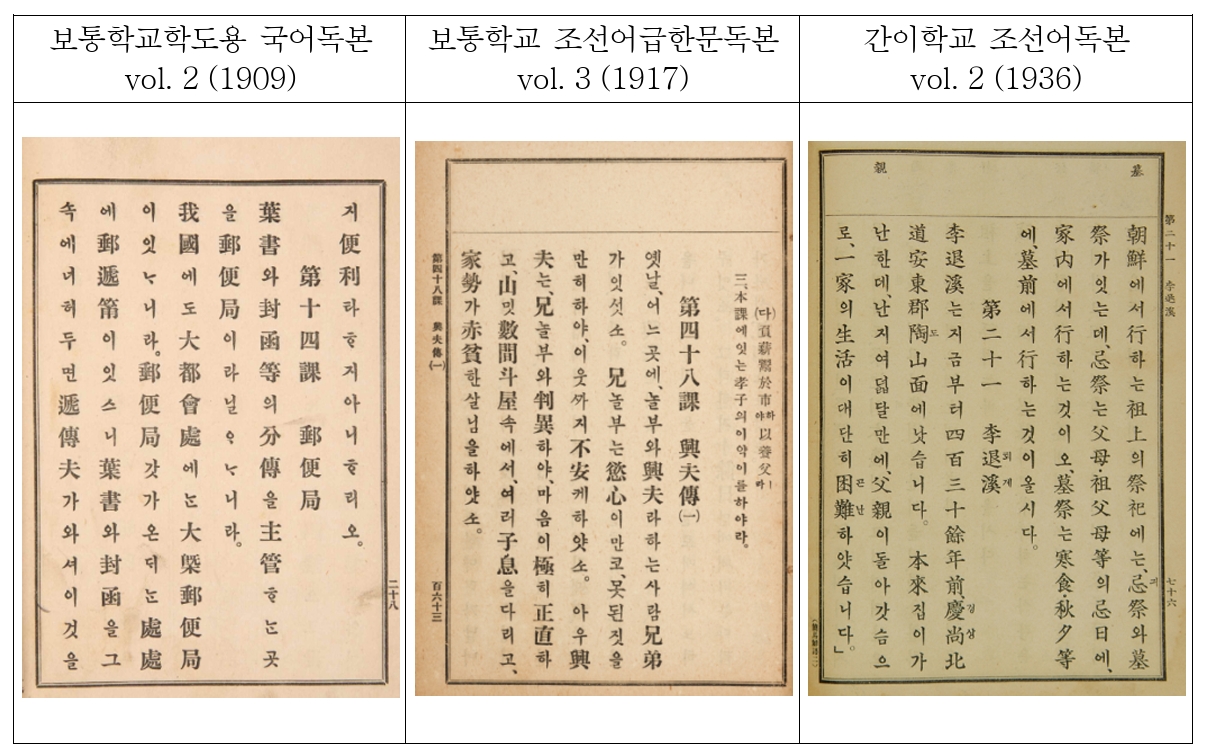
Figure 5
Sin Chosŏn po 新朝鮮報, December 20, 1945.
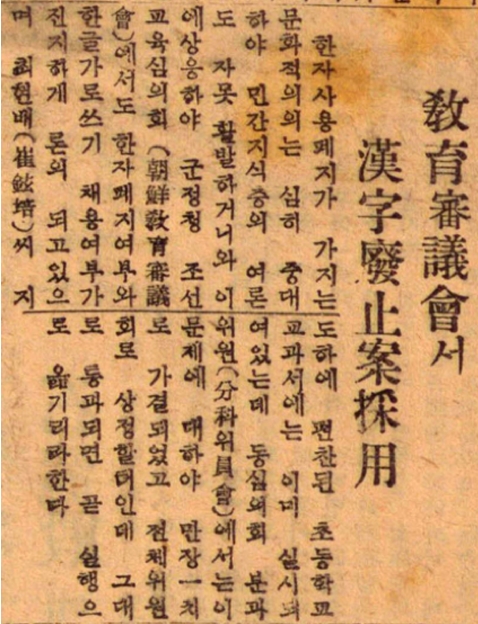
Figure 6
漢字 안쓰기의 이론, Ministry of Education, Chosŏn Kyohak Tŏsŏ Co., August 6, 1948.
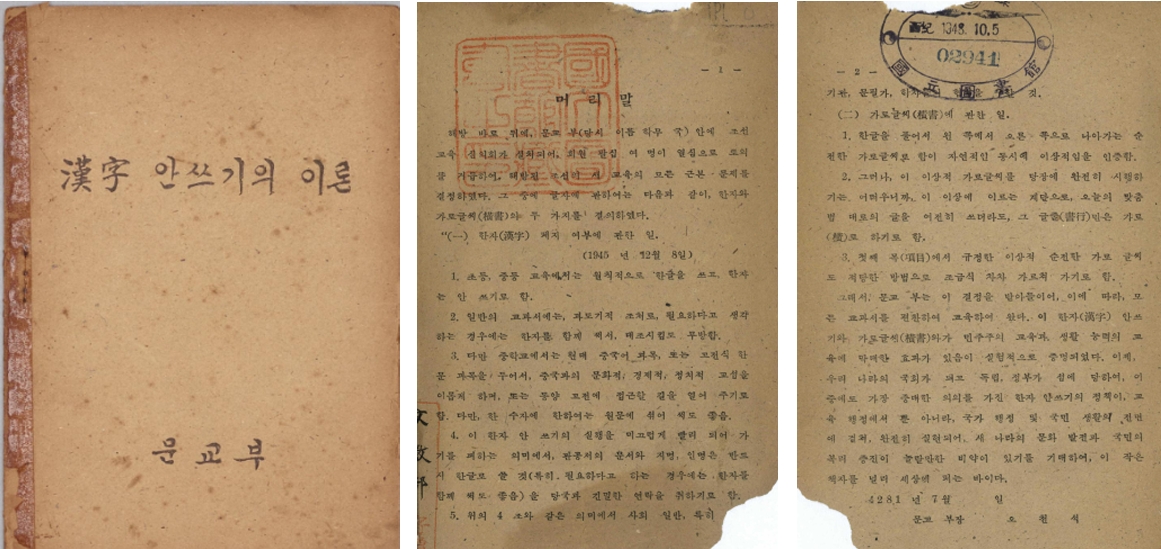
Figure 7Chŏng T’aejin, Hanja ansseugi munje.
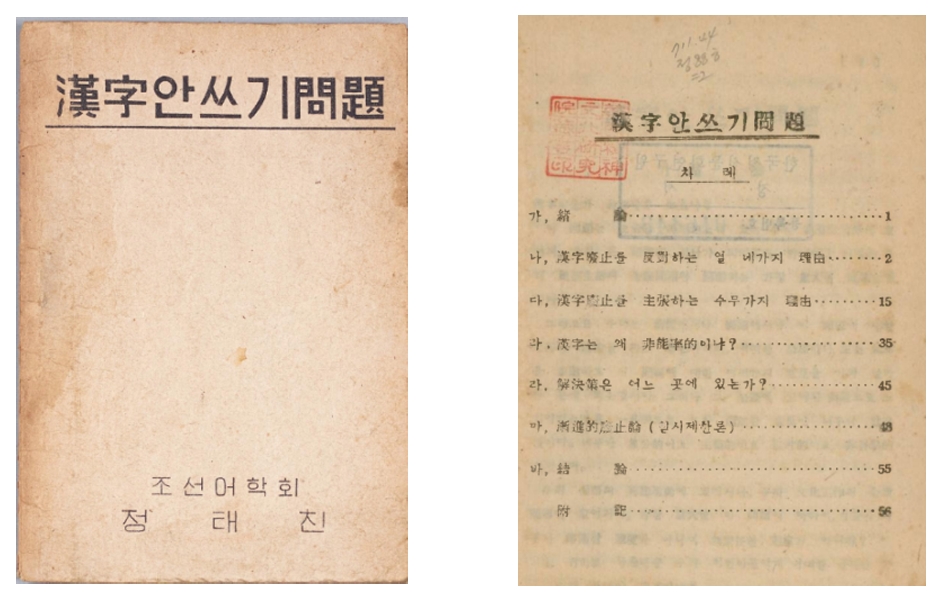
Figure 8Ch’oe Hyŏnbae, Kŭlcha ŭi hyŏngmyŏng.
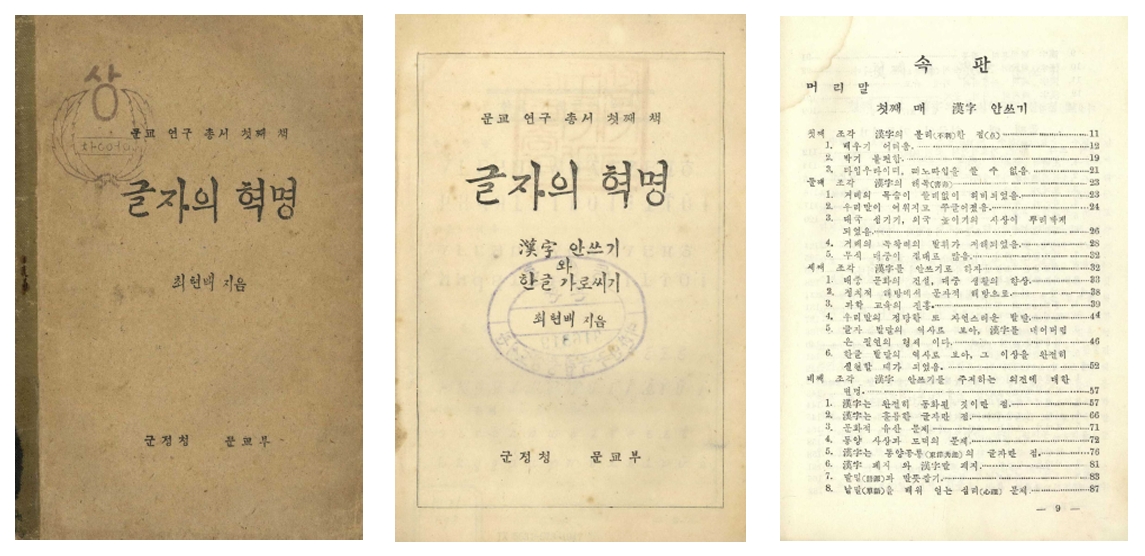
Figure 9『漢字안쓰기問題』 and 『漢字 안쓰기의 이론』
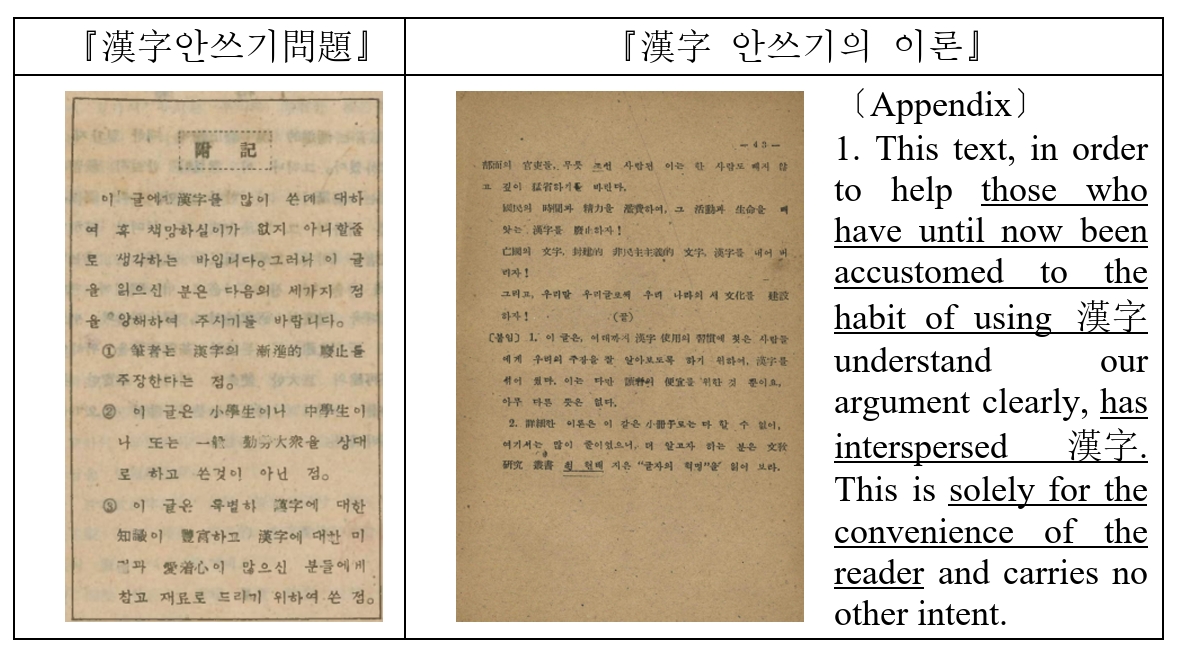
Figure 10
Chayu sinmun 自由新聞, November 6, 1949.
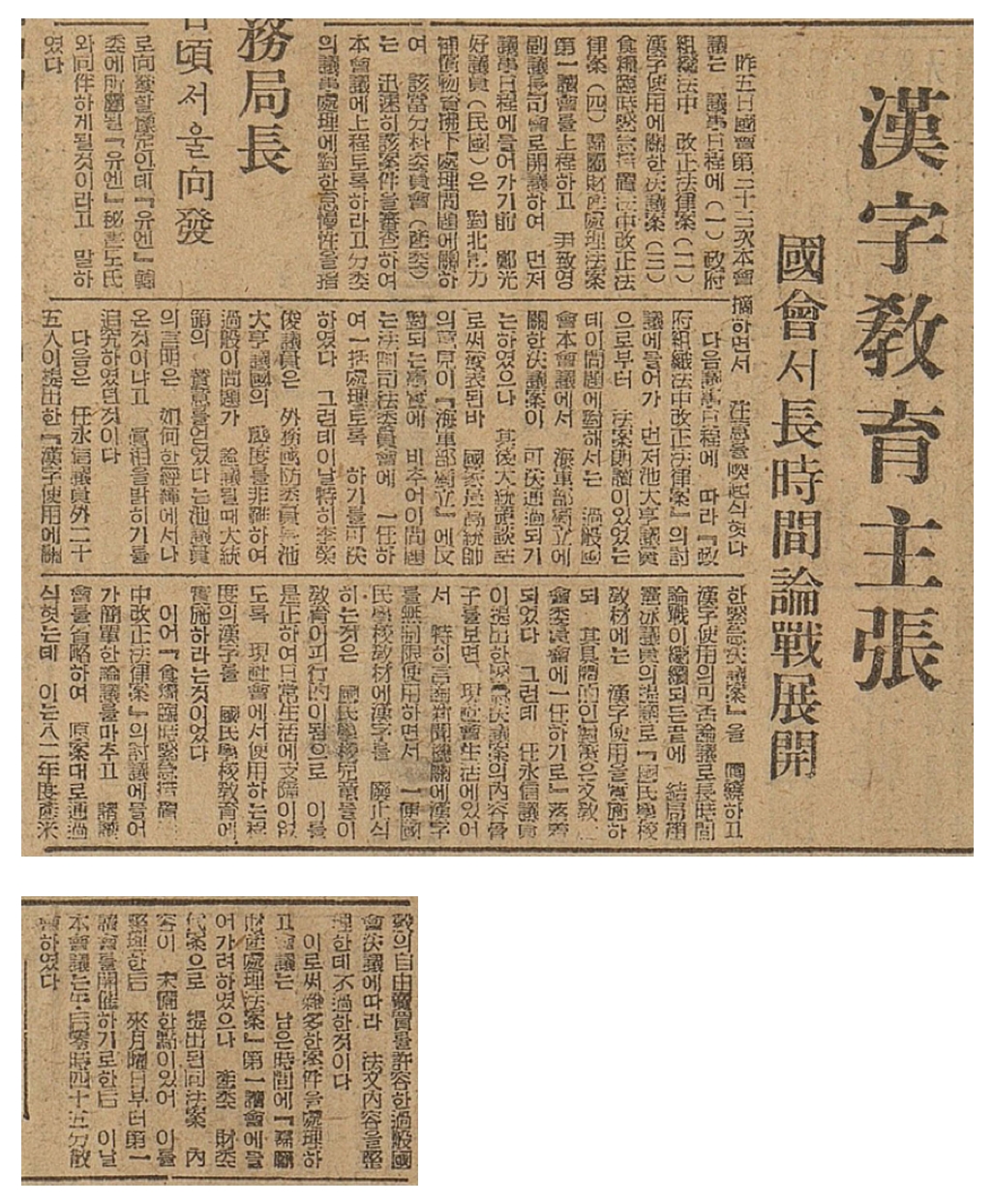
Figure 11
Masan ilbo 馬山日報, September 24, 1964.
|
1945 |
Decision to abolish Hanja |
|
1948 |
Promulgation of the ‘Act on the Exclusive Use of Han’gŭl’ |
|
1949 |
Combined use of Hanja permitted |
|
1950 |
Selection of 1,200 commonly used Hanja and 1,000 educational Hanja; implementation of mixed Hanja use |
|
1951 |
Survey of the frequency of vocabulary used in native Korean words and Sino-Korean words |
|
1952 |
Parallel notation, in parentheses, of 1,000 educational Hanja in Korean-language textbooks for the fourth grade of elementary school and above |
|
1953 |
Revision of orthography |
|
1954 |
Presidential directive for the exclusive use of Han’gŭl |
|
1955 |
Announcement of the ‘Act on the Exclusive Use of Han’gŭl’; establishment of Hanja education in middle schools |
|
1956 |
Parallel Hanja notation in elementary-school textbooks |
|
1957 |
Announcement of 1,300 commonly used Hanja; announcement of the ‘Guidelines for Implementing the Exclusive Use of Han’gŭl’ |
|
1958 |
Ministry of Education directive for the exclusive use of Han’gŭl in various documents, signboards, official seals, and the like |
|
1961 |
Directive for the exclusive use of Han’gŭl |
|
1962 |
Announcement of the first volume of the ‘Draft for the Exclusive Use of Han’gŭl’ |
|
1964 |
Decision to teach commonly used Hanja in elementary, middle, and high schools |
|
1968 |
Announcement of the Five-Year Plan for the Exclusive Use of Han’gŭl; abolition of commonly used Hanja and of Hanja in textbooks |
|
1970 |
Promulgation of the ‘Act on the Exclusive Use of Han’gŭl’; reorganization into exclusive-Han’gŭl textbooks |
|
1971 |
Designation of ‘Literary Sinitic’ as a required subject in middle and high schools |
|
1972 |
Operation of ‘Literary Sinitic’ as an independent subject; establishment of 1,800 basic Hanja for Literary Sinitic education |
|
1975 |
Parallel Hanja notation, in parentheses, within the range of the basic Hanja for Literary Sinitic education in middle- and high-school textbooks |
|
1984 |
Finalization of the unified plan for Korean grammar; establishment of the National Language Research Institute |
|
1986 |
Promulgation of the ‘Rules for the Transcription of Loanwords’ |
|
1988 |
Promulgation of the ‘Han’gŭl Orthography’ and the ‘Standard Language Regulations’ |
|
1989 |
Enforcement of the revised language and script regulations |
|
2014 |
The Ministry of Education announced that it was reviewing an expansion of the parallel notation of Hanja in textbooks. |
|
2016 |
The Ministry of Education announced the Standards for Hanja Notation in Elementary-School Textbooks (Ch’odŭng kyogwasŏ Hanja pyogi kijun 초등 교과서 한자 표기 기준). |
|
2017 |
The Ministry of Education did not include the 300 basic Hanja for elementary-school students in the editorial reference materials for textbook development. |
|
2020 |
A partial amendment bill to the Elementary and Secondary Education Act was proposed but later discarded. |
|
2026 |
The National Education Commission established the ‘Special Committee on Literacy.’ |
Reference List
- Ch’oe, Kwan-jin. ““Ŏmun chŏngch’aek kwa Hanmun kyoyuk chŏngch’aek ŭi pyŏnch’ŏn yŏn’gu: kaehwagi but’ŏ Ilche amukki kkaji” 어문 정책과 한문교육정책의 변천 연구 - 개화기부터 일제 암흑기까지 - [A Study of Changes in Language and Script Policy and Literary Sinitic Education Policy: From the Enlightenment Period to the Dark Period of Japanese Colonial Rule].” Ch’ŏngnam ŏmun kyoyuk 청람어문교육 26 (2003): 225-251.
- Chŏng, Chae-ch’ŏl. ““Han’guk ŭi muncha chŏngch’aek kwa Hanmun kyoyuk: Hanmun kwa Han’gŭl ŭi kyosŏp yangsang e chŭŭm hayŏ” 한국의 문자 정책과 한문교육―한문과 한글의 교섭 양상에 즈음하여 [Korea’s Script Policy and Literary Sinitic Education: With Reference to the Interaction between Literary Sinitic and Han’gŭl].” Hanmun kyoyuk yŏn’gu 한문교육연구 33 (2009): 21-50.
- Chŏng U-sang. “Hanmun-gwa kyoyuk chŏngch’aek kwa Hanmun kyoyugyong kich’o Hanja ŭi sŏnchŏng” 한문과 교육정책과 한문교육용 기초한자의 선정 [Educational Policy for the Literary Sinitic Subject and the Selection of Basic Hanja for Literary Sinitic Education]. Hanja Hanmun kyoyuk 한자한문교육, inaugural issue (1994): 65-80.
- Han’gukhak Tosŏgwan 한국학도서관 [The Academy of Korean Studies Library]. https://lib.aks.ac.kr/.
- Han’guksa Teit’abeisŭ 한국사데이터베이스 [Korean History Database]. http://db.history.go.kr.
- Hŏ, Chae-yŏng. ““Ŏmun chŏngch’aek mit ŏmun undong ŭi kaenyŏm kwa taesang” 어문 정책 및 어문 운동의 개념과 대상 [The Concept and Object of Language and Script Policy and Language and Script Movements].” Kyŏre ŏmunhak 겨레어문학 29 (2002): 201-223.
- Hŏ Man-gil 허만길. Hyŏndae ŭi kugŏ chŏngch’aek 현대의 국어 정책 [Modern Korean Language Policy]. Seoul: Kukhak Charyowŏn, 1994.
- Kich’o Hakmun Charyosent’ŏ 기초학문자료센터 [Korean Research Memory]. https://www.krm.or.kr/.
- Kim, Kyŏng-han. ““Kwangbok 40-nyŏn ŭi ŏmun chŏngch’aek ŭl chindan hae ponda: ‘chŏnyong’ ‘honyong’ non ŭl chungsim ŭro” 光復 40年의 語文政策을 診斷해 본다 - ‘전용’·‘混用’論을 中心으로 [Diagnosing Forty Years of Language and Script Policy since Liberation: Focusing on the Debate over Exclusive Use and Mixed Use].” Ŏmun yŏn’gu 語文硏究 16, no.3-4 (1988): 368-385.
- Kim, Sang-hong·Chŏng, U-sang·Yi, Tong-hwan·Sin, Yong-ho·Sim, Kyŏng-ho. ““Hanmun kyoyugyong kich’o Hanja 1,800-cha chojŏng e kwanhan yŏn’gu” 한문교육용 기초한자 1,800자 조정에 관한 연구 [A Study on the Adjustment of the 1,800 Basic Hanja for Literary Sinitic Education].” Hanmun kyoyuk yŏn’gu 한문교육연구 14 (2000): 125-193.
- Kim, Sang-hong·Chŏng, U-sang·Yi, Tong-hwan·Sin, Yong-ho·Sim, Kyŏng-ho. “———. “Han’guk ŭi Hanmun kyoyugyong kich’o Hanja pyŏnch’ŏn ko” 한국의 한문교육용 기초한자 변천 고 [A Study of Changes in the Basic Hanja for Literary Sinitic Education in Korea].” Hanmun kyoyuk yŏn’gu 한문교육연구 21 (2003): 187-237.
- Kim, Wang-gyu. ““Hanmun, kukka ŏmun chŏngch’aek e kir ŭl mutta” 漢文, 국가 語文 政策에 길을 묻다 [Literary Sinitic Asks National Language and Script Policy for Its Direction].” Tongyang Hanmunhak yŏn’gu 동양한문학연구 37 (2013): 33-47.
- Kim Yŏng-ok. “Hanmun kyoyugyong kich’o Hanja chahyŏng p’yojunhwa yŏn’gu” 한문교육용 기초한자 자형 표준화 연구 [A Study on the Standardization of Character Forms in the Basic Hanja for Literary Sinitic Education]. Ph.D. thesis, Korea University, 2012.
- Kim, Yŏng-ok. ““Hanmun kyoyugyong kich’o Hanja chejŏng kwajŏng e taehan sajŏk koch’al” <한문교육용 기초한자> 제정 과정에 대한 史的 고찰 [A Historical Study of the Process of Establishing the Basic Hanja for Literary Sinitic Education].” Hanmun kyoyuk yŏn’gu 한문교육연구 40 (2013): 211-245.
- Kim, Yŏng-ok. ““Ŏmun chŏngch’aek e ttarŭn Hanja kyoyuk chŏngch’aek pyŏnch’ŏn kwajŏng yŏn’gu” 어문 정책에 따른 漢字敎育 정책 변천 과정 연구 [A Study of the Process of Changes in Hanja Education Policy according to Language and Script Policy].” Tong’a hanhak yŏn’gu 동아한학연구 18 (2024): 139-168.
- Koryŏ Taehakkyo Haeoe Han’gukhak Charyosent’ŏ 고려대학교 해외한국학자료센터. http://kostma.korea.ac.kr/.
- Kukka Kirogwŏn 국가기록원 [National Archives of Korea]. https://www.archives.go.kr.
- Kukka Pŏmnyŏng Chŏngbo Sent’ŏ 국가법령정보센터 [Korea Law Information Center]. https://www.law.go.kr.
- Kungnip Chungang Tosŏgwan Kosinmun 국립중앙도서관 고신문 [National Library of Korea Old Newspapers]. https://nl.go.kr/newspaper.
- Kungnip Han’gŭl Pangmulgwan Ak’aibŭ 국립한글박물관 아카이브 [National Hangeul Museum Archive]. https://archives.hangeul.go.kr.
- Kungnip Kugŏ Yŏn’guwŏn 국립국어연구원. 21-segi kugŏ chŏngch’aek 21세기 국어 정책 [Korean Language Policy for the Twenty-First Century]. Seoul: Kungnip Kugŏ Yŏn’guwŏn, 2000.
- Kyoyuk Injŏk Chawŏnbu 교육인적자원부. Hanmun kyoyugyong kich’o Hanja 1,800-cha chojŏng paeksŏ 한문교육용 기초한자 1,800자 조정 백서 [White Paper on the Adjustment of the 1,800 Basic Hanja for Literary Sinitic Education]. 2000.
- Min, Hyŏn-sik. ““Kungnae kugŏ kyoyuk chŏngch’aek ŭi pansŏng kwa chŏnmang” 국내 국어 교육 정책의 반성과 전망 [Reflections on and Prospects for Korean Language Education Policy in Korea].” Kugŏ kyoyukhak yŏn’gu 국어교육학연구 36 (2009): 5-40.
- Ousan, Kŏsa 藕山居士. ““Nonsŏl (chŏnho sok)” 論說(前號續) [Editorial, Continued from Previous Issue].” Taedong Hakhoe wŏlbo 대동학회월보 5 (1908): 1-8.
- Pak, Kwang-min. ““Han’gŭl chŏnyong chungsim ŭi ŏmun chŏngch’aek yaksa” 한글전용 중심의 語文政策 略史 [A Brief History of Language and Script Policy Centered on the Exclusive Use of Han’gŭl].” Ŏmun kyoyuk 語文敎育 26, no.3 (1998): 221-231.
- Yi Ton-sŏk. “Kŭndae ihu ŏmun chŏngch’aek kwa Hanmun kyoyuk e kwanhan yŏn’gu” 「近代 以後 語文政策과 漢文敎育에 關한 硏究」 [A Study of Language and Script Policy and Literary Sinitic Education since the Modern Period]. Ph.D. thesis, Sungkyunkwan University, 2010.
- Yun Yŏ-t’ak et al. Han’guk kŭnhyŏndae minjok ŏmun kyoyuk kich’o yŏn’gu 3 한국 근현대 민족어문교육 기초 연구 3 [Basic Research on Modern and Contemporary National Language and Script Education 3]. Research report. Kich’o Hakmun Charyosent’ŏ, 2005.
- Yun Yŏ-t’ak 윤여탁. Kugŏ kyoyuk 100-nyŏnsa 2 국어교육 100년사 2 [A One-Hundred-Year History of Korean Language Education, vol. 2]. Seoul: Seoul National University Press, 2006.


 News
News