Abstract
-
This article examines the formation, transformation, and institutionalization of war memory in Chosŏn Korea through the case of Cho Hŏn (1544–1592) and the Tomb of the Seven Hundred Righteous Martyrs (Ŭich’ong 義塚). While contemporary evaluations of Cho Hŏn 朝憲, the righteous armies (Ŭibyŏng 義兵), and their actions during the Imjin War (1592–1598) were far from uniform, the earliest official account—Yun Kŭn-su 尹根壽’s inscription on the Sunŭibi 殉義碑 (1603)—selected and reorganized particular memories while excluding others. By framing Cho Hŏn and the seven hundred martyrs as embodiments of chŏlŭi 節義 (resolute loyalty unto death), this inscription exerted decisive influence on the subsequent shaping of collective memory.
Rather than adjudicating historical accuracy or military effectiveness, this study focuses on how divergent memories were transformed into authoritative records through commemorative media such as steles, ritual sites, didactic compilations, and state-sponsored rites. Special attention is given to An Pang-jun 安邦俊’s Hangŭi sinp’yŏn 抗義新編 and its illustrated woodblock prints, as well as the compilation of the Tongguk sinsok samgang haengsildo 東國新續三綱行實圖 under King Kwanghaegun 光海君, which visually and textually codified righteous martyrdom as a moral foundation for postwar reconstruction. The article further traces how these selectively reconstructed memories were reinforced through honorific commendations, local ritual practices, and repeated acts of royal recognition, extending into the modern period through state-led heritage restoration.
By situating the Ŭich’ong and the Sunŭibi within a long continuum of remembrance, this study argues that war memory in Chosŏn Korea was neither static nor consensual but actively produced through processes of selection, exclusion, and reconfiguration. Monuments and records functioned not merely as reflections of the past but as instruments that shaped shared perceptions of loyalty, righteousness, and national reconstruction. In highlighting these dynamics, the article underscores the critical role of commemorative practices in transforming fragmented experiences of war into enduring collective memory.
-
Keywords: Cho Hŏn, Ŭich’ong (Tomb of the Seven Hundred Righteous Martyrs), Sunŭibi, Imjin War, righteous armies (ŭibyŏng), war memory, collective memory, commemoration, stele inscriptions, Hangŭi sinp’yŏn, Tongguk sinsok samgang haengsilto
Introduction: King Yŏngjo and the Ŭich’ong
June 18, 1734 (lunar calendar; all dates in this paper follow the lunar calendar unless otherwise indicated), during a Kyŏngyŏn 經筵 (Royal Lecture), after reading the Chunqiu zuozhuan 春秋左傳(Zuo Tradition), King Yŏngjo 英祖 (1694–1776) remarked:
I recently read the
Hangŭi sinp’yŏn 抗義新編 (New Compilation on Righteous Resistance) by Yi Chŏng-gwi 李廷龜 (1564–1635). Cho Hŏn 朝憲 (1544–1592), though obscure and low in rank, raised volunteer forces and perished together with seven hundred righteous men. How noble and exalted! Ancient history honors Tian Heng 田橫 (?–292 BCE) and his five hundred followers, yet here seven hundred humble men responded to Cho Hŏn’s call and died as one, an even greater deed.
1
Following this statement, King Yŏngjo ordered officials to conduct memorial rites at the site where Cho Hŏn died and personally composed a ritual text for what would later be known as the Seven Hundred Righteous Tombs (Ch’ilbaek ŭich’ong 七百義塜, officially designated as The Tomb of Seven Hundred Patriotic Martyrs by the Cultural Heritage Administration of Korea).
The entry for the same date in the Sŭngjŏngwŏn ilgi 承政院日記 (Royal Secretariat Diaries) confirms the content of the lecture. According to this record, the passage under discussion was the account from the eighth year of Duke Zhuang of Lu 魯莊公, in which the Zuo Tradition records that the attendants Fei 費, Fenru 紛如, and Mengyang 孟陽 fought and died while protecting Duke Xiang of Qi 齊襄公. These men, though of humble status, became remembered as exemplars of loyalty and righteousness. King Yŏngjo then added:
Such examples are enough to shame those of later ages who harbor divided hearts. Today’s passage has stirred deep emotion in me. Rather than feeling moved by figures from ancient Chinese history, should we not instead admire and revere the loyal subjects of our own court?
2
The following section in the Yŏngjo sillok 英祖實錄 (Veritable Records of King Yŏngjo) continues the episode concerning Cho Hŏn and the Ŭich’ong. Responding to the king’s interest, Chŏng Ŏn-sŏ reported:
At the site of the defeat in Kŭmsan 錦山, the remains of the seven hundred righteous men were gathered and buried together in a single great mound, beside which a
Sunŭibi 殉義碑 (Monument to the Martyred for Righteousness) was erected. A
sŏwŏn 書院 (memorial academy) stands in Okch’ŏn 玉川, and the accounts of their deeds are recorded in detail in the
haengjang 行狀 (Funeral Record) written by Song Si-yŏl 宋時烈 (1607–1689).
3
Today, in Kŭmsan County, Chungcheongnam-do, South Korea, the site known as the
Ŭich’ong remains as a memorial to the seven hundred soldiers who fought against the Japanese forces during the Imjin War (1592) and died in battle with unwavering loyalty. Cho Hŏn raised more than 1,700 volunteer troops in Okch’ŏn and, joining forces with Yŏnggyu 靈圭 (?-1592), a Buddhist monk who led a righteous army, succeeded in recapturing Ch’ŏngju. He then fought at Kŭmsan with seven hundred remaining soldiers, resisting the Japanese army until they all perished heroically. After their deaths, Cho’s disciples Pak Chŏng-nyang and Chŏn Sŭng-ŏp gathered the bodies and buried them together, which became the Seven Hundred Righteous Tombs
.
On August 18, 1592, Cho Hŏn and his followers fell in battle. In 1593, Cho’s disciples and the local people of Kŭmsan gathered the remains of the seven hundred fallen soldiers and built the Ŭich’ong. Ŭich’ong means “a tomb erected by others for those without family ties,” in this case, a burial mound created for the abandoned bodies of war dead, thus becoming a tomb of the righteous.
This raises the question of why did King Yŏngjo revive the memory of Cho Hŏn and the seven hundred righteous men more than 150 years after their deaths? As noted earlier, the immediate catalyst was his reading of the Hangŭi sinp’yŏn, published in 1613, during the reign of King Kwanghaegun 光海君. Although Yŏngjo attributed the work to Yi Chŏng-gwi, Yi in fact wrote only the preface; the person who compiled the text was An Pang-jun 安邦俊 (1573–1654). As will be examined later, the memory of Cho Hŏn and the seven hundred righteous men circulated in multiple literary forms, including prose, epitaphs, ritual texts, and various commemorative inscriptions carved into stone. Among these were the Sunŭibi, the Myŏjŏngbi 廟庭碑 (Shrine Courtyard Stele), and the Shindobi 神道碑 (Spirit-Path Stele). Yŏngjo’s recollection was shaped by the accumulation of such written records. In 1772, on the occasion of the three chugap 三周甲 (180th anniversary of their deaths), the king dispatched officials to conduct large-scale, state-sponsored rites, thus formally reviving and institutionalizing their memory at the level of collective commemoration.
This study examines how Cho Hŏn and the seven hundred righteous men have been remembered and recorded, by whom, and through what mechanisms of textual and commemorative practice. It further explores how these modes of remembrance have transformed over time and what such changes reveal about shifting cultural and ideological frameworks in Chosŏn society.
Previous scholarship has long addressed Cho Hŏn’s
ŭibyŏng activities and the Battle of Kŭmsan
5, ranging from comprehensive assessments of the impact of the Imjin War on Chosŏn society
6 to studies that foreground memory and record as critical interpretive frameworks.
7 Among this body of research, the works most relevant to the present study are those that trace the historical evolution of perceptions surrounding Cho Hŏn and the
ŭibyŏng.
8 In addition, research related to the compilation of the
Tongguk sinsok samgang haengsilto 東國新續三綱行實圖 has been used as supporting material,
9 particularly in understanding how institutional, didactic, and commemorative discourses contributed to the formation and transmission of their legacy.
The First Record: The Inscription on the Sunŭibi
In 1603, the local community erected the Sunŭibi and inscribed upon it an inscription composed by Yun Kŭn-su 尹根壽 (1537–1616). This inscription constitutes the earliest official written record documenting the deeds of Cho Hŏn and the seven hundred righteous men. The main contents of the inscription may be summarized as follows:
1. Site of Martyrdom for Cho Hŏn and the ŭibyŏng (righteous army)
2. Outbreak of the Japanese Invasions and the Initiation of the ŭibyŏng
3. Recapture of Ch’ŏngju and Frictions with Government Troops
4. Battle of Kŭmsan and Martyrdom
5. Contemporary Responses and Later Commentaries on the Martyrdom
6. Cho Hŏn’s Deeds and Character in Peacetime
7. Representative Biographies among the Seven Hundred Righteous Men
8. Erection of the Sunŭibi and the Circumstances of Its Inscription
9. Poems
The inscription follows the conventional structure of a stele text and records events in chronological order. Yet it reads with striking tension and narrative engagement. This effect derives from the subtle but persistent presence of conflict throughout the text.
In the latter half of the second paragraph, which describes the initiation of the
ŭibyŏng, the inscription states that during the process of raising the
ŭibyŏng, the
sunch’alsa 巡察使 (provincial inspector) and local commanders persistently obstructed Cho Hŏn’s efforts.
10 At this stage, the narrative does not elaborate on the conflict but merely signals it, functioning as a subtle foreshadowing that hints at tensions yet to unfold. In the third paragraph, which recounts the Recapture of Ch’ŏngju, such tensions become far more explicit, emerging under the theme of frictions with government troops.
After the victory at Ch’ŏngju, it was the provincial military inspector, the leader of the government forces, who proposed attacking the Japanese at Kŭmsan.
11 Although this proposal ostensibly involved Cho Hŏn’s comrades, the narrative reveals that the government troops ultimately impeded the actions of the
ŭibyŏng, causing the volunteer forces to become scattered and leaving only about seven hundred men.
12
Through such narrative framing, the inscription subtly suggests that although Cho Hŏn and the ŭibyŏng achieved success in the Battle of Ch’ŏngju, their eventual defeat and death at Kŭmsan were caused, at least in part, by the interference of government officials and troops.
Another factor that prevents the narrative from becoming repetitive is the vivid characterization of Cho Hŏn in the second through fourth paragraphs. In the second paragraph, the inscription conveys his resolute temperament with phrases such as “he rose alone, rolling up his sleeves, and, with blood welling in his throat, circulated proclamations to rally support” 獨投袂而起,沫血移檄. Likewise, in the third paragraph, Cho is depicted as a commander who “personally braved arrows and stones and urged the troops throughout the entire day of battle” 親冒矢石, 竟日督戰emphasizing both his courage and his willingness to lead from the front.
Furthermore, when the fourth paragraph recounts the events leading to martyrdom, the inscription preserves key utterances in Cho’s own voice. When these statements are read together, it becomes evident that Yun Kŭn-su sought to highlight dimensions of Cho’s character not through detached evaluation or argumentative exposition, but through a narrative mode that allows Cho to reveal himself. In this way, the stele employs narrative rather than discursive rhetoric to elevate Cho’s moral presence and to frame his martyrdom as an embodiment of unwavering loyalty and righteous conviction.
The power of this narrative method is most visible in moments where the inscription directly preserves Cho Hŏn’s voice. The text records three key statements attributed to him, each situated at a decisive stage of the campaign:
① Cho Hŏn wept and swore: “How can one speak of advantage or disadvantage when our sovereign is in peril? When the king suffers humiliation, his subjects must give their lives. I know only death, nothing else.”
② He ordered his troops: “Today there is only death before us. In life or in death, in advance or retreat, let there be no shame before righteousness (ŭi 義).”
③ He said with a smile: “For a true man, there is only death. In times of chaos, one cannot cling to life in disgrace.”
The first statement appears in response to a subordinate’s recommendation that the army should halt its advance and await instructions from the court, given the scale of the enemy forces and the unfavorable circumstances.
13 The second statement is recorded when the enemy, having discovered the isolation of Cho’s forces, launched repeated assaults; the third comes after prolonged fighting, when the Japanese closed in as the
ŭibyŏng exhausted their arrows and a soldier urged Cho to withdraw for safety.
14
Whether these decisions were militarily sound is difficult to determine with certainty, but it is evident that Cho was neither a strategist nor a tactician in the conventional sense. From the moment he first raised the ŭibyŏng, Cho framed his campaign as one undertaken with death already assumed, and his own words lay bare the extent of that disposition. Yun Kŭn-su’s aim in presenting these utterances was similarly not to evaluate tactical judgment or assess military outcomes, but rather to foreground the moral stance embodied in Cho’s actions.
In the fifth paragraph, Yun explicitly evaluates Cho, asking rhetorically: “Did he not arise solely from righteousness (
ŭi), stand against powerful enemies with only a small force, and die without regret? How could he be anything other than a man of burning spirit?” To heighten this assessment, Yun invokes two contrasting conditions: first, that Cho was a civil official, not a military officer, and therefore not obligated to take to the battlefield; and second, that even had he halted his advance, assessed the situation, and awaited royal commands, no one could have faulted him.
15
Through such contrasts and rhetorical emphasis, Yun articulates the core moral argument of the inscription: the ideal of “discarding life and upholding righteousness” (sasaeng ch’ŭiŭi 捨生取義). What Yun sought to foreground, both in narrative structure and in evaluative discourse, was not military logic but the enactment of unwavering moral principle. Within this framework, Cho Hŏn emerges as an uncompromising figure—a “steadfast man of fiery integrity”—whose life, actions, and death constitute an exemplary performance of chŏlŭi 節義, the Confucian ideal of resolute loyalty carried to its ultimate conclusion.
Other Memories, Other Records
In this respect, most extant accounts appear to share the assessment of Cho Hŏn’s character, identifying “uncompromising frank remonstrance and action” and a “righteous spirit indifferent to surrounding circumstances” as defining traits. It is important to recall, however, that prior to being framed through the exceptional event of
sunjŏl 殉節 (martyrdom), such traits were not always evaluated in an unequivocally positive light. According to Kim Sang-hŏn 金尙憲 (1570-1652)’s recollection, Yi I 李珥 (1536-1584) once remarked of Cho Hŏn: “He insists, time and again, on restoring the governance of the age of
Yao and Shun 堯舜; in the end, he will surely provoke disorder.”
16 A passage by Yi Chŏng-gwi, composed not long after Cho Hŏn’s lifetime, further illuminates this ambivalence embedded in assessments of his character. Yi offers a sharply etched portrayal that captures both the virtues and liabilities of Cho’s moral disposition:
Cho Hŏn was excessively obstinate and uncompromisingly pure in conduct. When confronted with a righteous cause, he would rush forward as if possessed, and when he encountered the faults of others, he loathed them as one would recoil from filth. Thus, if a single word or action struck him as improper, he would rebuke even high-ranking officials openly at court, scolding them without restraint as though they were servants or dogs. Even in audiences before the throne, when he spoke candidly with the king and disputed matters of right and wrong, he would not relent unless his position prevailed. He never showed the slightest leniency toward others. That he was consequently exiled, suffered hardship, and failed to find acceptance in the world can hardly be regarded as surprising. Yet had his temperament not been such as this, how could he ever have achieved accomplishments of that magnitude?
17
獨其執太固守太潔 奔義如狂 見人過若浼 一言不是 則雖公卿大臣 廷叱之如奴狗 立玉陛前 與人主抉腎腸爭是非 不得則不已 未嘗以毫髮恕人 宜其流竄困厄 不容於世也 然不如是 焉能成就此哉
Moreover, Cho Hŏn’s conduct in times of peace was marked by a pronounced factional orientation. His assessment of the early defeats suffered by government forces during the war placed unequivocal responsibility on the Easterners 東人 in power, including Yu Sŏng-ryong 柳成龍, Yi San-hae 李山海, and Kim Kong-nyang 金公諒.
18 This stance was consistent with the factional position he had long upheld and put into practice, and his subsequent engagement in righteous army activities may be understood as a concrete extension of this perception. The following passage records King Sŏnjo’s edict concerning a memorial submitted by Cho Hŏn upon his release from exile and return home shortly before the outbreak of the Imjin War:
The perversity and insubordination of human hearts have reached this extreme. I have not yet read all of their memorials in detail, but what need is there to examine them closely? How could the minds of court officials remain at ease? A few among them submitted memorials in which they indiscriminately censured the entire body of court officials, while praising only a handful, beginning with the Right State Councillor Chŏng Ch’ŏl 鄭澈, and then styled this behavior as ‘frank remonstrance.’ In so doing, they only laid bare their true motives, which is laughable. Cho Hŏn is nothing but a treacherous schemer. He still knows no fear, holds the court in contempt, and acts with ever greater recklessness. That man will, in the future, once again cross Mount Mat’yŏn 磨天嶺.
19
Even allowing for the fact that the Sŏnjo sillok reflects a record compiled under the Northerners’ regime, the political heirs of the Easterners, during the reign of King Kwanghaegun, it is unlikely that King Sŏnjo’s characterization of Cho Hŏn as a “treacherous schemer” (kangwi 奸鬼) was a fabrication. Even if uttered in the heat of factional strife and occasioned by a momentary political confrontation, the remark nonetheless represents a judgment at the time voiced by a segment of the political elite. As the passage cited above suggests, the figure situated at the center of the conflict between the Easterners and Westerners was Chŏng Ch’ŏl; yet it was precisely Yi San-hae and Kim Kong-nyang, whom Cho Hŏn had castigated, who later took the lead in impeaching him. Because of this episode, the most prominent Westerner forced to withdraw from political life was none other than Yun Kŭn-su.
It is not difficult to infer that such factional considerations were implicated in the fact that Yun Kŭn-su became the author of the first official account of Cho Hŏn at a point not long after the Imjin War had been brought under control. This circumstance should, of course, serve as an important interpretive key in reading Yun’s inscription on the Sunŭibi. With this in mind, the discussion now turns to several sources that articulate memories distinct from those recorded in the Sunŭibi.
First, the personal recollection of Yun Kuk-hyŏng 尹國馨 (1543–1611; originally named Yun Sŏn’gak 尹先覺)—the
sunch’alsa identified in the
Sunŭibi as having been in conflict with Cho Hŏn—differs sharply from Yun Kŭn-su’s account. According to Yun Kuk-hyŏng’s own record, it was he who led the victory in the battle of Ch’ŏngju Fortress prior to the engagement at Kŭmsan, and initially selected Yŏnggyu, whose exploits were later celebrated, for a position of command.
20 Moreover, Yun Kuk-hyŏng attributes the defeat at Kŭmsan and the consequent loss of substantial forces to Cho Hŏn himself.
Around the tenth day of the eighth month, when Kwŏn Yul, then serving as
sunch’alsa of Chŏlla Province, was unable to defeat the enemy at Kŭmsan and sought to appoint Yŏnggyu as the vanguard commander, I consented to this proposal. Yŏnggyu led his troops forward and established camp at Yusŏng. Cho Hŏn had previously joined Yŏnggyu’s encampment with several hundred men during the battle of Ch’ŏngju Fortress and assisted him in combat. At this time, Cho repeatedly urged Yŏnggyu to proceed to Kŭmsan and engage the enemy. Yŏnggyu responded, saying, ‘Kwŏn Yul is preparing to advance with tens of thousands of troops and has requested that I serve as the vanguard, but the timing has not yet been fixed. We cannot act rashly.’ He therefore advised Cho Hŏn to make arrangements with Kwŏn Yul regarding the date. However, before any reply arrived from Kwŏn Yul, Cho Hŏn obstinately insisted that the enemy must be attacked without delay and, leading the troops under his own command, advanced first toward Kŭmsan. Yŏnggyu, though reluctant, followed after him. […] While Yŏnggyu was encamped in coordination with Cho Hŏn within five ri of Kŭmsan, the enemy forces surged in great numbers. Cho Hŏn’s camp fell first, and Yŏnggyu’s camp soon followed. In this battle, eight or nine out of every ten of our troops were killed, though the enemy also suffered many casualties. Had Cho Hŏn listened to Yŏnggyu’s words, how could such a defeat have occurred? How grievous—how grievous indeed! On the day following the defeat, one of Cho Hŏn’s officers came to me bearing Kwŏn Yul’s reply, which specified the date for the planned attack. By then, however, the moment had already passed, what was there left to say?
21
八月旬間 全羅巡察攻錦山不能拔 願得圭爲先鋒 余許之 圭率其兵 趨儒城陣焉 趙提督曾於初一再戰時 往赴圭陣 出兵數百人而助戰 知圭之可與有爲 追往儒城 與圭連營 督圭共入錦山 圭曰 全羅巡察將數萬兵 方謀進攻 請我爲先鋒 然時未定期 不可輕發 勸趙約日於權巡察 其報未回前 趙强執速討 領其軍先入 圭亦不得已從焉 […] 與趙連陣於錦之五里內 賊大至 趙陣先陷 而圭陣次沒 我軍死者什八九 賊亦多斃 使趙若聽圭說 豈有此敗 痛哉痛哉 軍敗翌日 趙之軍官 持權約日之書來示我 然事旣無及 言之奈何奈何
Since this account was written by Yun Kuk-hyŏng himself, who bore responsibility for the defeat, the possibility of a deliberate distortion of memory cannot be entirely ruled out. Nevertheless, the
Sŏnjo sujŏng sillok 宣祖修正實錄, which re-narrates the events with a focus on Cho Hŏn’s righteous army, likewise records that government troops such as those led by Yi Ok, the regional defense commander, and Hŏ Uk magistrate of Kongju participated alongside the militia.
22 This suggests that attempts by government forces to form a joint front with the righteous armies were indeed made at the time. By contrast, Yun Kŭn-su’s inscription on the
Sunŭibi presents a markedly different account: it describes the government troops under Yi Ok as having already been annihilated, after which Cho Hŏn, leading the righteous army, joined forces with Yŏnggyu’s monk-soldiers to retake Ch’ŏngju Fortress.
When set against Yun Kuk-hyŏng’s account, the first point that calls for attention is the perspective on the relationship between the righteous armies and the government troops. It is still commonly accepted today that righteous armies arose because government forces were ineffective during the Imjin War. As noted above, Yun Kŭn-su states in his inscription on the Sunŭibi that the righteous army was dispersed due to obstruction by the provincial inspector. Yun Kŭn-su also composed a spirit-path stele inscription for Ko Kyŏng-myŏng 高敬命 (1533-1592), a righteous army leader who perished together with Cho Hŏn; in that text as well, he forcefully articulates a negative view of the incompetence and cowardice of government troops and portrays the conflict between official forces and righteous armies as extremely severe. Even in the concluding passage, he invokes government troops as a means to heighten Ko Kyŏng-myŏng’s stature:
When military calamity arose in the state and Japanese forces continued to encroach upon the land, the provincial governor, struck by fear, shrank back, and the armed officials scattered and fled. By contrast, though the lord was a Confucian official who had returned to his native village and bore no formal responsibility for defending the realm, he alone raised troops, confronted a powerful enemy, roused a weak force to strike a formidable foe, and vowed to repay the state.
23
國有兵禍 蛇豕荐食 按臣退縮 武將奔潰 而乃以還里之儒臣 非有封疆城守之責 而提孤軍抗勍賊 奮弱批堅 誓以報國
But was this truly the case? Even when various records are considered together, it does appear that government troops in the early phase of the war were largely ineffective. Yet it would be misleading to compare those troops in terms of modern standing armies. While commanders such as provincial inspectors were dispatched from the central court, the bulk of the soldiers consisted of ordinary farmers who were mobilized only in times of war. Even this system faltered amid the urgency of invasion, as many commoners had already fled, making mobilization exceedingly difficult.
24 Moreover, when locally respected figures emerged as leaders of righteous armies, those who might otherwise have been conscripted into government forces instead joined the militias, so that the recruitment of righteous armies itself contributed in part to the weakening of official troops.
25 In addition, the king at times bestowed offices and ranks on righteous army leaders, creating militia forces that held status equivalent to government troops, and there were numerous instances in which government forces and righteous armies conducted joint operations. Depictions especially those from the standpoint of the righteous armies that either entirely disregard the role of government troops or portray them as actively obstructive must be examined critically as records shaped by partial and selective memory, whose factual accuracy requires scrutiny.
Accounts of the recruitment of righteous armies likewise do not fully align across sources. In the
Sunŭibi inscription, Yun Kŭn-su writes that, despite the provincial inspector’s opposition, those who admired Cho Hŏn’s sense of righteousness gathered from near and far. However, when related records are examined collectively, Cho Hŏn appears to have failed in all three recruitment attempts between May 3 and mid-June, and it was only on the fourth attempt that he managed to assemble a force. Furthermore, the third recruitment effort was carried out with the support of Yun Kuk-hyŏng, who himself, based on his own assessment of the situation, had at one point sought to form a joint front with the righteous army.
26
It is also necessary to recall that evaluations of righteous armies were not particularly high at the time. Cho Hŏn was posthumously enrolled in 1604 as a first-rank
Sŏnmu wŏnjong kongsin 宣武原從功臣, a designation that functioned as a supplementary measure for those not included among the primary Sŏnmu kongsin 宣武功臣.
27 King Sŏnjo reportedly remarked, “Aside from Yi Sun-sin, Wŏn Kyun, and Kwŏn Yul, there are virtually no commanders of our country whose merits are worth discussing.”
28 He thus made clear his view that the pacification of the war owed everything to the Ming forces that came to Korea’s aid, and that only those officials who accompanied him to Ŭiju and appealed directly to China, the
hojong 扈從 officials, were true meritorious subjects.
According to Yun Kuk-hyŏng’s record, Cho Hŏn could even be seen as having contributed to the cause of defeat. A passage by Pak Tong-nyang 朴東亮 (1569–1635) indicates that this memory was not Yun Kuk-hyŏng’s alone:
At dawn the next day, the enemy advanced first with their troops. At this time Yŏnggyu had more or less established his encampment, whereas Cho Hŏn’s forces stood exposed on open ground. When the enemy charged, the general shouted loudly and fought at close quarters with short weapons, and they slew one another fiercely. As enemy soldiers continued to arrive in ever greater numbers, Cho Hŏn’s troops briefly withdrew before finally moving into Yŏnggyu’s camp. The enemy pursued closely and took advantage of the moment to break in, and the troops fell into great disorder. Even then they fought barehanded, without the slightest loss of spirit. Before long, Cho Hŏn was killed by his own soldiers amid the confusion.
29
If so, even the position that views the deaths of Cho Hŏn, Ko Kyŏng-myŏng, and the seven hundred righteous martyrs as acts of righteous self-sacrifice may be unstable. This issue is addressed in the writings of Yi Hang-bok 李恒福 (1556-1618), one of the hojong officials:
People of the world call the deaths of Cho Hŏn and Ko Kyŏng-myŏng acts of
chŏlŭi. If it is said merely that they died for the royal house, that may be acceptable, but to praise them as
chŏlŭi goes too far. When the state fell into chaos, Cho Hŏn and others, mere scholars, rolled up their sleeves and hastily rose to gather righteous armies with the intent of preserving the royal house, and their loyalty and righteousness are indeed commendable. Yet at the battle of Kŭmsan, when the formations collapsed in the darkness and the enemy burst forth with drawn blades, the cramped terrain caused the troops to trample one another. Cho Hŏn was killed by his own soldiers amid the confusion, and Ko Kyŏng-myŏng fell in battle while so drunk that he could not even grasp his horse’s reins. That they did not flee when faced with defeat and ultimately died for the royal house deserves recognition, but to call this
chŏlŭi is unacceptable.
30
This account stands in stark contrast to the solemn depiction in Yun Kŭn-su’s Sunŭibi inscription, which describes Cho Hŏn beating a war drum to spur his men on, while the soldiers, resolved to die, engaged in close combat without breaking formation and ultimately perished together with him. Yun Kŭn-su, like Yi Hang-bok and Pak Tong-nyang, also belonged to the group of hojong officials, and it is unlikely that he would have been unaware of the reports summarized above. That he nevertheless chose to narrate the events in this manner suggests a strong likelihood of deliberate omission and reshaping. For Yun Kŭn-su, negative assessments of Cho Hŏn’s prior conduct, his obstinacy during militia activities, or shortcomings in the conduct of battle were not elements he regarded as central to the purpose of his inscription. Instead, by reconstructing the heroic martyrdom of a Western faction righteous martyr as a shared memory, Yun Kŭn-su foregrounded and maximized the dimension of chŏlŭi.
The aim of this study, in comparing Yun Kŭn-su’s inscription with other records and examining his factional alignment and authorial intent, is not to prove factual distortion or to determine what the historical truth ultimately was. Rather, it is to assess the position and function of Yun Kŭn-su’s Sunŭibi inscription, as the earliest record, in the process by which the deaths of Cho Hŏn and the seven hundred righteous martyrs were transformed into diverse individual and collective memories.
The Formation of Memory and the Transformation of Records
Contemporary evaluations of Cho Hŏn, the seven hundred righteous martyrs, and the righteous armies were thus far from uniform. Yet among these divergent memories, Yun Kŭn-su’s inscription on the Sunŭibi, the earliest official record, selected and foregrounded certain recollections while excluding others. Even the value of chŏlŭi that Yun ascribed to Cho Hŏn and the seven hundred martyrs was not one that enjoyed universal acceptance at the time. Nevertheless, precisely because it was not only the first official record but also one carved in stone and erected on site with the intention of permanent preservation, Yun Kŭn-su’s inscription exerted extraordinary influence. By naming the burial site of Cho Hŏn and the seven hundred martyrs an ŭich’ong and by erecting there a stele explicitly commemorating “those who sacrificed their lives for righteousness,” the Sunŭibi gradually caused a single, selective memory to be perceived as the sole and universal one, thereby shaping a collective memory shared by later generations.
The erection of the Sunŭibi at the ŭich’ong and the posthumous enshrinement of Cho Hŏn as a Sŏnmu wŏnjong kongsin took place in 1603 and 1604, during the reign of King Sŏnjo. Yet it was not until the reign of King Kwanghaegun that active reassessment and commemoration of Cho Hŏn and other righteous army leaders truly gained momentum. The most representative record of this period is An Pang-jun’s Hangŭi sinp’yŏn, later read and singled out by King Yŏngjo:
My friend An Pang-jun is a man devoted to righteousness. He gathered Cho Hŏn’s memorials and his everyday words and deeds, illustrated his exploits, and titled the work
Hangŭi sinp’yŏn. Before I had even finished reading it, my hair stood on end and my heart felt as though it were being torn apart by loyal indignation. I regret that I could not show this book to Toyotomi Hideyoshi, to let him know that such deliberations were not absent from our court.
31.
吾友安君邦俊氏 嗜義人也 撮公封事曁平日言行 又繪其蹟 名之曰抗義新編 讀之未終 不覺髮之豎而膽欲裂也 恨不令平秀吉見之 使知朝廷亦未嘗無此議也
This compilation selected Cho Hŏn’s writings that most clearly revealed his chŏlŭi and added writings by others that praised his moral resolve. Beyond Hangŭi sinp’yŏn, An Pang-jun devoted his life to investigating and recording the deeds of righteous army figures. His works include Imjŏng ch’ungjŏl sajŏk 壬丁忠節事蹟, which records the lives of Song Sang-hyŏn and eight others who died as martyrs during the Imjin War; Honam ŭirok 湖南義錄, documenting righteous armies in the Honam region; and Samwŏn kisa 三寃記事, biographical accounts of three men unjustly killed during righteous army activities. Even An Pang-jun’s pen name, Ŭnbong 隱峯, was deliberately fashioned by combining one character each from Chungbong 重峯, Cho Hŏn’s pen name, and P’oǔn 圃隱, the pen name of Chŏng Mong-ju, who died for righteousness at the end of the Koryŏ dynasty. This orientation was not confined to his writings or his name alone. An Pang-jun himself participated in righteous army activities during the Imjin War at a young age and continued to raise volunteer forces whenever the state faced crisis, including during the Manchu invasions, thus putting into practice the very ideal of chŏlŭi that he revered.
One particularly noteworthy feature of
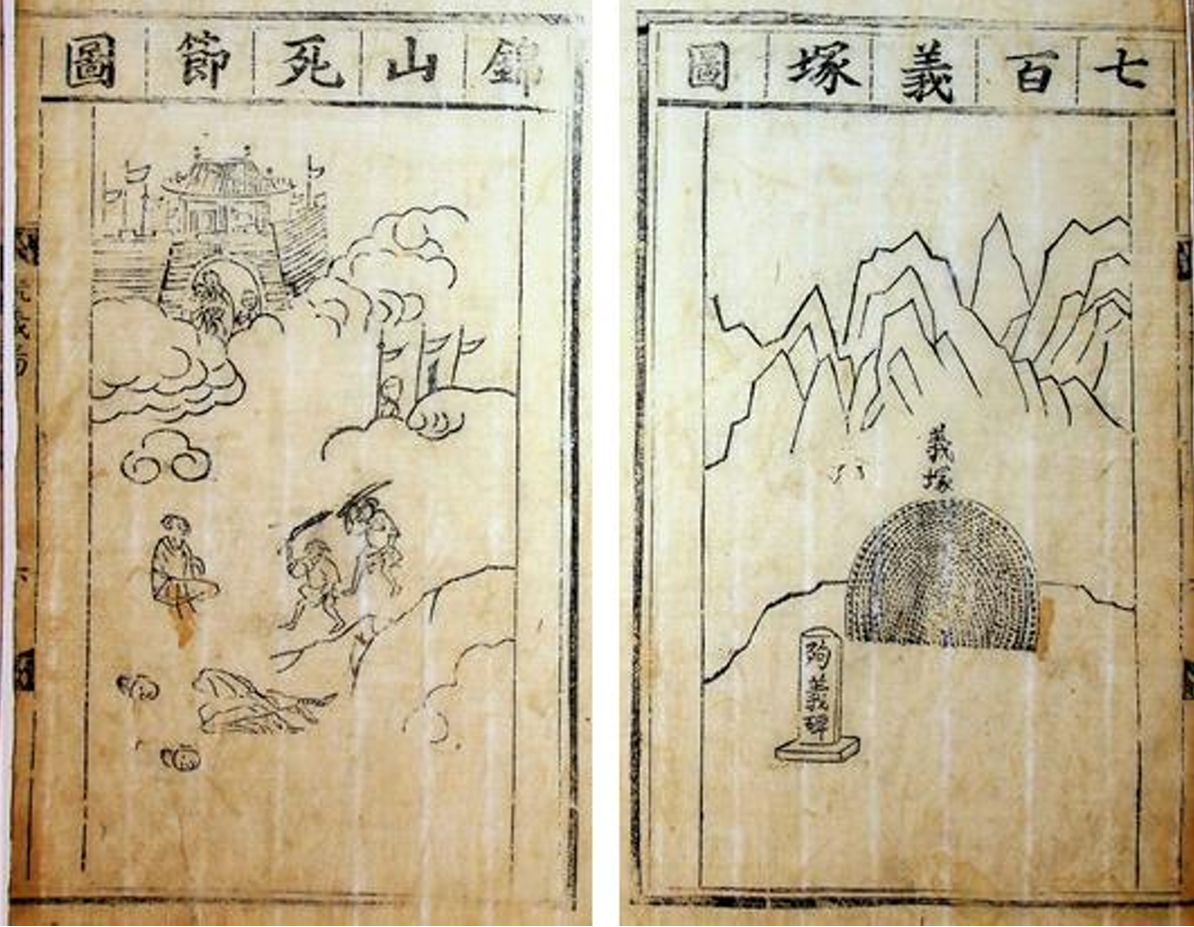
Hangŭi sinp’yŏn is that it was published together with woodblock illustrations depicting Cho Hŏn’s righteous deeds. Among the eight illustrations, three directly address Cho Hŏn’s militia activities: Ch’ŏngju p’aechŏk to 淸州破敵圖 (Illustration of Defeating the Enemy at Ch’ŏngju), Kŭmsan sajŏl to 錦山死節圖 (Illustration of Dying for Righteousness at Kŭmsan) and
Ch’ilbaek ŭich’ong to 七百義塚圖 (Illustration of the Tomb of Seven Hundred Righteous Martyrs). The work went through multiple editions. The illustrations in the presumed first edition, printed around 1614, were carved from drawings by Yi Ching 李澄 (1581–1653?), one of the most prominent painters of the royal Bureau of Painting. Different versions of these illustrations later appeared in the 1748 Kyosŏgwan edition of
Chungbongjip, the 1863 reprint of
Hangŭi sinp’yŏn, and the 1864 publication of An Pang-jun’s collected works, Ŭnbong chŏnsŏ
.
32
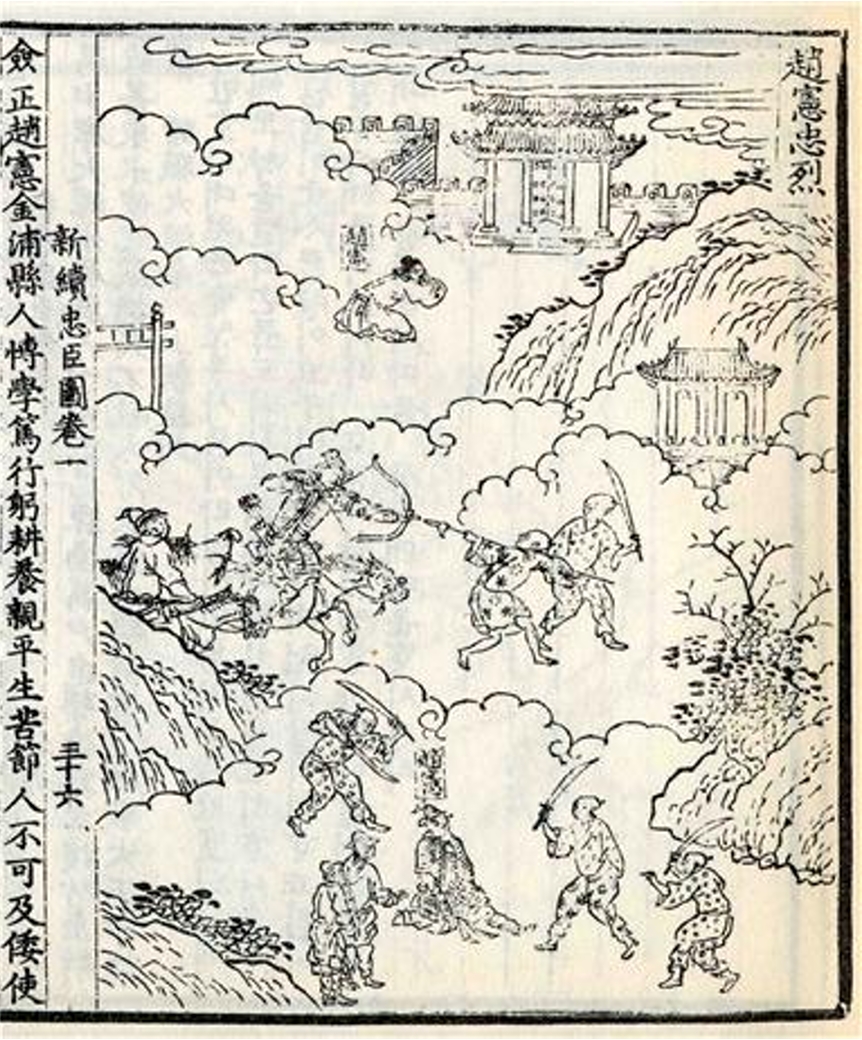
The rationale behind An Pang-jun’s decision to include illustrations is clear: by visually presenting the deeds of Cho Hŏn and his righteous army, he sought to impress the value of chŏlŭi upon a broader audience. This effort closely parallels the objectives of the Tongguk sinsok samgang haengsilto, compiled under the leadership of King Kwanghaegun. Whereas earlier editions of the Samgang haengsilto series, first published during King Sejong’s reign, focused largely on figures from Chinese history, the Tongguk sinsok samgang haengsilto exclusively featured Korean exemplars and expanded its scope significantly. In the aftermath of the first full-scale foreign invasion since the founding of the Chosŏn dynasty, the erosion of royal authority and national strength posed a grave challenge. Under such circumstances, commemorating those who died for the state through honorific arches and recording their deeds in didactic texts was a matter of urgent importance for reinforcing royal authority.
Preparations for the compilation of this work had begun during King Sŏnjo’s reign, but publication was delayed as priority was given to the careful bestowal of honorific commendations. Following King Sŏnjo’s sudden death, King Kwanghaegun ascended the throne amid political instability, facing the dual task of restoring order after war and securing the legitimacy of his rule. This context explains why he expedited both the completion of honorific commendations and the large-scale publication of didactic texts.
33
Not only the pace of commemoration but also its focus differed between the reigns of Sŏnjo and Kwanghaegun. As discussed earlier, King Sŏnjo recognized primarily the
hojong officials and a handful of government commanders, showing little regard for the contributions of the righteous armies. King Kwanghaegun, by contrast, having personally led a
punjo 分朝 government and taken part in battlefield affairs, appears to have placed greater importance on honoring those who voluntarily fought and died for righteousness. At the center of this perspective stood the righteous armies
.
With the rise to power of the Western faction following the Injo Restoration 仁祖反正, the commemoration of Cho Hŏn and the seven hundred martyrs proceeded with even greater consistency. In 1625, a petition was submitted requesting the state-sponsored distribution of An Pang-jun’s Hangŭi sinp’yŏn. In 1629, Song Si-yŏl erected a shrine courtyard stele at Ch’angju Academy. This was followed by a succession of commemorative writings: Kim Chip’s “Chungbong cho sŏnsaeng sijang” 重峯趙先生諡狀 (Posthumous Appraisal of Master Cho Hŏn, 1642), Song Si-yŏl’s “Chungbong cho sŏnsaeng haengjang” 重峯趙先生行狀 (Account of the Life of Master Cho Hŏn, 1646), and Kim Sang-hŏn’s “Chungbong cho sŏnsaeng sindobimyŏng” 重峯趙先生神道碑銘 (Spirit-Path Stele Inscription for Master Cho Hŏn, 1648). These efforts culminated in 1649, the first year of King Hyojong’s reign, when Cho Hŏn was finally granted the posthumous title Munnyŏl-gong.
The memory of the righteous armies also gradually became a source of regional pride. In 1634, local scholars and officials of Kŭmsan erected a ritual altar before the
ŭich’ong and conducted annual rites for Cho Hŏn, Ko Kyŏng-myŏng, and Yŏnggyu. Song Si-yŏl’s “
Kŭmsan-gun uidantang chaegi” 錦山郡義壇堂齋記 (Record of the Altar Hall of Righteousness in Kŭmsan, 1655) responded directly to these local initiatives. In 1663 (Hyŏnjong 4), Confucian scholars of Kŭmsan County, including Yi Yu-t’ae, jointly submitted a petition requesting a royal signboard for the shrine dedicated to Cho Hŏn and others.
34
King Hyŏnjong granted the shrine the name Chongyong, citing the phrase chongyong yusang 從容有常 from the Book of Rites 禮記, signifying unwavering composure and steadfast adherence to principle in all circumstances. The calligraphy of the signboard was written by Song Si-yŏl.
The Chongyong Shrine enshrined Cho Hŏn and Ko Kyŏng-myŏng as primary figures, with additional enshrinement of Ko In-hu, Yi Kwang-nyun, Cho Wan-gi, Pyŏn Ŭng-jŏng, Yu Paeng-no, An Yŏng, and Han Sun. It further included auxiliary halls for the unnamed soldiers under Cho Hŏn and Ko Kyŏng-myŏng, as well as the monk-general Yŏnggyu and his followers, thus incorporating not only prominent literati but also the seven hundred unnamed martyrs into the ritual community. Initially conducted locally with support from nearby magistrates and Confucian schools, these rites gradually came under state supervision, with royal officials dispatched and sacrificial provisions supplied in 1653, 1670, 1684, 1699, 1712, and 1717.
35 The 1734 record discussed at the beginning of this study stands squarely within this continuum. In that year, King Yŏngjo posthumously promoted Cho Hŏn to the rank of Chief State Councillor, and in 1772, marking the third
chugap anniversary of his martyrdom, he ordered renewed state-sponsored rites at the
ŭich’ong.
Over time, commemoration expanded from well-known figures such as Cho Hŏn and Ko Kyŏng-myŏng to the anonymous martyrs who died alongside them. In 1735, a year after King Yŏngjo’s reference to
Hangŭi sinp’yŏn, the Confucian scholar Kim Yang-nae submitted a memorial on behalf of a man named Yi Kang, who had died in battle leaving only an infant child and whose remains, never recovered, were buried in the
Ŭich’ong without receiving posthumous honors.
36
Such petitions continued thereafter. Even after the abolition of academies under the Taewŏn’gun in 1871, local rites persisted. In 1940, however, during the late colonial period, Ishikawa Michio 石川道夫, then chief of the Kŭmsan Police Station, destroyed the Sunŭibi, desecrated the Ŭich’ong, demolished the ritual altar and shrine, and sold the land at auction. This incident later became a representative case examined during the 1949 investigations of the Anti-National Activities Special Committee.
Despite these trials, local commemorative efforts endured. In 1952, marking the sixth
chugap anniversary of Cho Hŏn’s martyrdom, Kŭmsan residents raised funds to repurchase the land, repair the
Ŭich’ong, rebuild the Chongyong Shrine, and resume annual rites on the lunar eighth month, eighteenth day. State-level commemoration resumed in 1963, when President Park Chung-hee visited the site, designated it National Historic Site No. 105, and ordered extensive restoration. Subsequent developments included the construction of the Seven Hundred Martyrs’ Memorial Tower in 1967, the reconstruction of the Chongyong Shrine and the damaged
Sunŭibi in 1971, and, in 1976, the establishment of a memorial hall together with the re-erection of a 13.
6-meter Seven Hundred Martyrs’ Memorial Tower bearing an inscription in President Park Chung-hee’s own calligraphy.
A comparable trajectory can be observed at the
Manin ŭich’ong 萬人義塚 in Namwŏn, which commemorates the more than ten thousand civilians and soldiers who died defending Namwŏn Fortress during the Japanese re-invasion of 1597. After suffering destruction under Japanese rule, the site was likewise designated a historic site and sanctified following President Park Chung-hee’s visit in 1963.
37
The intentional invocation of collective memory through commemoration thus proves not unique to premodern states; it remains equally relevant in the modern nation-state, particularly during periods when loyalty to the state must be emphatically reinforced.
Conclusion: Recording Memory, Remembering Records
Memory not only links past and present but also reorients the future through that linkage. When narrating events or lives based on memory or fragmentary records, we inevitably select and rearrange certain facts according to particular criteria, thereby reconstructing memory itself. Once reconstructed, such memory exerts influence over the community that shares it, shaping the future in turn.
This process is especially evident in monuments such as spirit-path steles and Sunŭibi, erected by institutions or the state to commemorate individuals. The stele itself functions as a medium of memory, while the act of composing inscriptions entails the selection, ordering, and consolidation of dispersed recollections into a single authorized narrative. When the memory in question transcends the life of an individual and instead reflects experiences shared by a broad community, the resulting narrative becomes not merely personal memory, but what society believes, or wishes to believe, to be its collective past.
Among the most powerful forms of shared memory is that of war. As an extraordinary historical experience, war brings about sweeping and often traumatic transformations within a cultural sphere. While a conflict between states, war also constitutes a series of layered personal and social catastrophes, leaving permanent wounds. This study has focused on the process by which such memories of war move beyond private grief to become embedded in the public sphere through commemorative media, forming collective memory.
By taking the
Ŭich’ong of Cho Hŏn and the seven hundred martyrs as its primary object, this study has examined how the righteous armies came to occupy a central place in the memory of the Imjin War. During and immediately after the war, righteous armies were largely excluded from the process of awarding meritorious titles. Their emergence at the center of war memory owed much to King Kwanghaegun and was further reinforced after the Injo Restoration, as the Western faction reevaluated the contributions of righteous armies in opposition to the preceding Northern faction. This perspective is vividly reflected in the
Sŏnjo sujŏng sillok, which, unlike the original
Sŏnjo sillok, drew extensively on unofficial records such as anecdotes, inscriptions, and funerary accounts.
38
Alongside this shift, an emphasis on chŏlŭi over battlefield success or failure became increasingly common, an emphasis that was not necessarily shared during or immediately after the war. Although conflicts between righteous armies and government troops were real, and early failures of official forces had serious consequences, the stark moral dichotomy that casts righteous armies as embodiments of public righteousness and official commanders as self-interested emerged through selective remembrance and amplification.
Yun Kŭn-su, the author of the Sunŭibi inscription examined in this study, was himself a hojong official and a meritorious subject of King Sŏnjo. Yet the inscription he composed already embodies the perspective that became dominant among the Western faction after the Injo Restoration. This reflects not only Yun’s own factional position but also a deeply held conviction that the state must be rebuilt (chaejo 再造) through Neo-Confucian moral principle in the aftermath of war. The enduring influence of this inscription attests to the effectiveness of that vision: it became one of the foundational texts shaping a righteous-army-centered memory of the Imjin War.
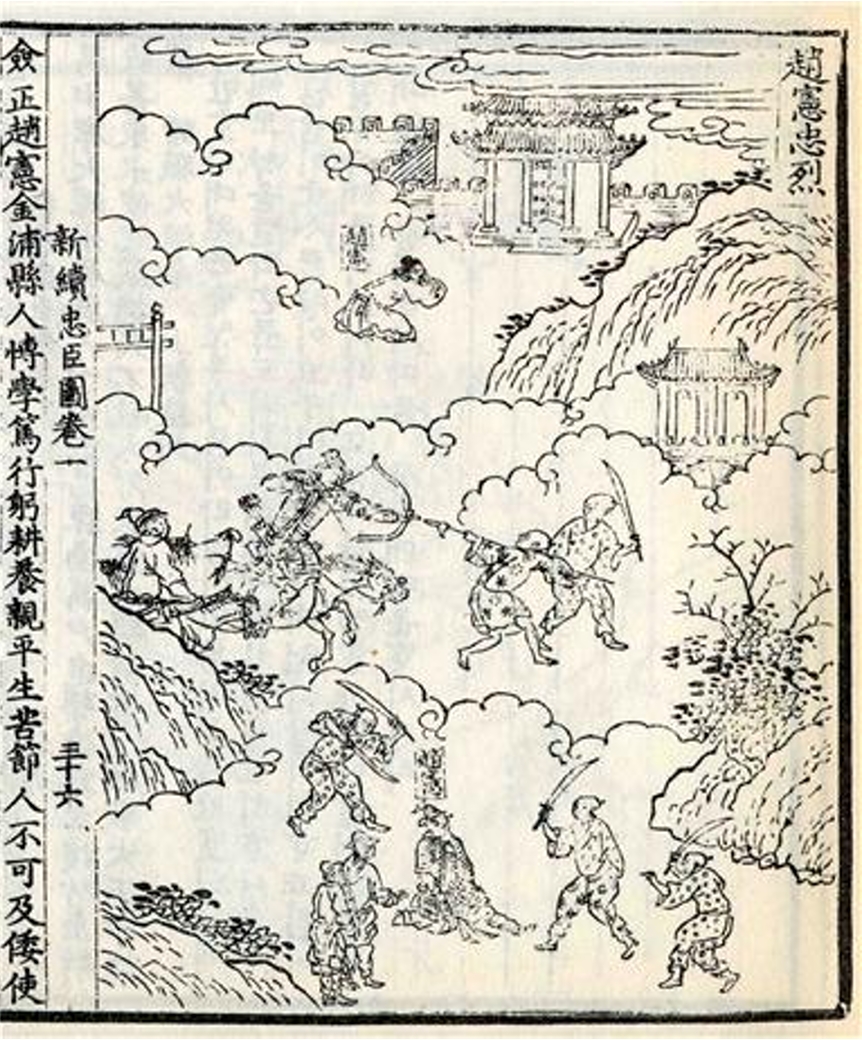
An Pang-jun’s Hangŭi sinp’yŏn extended this project by disseminating the ideal of chŏlŭi through visual imagery, while the Tongguk sinsok samgang haengsilto, whose preface was likewise written by Yun Kŭn-su, institutionalized the commemoration of wartime martyrs as a strategy of national recovery. Through honorific arches, ritual observances, textual compilations, and state-sponsored rites, selectively reconstructed memories of Cho Hŏn and the seven hundred martyrs were universalized and institutionalized.
This study began with King Yŏngjo’s 1734 recollection of Cho Hŏn while reading Hangŭi sinp’yŏn, some 150 years after the events themselves. By juxtaposing Yun Kŭn-su’s inscription with alternative accounts, the aim was not to adjudicate historical accuracy or to diminish the moral significance of Cho Hŏn’s sacrifice. Rather, it was to illuminate the process by which certain memories were selected, reconfigured, and preserved as official records. The Ŭich’ong, the Sunŭibi, the ritual altar, and the shrine, together with acts of royal recognition, local ritual continuity, and textual commemoration, constitute the mechanisms through which memory was transformed into institutionalized history. The physical remains that survive today stand as material witnesses to that process. To analyze critically the intentions, ideological orientations, and political interests behind their formation is one of the central tasks of scholarship grounded in texts and historical sites, especially because the selective construction of memory continues constant in the present.
Notes
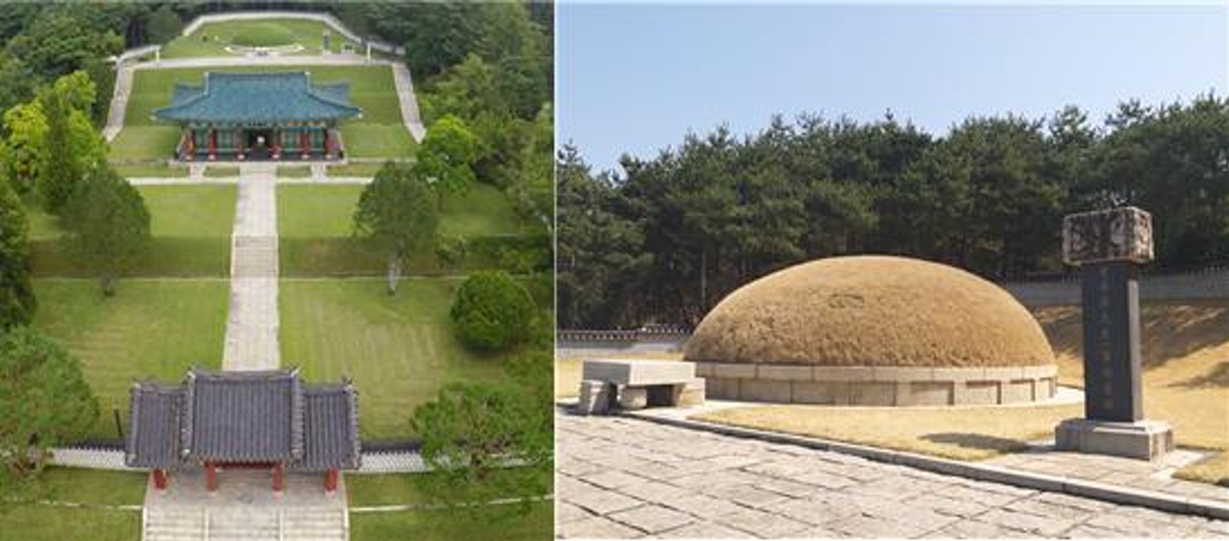
Figure 1.The Tomb of Seven Hundred Patriotic Martyrs, Kŭmsan
4
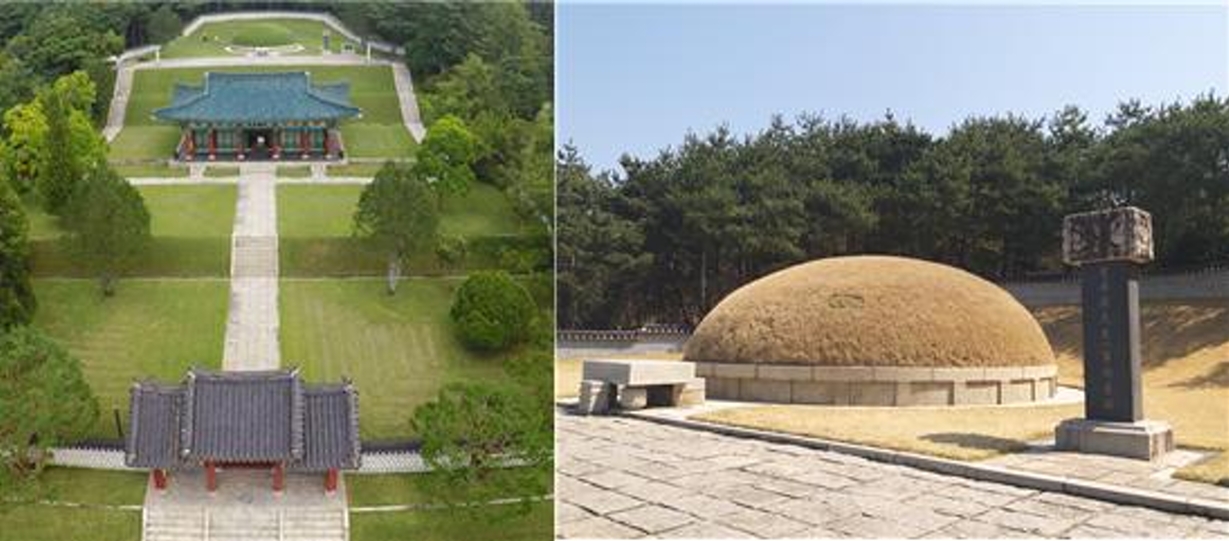
Figure 2.Woodblock illustration from the first edition of Hangŭi sinp’yŏn. Korea University Library collection, Chungbong sŏnsaeng Hangŭi sinp’yŏn (Mansong B9 A64 2)
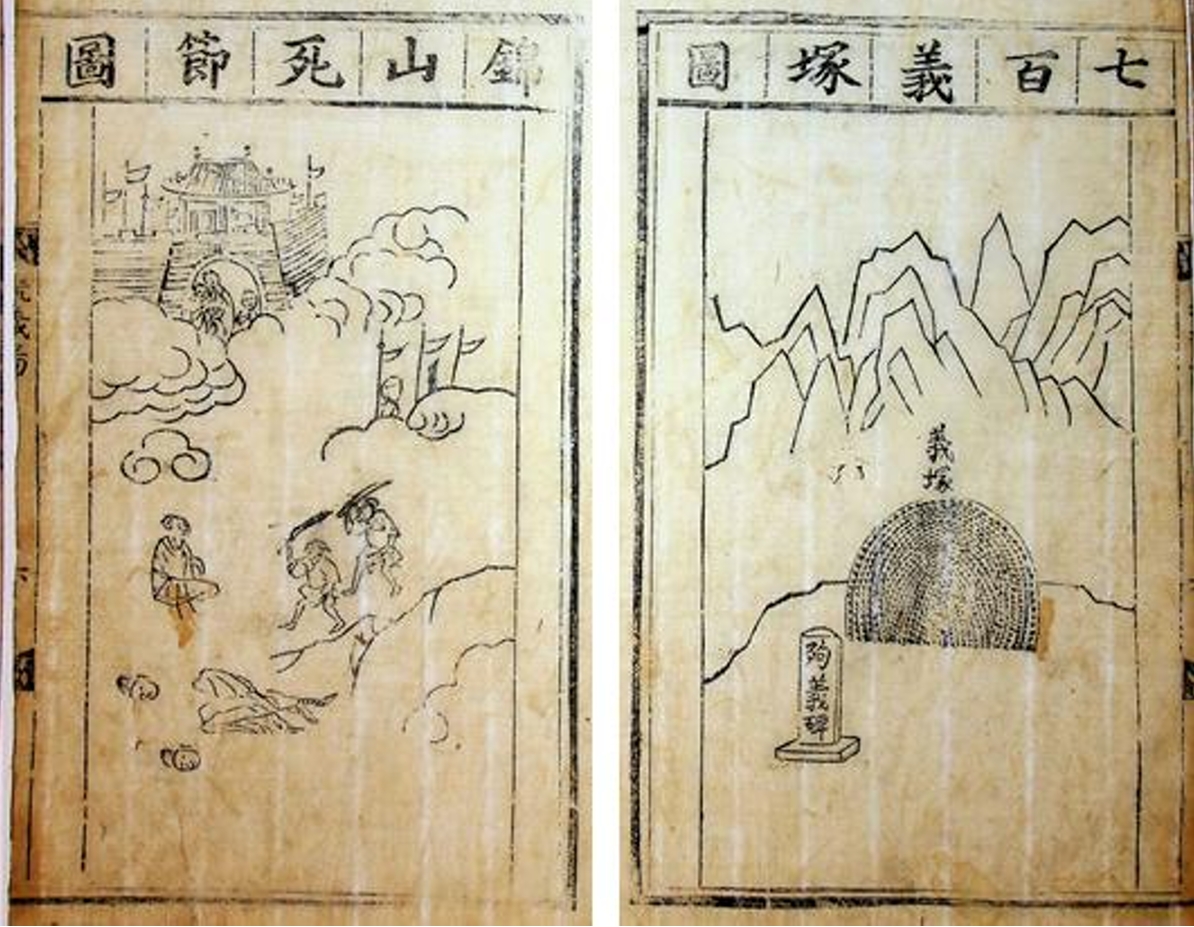
Figure 3.“Cho Hŏn’s Loyal Martyrdom.” Tongguk sinsok samgang haengsilto, Ch’ungsin (Loyal Subjects) section, juan 1.
Reference List
- An Pang-jun 安邦俊. Ŭnbong chŏnsŏ (隱峯全書, Collected Works of Ŭnbong). Han’guk Munjip Ch’onggan (韓國文集叢刊, hereafter HMJC) 81. Seoul: Institute for the Translation of Korean Classics.
- Cho Hŏn 趙憲. Chungbongjip (重峯集, Collected Works of Chungbong). HMJC 54. Seoul: Institute for the Translation of Korean Classics.
- ———. Chungbong sŏnsaeng hangŭi sinp’yŏn (重峯先生抗義新編, New Compilation on Righteous Resistance by Master Chungbong), compiled by An, Pang-jun (安邦俊). Woodblock edition. Seoul: Korea University Library Collection.
- Kim Sang-hŏn 金尙憲. Ch’ŭngŭmjip (淸陰集, Collected Works of Ch’ŭngŭm). HMJC 77. Seoul: Institute for the Translation of Korean Classics.
- Kim Chip 金集. Sindokchae yugo (愼獨齋遺稿, Posthumous Manuscripts of Sindokchae). HMJC 82. Seoul: Institute for the Translation of Korean Classics.
- Pak Tong-nyang 朴東亮. Kijae sach’o (寄齋史草, Kijae Historical Drafts). In Kugyŏk Taedong Yaseung (國譯 大東野乘, Korean Translation of Taedong Yaseung). Seoul: Institute for the Translation of Korean Classics.
- Song Si-yŏl 宋時烈. Songja taejŏn (宋子大全, Complete Works of Songja). HMJC 115. Seoul: Institute for the Translation of Korean Classics.
- Sŏng Hon 成渾. Ugyejip (牛溪集, Collected Works of Ugye). HMJC 43. Seoul: Institute for the Translation of Korean Classics.
- Yi Chŏng-gwi 李廷龜. Wŏlsajip (月沙集, Collected Works of Wŏlsa). HMJC 70. Seoul: Institute for the Translation of Korean Classics.
- Yi Hang-bok 李恒福. Paeksajip (白沙集, Collected Works of Paeksa). HMJC 62. Seoul: Institute for the Translation of Korean Classics.
- Yi Yu-t’ae 李惟泰. Ch’orojip (草廬集, Collected Works of Ch’oro). HMJC 118. Seoul: Institute for the Translation of Korean Classics.
- Yun Kŭn-su 尹根壽. Wŏltŏngjip (月汀集, Collected Works of Wŏltŏng). HMJC 47. Seoul: Institute for the Translation of Korean Classics.
- Yun Kuk-hyŏng 尹國馨. Munsŏ mannok (聞韶漫錄, Miscellaneous Notes on Hearing Shao Music). In Kugyŏk Taedong Yaseung (國譯 大東野乘, Korean Translation of Taedong Yaseung). Seoul: Institute for the Translation of Korean Classics.
- Han’guk kojŏn pŏnyŏgwŏn (韓國古典飜譯院, Institute for the Translation of Korean Classics). Han’guk Kojŏn Chonghap Database (韓國古典綜合DB, Integrated Korean Classics Database). http://db.itkc.or.kr.
- Kuksap’yŏnch’an wiwŏnhoe (國史編纂委員會, National Institute of Korean History). Chosŏn wangjo sillok (朝鮮王朝實錄, The Veritable Records of the Joseon Dynasty). http://sillok.history.go.kr.
- ———. Sŭngjŏngwŏn ilgi (承政院日記, Diaries of the Royal Secretariat). https://sjw.history.go.kr.
- Chŏn Chin-sŏng 전진성. Yŏksaga kinyŏk ŭl malhada 역사가 기억을 말하다, History Speaks Memory. Seoul: Humanist, 2005.
- Cho Wŏn-rae 조원래. “Imnan ch’ogi tu ch’arye ŭi kŭmsan chŏnt’u wa kŭ chŏllyakchŏk ŭiŭi” 임란 초기 두 차례의 금산 전투와 그 전략적 의의, “The Two Battles of Kŭmsan in the Early Imjin War and Their Strategic Significance”. Chungnam sahak 12 (2000): 77-108.
- Chŏng Ch’ul-hŏn 정출헌, “Imjin waeran ŭi yŏng’ung ŭl kinyŏk hanŭn tu kae ŭi pangsik - Sasir ŭi kinyŏk, tto nŭn kinyŏk ŭi sŏsa” 임진왜란의 영웅을 기억하는 두 개의 방식: 사실의 기억, 또는 기억의 서사 The Two Ways of Remembering Heroes of the Imjin War: Memory of Historical Facts, or Narratives of Memory, Hanmunhakbo 21 (2009), pp. 295-332.
- Dongguk University Institute of Korean Literature. Chŏnjaeng ŭi kinyŏk, yŏksa wa munhak 전쟁의 기억, 역사와 문학, War Memory, History, and Literature. Seoul: Wolin, 2005.
- Ha T’ae-gyu 하태규. “Imjin waeran ch’ogi chŏllado kwankun ŭi tonghyang kwa honam pangŏ” 임진왜란 초기 전라도 관군의 동향과 호남방어 The Activities of Government Troops in Chŏlla Province and the Defense Strategy in the Early Imjin War. The Korea-Japan Historical Review 26 (2007): 147-180.
- Han Myŏng-gi 한명기. “Imjin waeran sigi chaejo chiŭn ŭi hyŏngsŏng kwa kŭ ŭiŭi” 임진왜란 시기 ‘再造之恩’의 형성과 그 의미 The Formation and Meaning of ‘Restoring the Nation’s Grace’ during the Japanese Invasion of 1592. Tongyanghak 29 (1999): 119-136.
- Hŏ Nam-rin 허남린, “Imjin waeran kwa yugyŏjŏk sahoejilsŏ” 임진왜란과 유교적 사회질서 Crime and Punishment in Wartime Chosŏn Korea: The Imjin War and Confucian Social Order, Kukhak yŏngu 14 (2009), pp. 249-288.
- Imjinwaeran Research Society. “Ko kyŏng-myŏng ŭi ŭibyŏng undong” 고경명의 의병 운동 The Ŭibyŏng Movement of Ko Kyŏng-myŏng. Jinju: National Jinju Museum, 2008.
- Kaneko Yūki 金子祐樹. “Haengsildo-gye kyohwasŏ ŭi chŏn’gae wa ch’ung haengwi ŭi ch’ui” 행실도계 교화서의 전개와 충 행위의 추이 The Evolution of the Haengsildo Series and Shifting Conceptions of Loyalty: An Analysis of the Tongguk sinsok samgang haengsilto. Korean Classics Studies 51 (2009): 525-579.
- Kim Kang-sik 김강식. “Chosŏn hugij ŭi imjin waeran kinyŏk kwa ŭimi” 조선후기의 임진왜란 기억과 의미 The Memory and Meaning of the Japanese Invasion of 1592-1598 in the Late Chosŏn Dynasty. Chiyŏk kwa yŏksa 31 (2012): 5-40.
- Kim, Kyŏng-tae 김경태. “Imjin waeran tangs’i kŭmsan chŏnt’u ŭi kaeyo” 임진왜란 당시 금산전투의 개요 An Outline of the Battle of Kŭmsan during the Imjin War. In Ch’ilbaegŭisa kŭ ch’ungjŏl ŭi kirok-tŭl (칠백의사 그 충절의 기록들, The Records of Loyalty). Kŭmsan: Chilbaegŭich’ong Management Office, 2021.
- Kim, Sŏng-hŭi 김성희. “Cho hŏn-sang ŭi pyŏnhwa rŭl t’onghae pon chosŏn hugij sidae chŏngsin ŭi ch’ui” ‘朝憲像’의 변화를 통해 본 조선후기 시대정신의 추이 Memory, History, and Ideology: A Shift in the Zeitgeist of the Late Chosŏn Period Reflected in Changing Representations of Cho Hŏn. Yŏksa wa hyŏnsil 92 (2014): 297-331.
- Kimpo Cultural Center. Pulmyŏl ŭi chungbong cho hŏn 불멸의 중봉 조헌 The Immortal Cho Hŏn. Kimpo: Kimpo Cultural Center, 2004.
- Lee Jang-hee 이장희. Imjin waeran-sa yŏn’gu 임진왜란사 연구 A Study of the History of the Imjin War. Seoul: Asia Munhwasa, 2007.
- Lee Kwang-yŏl 이광열. “Kwanghaegun-dae tongguk sinsok samgang haengsildo p’yŏnch’an ŭi ŭiŭi” 광해군대 《東國新續三綱行實圖》 편찬의 의의 The Significance of the Compilation of the Tongguk sinsok samgang haengsilto during the Reign of King Kwanghaegun. Hankuk saron 53 (2007): 143-202.
- Lee Sŏk-rin 이석린. Imnan ŭibyŏngjang cho hŏn yŏn’gu 임란의병장 조헌 연구 A Study of Cho Hŏn, Righteous Army Leader in the Imjin War. Seoul: Singu munhwasa, 1993.
- Noh Yŏng-gu 노영구. “Kongsin sŏnjŏng kwa chŏnjaeng p’yŏngga rŭl t’onghan imjin waeran kinyŏk ŭi hyŏngsŏng” 공신 선정과 전쟁 평가를 통한 임진왜란 기억의 형성 The Formation of Imjin War Memory through Merit Appointments and War Evaluation. Yŏksa wa hyŏnsil 51 (2004): 11-35.
- O Hang-nyŏng 오항녕. “Sŏnjo sillok sujŏng-go yŏn’gu” 《宣祖實錄》 修正攷 A Study of the Revised Edition of the Sŏnjo sillok. Hanguksa yŏngu 123 (2003): 55-94.
- Pak Chu 박주. Chosŏn sidae ŭi chŏngp’yo chŏngch’aek 조선시대의 旌表政策 Honorific Commendation Policy of the Chosŏn Dynasty. Seoul: Ilchogak, 1990.
- Pak Pŏm 박범. “Kŭmsan chŏnt’u kinyŏk ŭi chŏnsŭng kwa ch’ilbaegŭich’ong ŭi yŏksa” 금산전투 기억의 전승과 칠백의총의 역사 The Transmission of Memories of the Battle of Kŭmsan and the Historical Development of the Tomb of Seven Hundred Patriotic Martyrs. Kukhak yŏngu 52 (2023): 151-195.
- Song Hyŏk-ki 송혁기. “Yun kŭn-su ŭi sŏsa sanmun ilgo: ŭibyŏng kinyŏk ŭi chaegusŏng ŭl chungsim ŭro” 윤근수의 서사 산문 일고: 의병 기억의 재구성 중심으로 A Study on the Narrative Prose of Yun Kŭnsu: Reconstructing the Memory of the Ŭibyŏng. Hanmunhak nonjip 36 (2013): 55-95.
- Son Sŭng-ch’ŏl 손승철. “Tongguk sinsok samgang haengsilto rŭl t’onghae pon imjin waeran ŭi kinyŏk” 《東國新續三綱行實圖》를 통해 본 임진왜란의 기억 Imjin War Memory as Represented in the Tongguk sinsok samgang haengsilto. In “Imjin waeran kwa tong asia segye ŭi pyŏndong” 임진왜란과 동아시아 세계의 변동 The Imjin War and Transformations in the East Asian World. Seoul: Kyŏngin munhwasa, 2010.
- Yu Mina 유미나. “Imjin waeran ŭibyŏngjang cho hŏn ŭi haengjŏk ŭl kŭrin hangŭi sinp’yŏn p’anwha koch’al” 임진왜란 의병장 조헌의 행적을 그린 항의신편 판화 고찰 A Study of the Woodblock Prints Depicting Cho Hŏn: Focusing on the Hangŭi sinp’yŏn. Kangjwa misulsa 35 (2010): 115-140.



 News
News