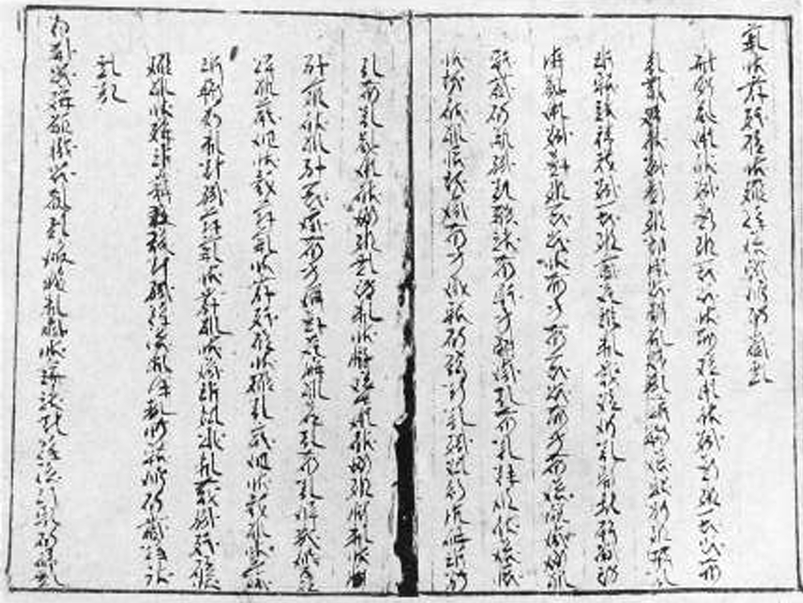
Tangut culture, the knowledge of which seemed almost completely lost a little more than a century ago, is now widely available for study thanks to unbelievable finds of Petr Kozlov in the so-called “dead city” of Khara-Khoto, located in the plain Alashan Gobi Desert. A question of investigating the level of influence on Tangut by the neighboring cultures, especially Chinese is one the key importance. This paper looks into what place the Confucian canons occupied in Tangut culture, specifically that of Xiao jing 孝經 (Canon of [Descendants’] Piety).
This paper examines Xu Shen’s 許慎 Shuowen jiezi 說文解字 and its “Postface” in order to illuminate how Han intellectuals conceptualized the origins and functions of Chinese writing. By analyzing Xu Shen’s narrative of script development—from Cang Jie’s 倉頡 legendary invention of the “ancient script,” through Shi Zhou’s large seal script, to the Qin dynasty’s small seal and clerical scripts—this study argues that Xu Shen framed the history of writing not as a neutral record but as a moralized genealogy. The central claim is that Xu Shen associated the legitimacy of each script with the character and moral standing of its attributed creator. Cang Jie, with his superhuman vision, epitomized the earliest and most authoritative script, whose purpose was to order society and enable moral education. By contrast, Qin figures such as Li Si 李斯, Hu Wu Jing 胡毋敬, and Zhao Gao 趙高 embodied opportunism, low bureaucratic standing, or outright immorality, thereby rendering the small seal script a compromised though still usable medium. The clerical script, attributed to the judicial official Cheng Miao, was rejected altogether because it originated in administrative expediency rather than ethical cultivation, and thus signified hegemonic rather than kingly governance.
Through cross-textual analysis of transmitted sources and Han commentaries, this paper shows that Xu Shen’s philosophy of writing reflects broader Han concerns over the relationship between language, morality, and political order. Ultimately, Shuowen jiezi is not merely a philological enterprise but a moral-political project: it positions writing as the foundation of Confucian governance and as a vehicle for sustaining the kingly way.


 News
 First
 Prev