In the first half of the 8th century, a Korean monk named Hyech’o (704?-787 CE) went on a pilgrimage to India. It was not the first time a monk originating from the Korean Peninsula travelled to India; before Hyech’o, several Korean monks went to the border of the oecumene. The only survived travelogue of a Korean monk visited India is the one by Hyech’o, Memoirs of a Pilgrimage to the Five Indian Kingdoms (往五天竺國傳). The preserved manuscript was found in Mogao caves by Paul Pelliot (1878-1945) and is held in the French National Library. There are two translations of the travelogue into English; however, none of them study stylistic features of the text, nor are travelogue’s lexicon features researched, whereas Hyech’o’s travelogue has distinctive style and does not follow standard Buddhist travelogue structure.
This paper shows preliminary results of a research which aims to study composition, lexical and stylistic features of the travelogue compared to notes of Xuanzang (Records of the Western Regions, 大唐西域記). The study is qualitative research. Comparative method was applied to check the structure and toponym differences in Hyech’o’s text and Records of the Western Regions. Literary analysis is used to identify lexical features of the travelogue, to understand if Hyech’o uses specific phrases for introducing a new place he visits. Hyech’o, compared to other renowned Chinese pilgrims, is quite frank with the reader, especially in his poems, each of which shares Hyech’o’s emotions. Hyech’o, being of Korean origin, might have left unique lexical and stylistic characteristics in the travelogue.
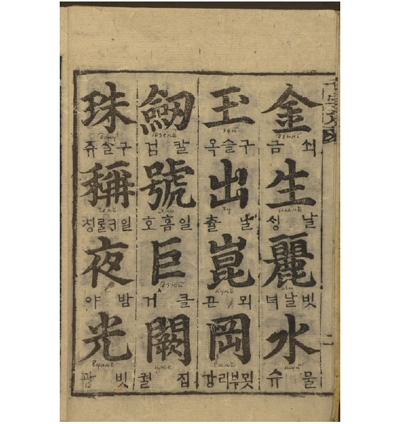
The aim of this study was to establish the origin of Korean books from the so-called “Brosset Collection” kept at the Institute of Oriental Manuscripts of the Russian Academy of Sciences (Asiatic Museum). The “Brosset Collection” is a conventional name for the books which are mentioned in the handwritten catalogue of the Asiatic Museum’s Far Eastern collection compiled by Academician Marie-Félicité Brosset (1802–1880). This catalogue lists nine identifiable Korean texts, eight of which are written entirely or partially in Hanmun.1 Judging by the date of their cataloguing (1840 and 1842), they are most likely the first Korean books to appear in Russia and are among the earliest surviving Korean-printed books held in European scholarly institutions. The study includes analysis of the various archival documents and marginalia in the books themselves. As a result, it was proven that most of these books form a single collection that originally came from the library of Baron Paul Schilling (1786–1837), who probably received them from the sinologist Nikita Iakovlevich Bichurin (Archimandrite Hyacinth; 1777–1853), head of the Ninth Russian Spiritual Mission in Beijing, and one book originated from the collection of Manchu studies scholar Stepan Vasil’evich Lipovtsov (1770–1841)
 News
News First
First Prev
Prev