The aim of this study was to establish the origin of Korean books from the so-called “Brosset Collection” kept at the Institute of Oriental Manuscripts of the Russian Academy of Sciences (Asiatic Museum). The “Brosset Collection” is a conventional name for the books which are mentioned in the handwritten catalogue of the Asiatic Museum’s Far Eastern collection compiled by Academician Marie-Félicité Brosset (1802–1880). This catalogue lists nine identifiable Korean texts, eight of which are written entirely or partially in Hanmun.1 Judging by the date of their cataloguing (1840 and 1842), they are most likely the first Korean books to appear in Russia and are among the earliest surviving Korean-printed books held in European scholarly institutions. The study includes analysis of the various archival documents and marginalia in the books themselves. As a result, it was proven that most of these books form a single collection that originally came from the library of Baron Paul Schilling (1786–1837), who probably received them from the sinologist Nikita Iakovlevich Bichurin (Archimandrite Hyacinth; 1777–1853), head of the Ninth Russian Spiritual Mission in Beijing, and one book originated from the collection of Manchu studies scholar Stepan Vasil’evich Lipovtsov (1770–1841)
This study examines how the social status of Hanja 漢字 “Sino-Korean characters” and Hanmun 漢文 “Literary Sinitic” has changed within the history of knowledge formation in Korea, focusing on three interrelated layers: shifts in episteme, the reconfiguration of knowledge baselines, and transformations in curriculum discourse. Hanja and Hanmun were marginalized in the context of modern nationstate language policy and the establishment of disciplinary academic systems, but this did not immediately entail the disappearance of their educational value. Rather, Hanja education came to be assigned new goals, such as deepening vocabulary and literacy, facilitating access to historical texts, and cultivating an understanding of the shared written culture of East Asia. At the same time, the ways in which each country and region evaluated and authorized “valuable” knowledge became a key factor in reshaping the respective status of Hanja and Hanmun.
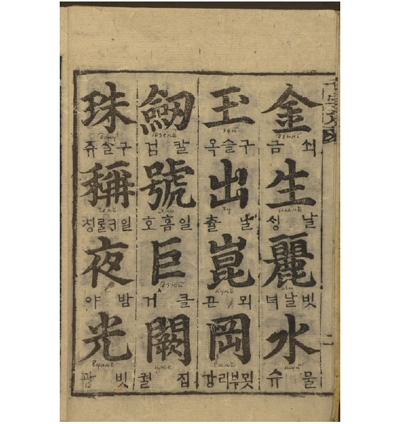
In the early 20th century, a number of Korean textbooks on Hanmun (Korean Literary Sinitic) were published. These textbooks introduced new ways of understanding and teaching Hanmun grammar. Some of these innovations are highly original and explore experimental ideas.
The hŏsa/silsa paradigm (usually translated as “empty” and “full words” in English) forms the basis of many pre-modern and early modern Literary Sinitic grammars, but these concepts are understood in different ways in each of them. The conventional understanding that hŏsa are ‘function words’ does not sufficiently explain their descriptive usage in early modern Korean grammars. This article investigates how the concept of hŏsa/silsa is understood in Korean Literary Sinitic grammars and textbooks from the Late Chosŏn and Colonial periods, and how it is applied in teaching.
Although these old grammars are clearly outdated in many ways, the grammatical concepts they present still hold some didactic value. Some of these concepts, particularly the hŏsa/silsa concept, are still useful for teaching basic Literary Sinitic courses.
Although Hanmun formed the backbone of Korean literary culture until the early twentieth century, its position within contemporary Korean Studies in Europe remains precarious. Limited curricular space, funding constraints, and a shortage of trained specialists have often relegated Hanmun to the status of a “luxury” rather than a core component of the field. While existing debates on Hanmun instruction have focused primarily on questions of textual selection, the underlying pedagogy has received comparatively little attention. This article addresses this gap by rethinking Hanmun training through learner-centered, interactive, and multilingual instructional strategies. Drawing on Bloom’s taxonomy as a heuristic framework, the article critiques the teacher-centered transmission model and the monolingual principle that continue to shape language instruction. It examines a corpus of eleven Hanmun textbooks and digital resources published in Korea, North America and Europe, focusing on the extent to which they enable interactivity and multilingual engagement. Building on these analyses, the article develops a set of experimental teaching practices presented in a concluding Hanmun Sandbox. These exercises emphasize chunking, translanguaging, and productive struggle, demonstrating how learners mobilize diverse linguistic and cognitive resources to construct meaning. The article argues that effective Hanmun instruction benefits from treating uncertainty not as an obstacle, but as a productive space for learning and meaning-making.
This paper takes as its point of departure the persistent difficulty in reading Hanmun (Korean Literary Sinitic) texts despite prior knowledge of grammatical rules, and reexamines this problem from cognitive and pedagogical perspectives. It argues that reading failure in Hanmun texts lacking punctuation should not be attributed to an insufficient understanding of individual grammatical items, but rather to a lack of syntactic unit recognition and reading stability. From this perspective, the article focuses on toksong 讀誦, a core practice in premodern Hanmun education, and interprets it not merely as recitation or memorization but as a mode of reading through which syntactic structures are embodied via rhythm and repetition.
Drawing on theories of embodied cognition and skill acquisition, the article demonstrates that toksong functioned as a cognitive mechanism that fostered syntactic familiarity and stabilized grammatical segmentation prior to semantic interpretation. It further examines the place of toksong in modern Hanmun pedagogy and repositions it not as a substitute for grammatical analysis, but as a preparatory reading practice that enables such analysis. By reconceptualizing the reading of Hanmun as a structural experience that precedes meaning-centered interpretation, this study offers pedagogical and theoretical implications for contemporary Hanmun education and research on classical literacy.


 News
News First
First Prev
Prev